Printable guide
Oxkintok Guide: Yucatán's Oldest Puuc City and the Labyrinth of Tzat Tun Tzat
Updated
Oxkintok is one of the longest-occupied Maya sites in Yucatán and the oldest centre of the Puuc region. This guide covers the labyrinth, the pyramids, transport, fees, and how to combine it with the Ruta Puuc.

Oxkintok sits at the western edge of the Puuc hills, 55 km south of Mérida, and most travellers drive right past it on their way to Uxmal. That is a mistake. This is one of the longest-occupied Maya cities in Yucatán — people lived here from roughly 500 BCE to around 1450 CE — and its architecture tracks the entire evolution from Early Classic construction through to mature Puuc style. The site is also home to one of only three known labyrinths in southern Mexico, a three-level structure called the Satunsat that the Maya may have used for ritual initiation.
The site receives a fraction of the visitors that Chichén Itzá or Uxmal get. You may have the entire place to yourself, especially on weekday mornings. There is minimal signage and very little shade, but the trade-off is an experience that feels closer to genuine exploration than curated tourism. If you have any interest in Maya architecture, Oxkintok is worth the detour.
A Brief History
Oxkintok was occupied for nearly two thousand years, which makes it unusual among Yucatán's Maya sites. The earliest ceramic evidence (the Sihil phase) dates to the Late Preclassic, around 500–300 BCE. The city hit its stride during the Early Classic period (300–550 CE), when it became an important hub on trade routes linking the Yucatán Peninsula to the Gulf of Mexico and the Central Highlands.
A transition known as the Oxkintok Regional phase occurred in the sixth century. This is when Proto-Puuc architecture emerged — the shift from stepped vaults to jutting flagstones and improved stoneworking techniques that would later define the entire Puuc style. Oxkintok was, in effect, the architectural laboratory where Puuc was invented.
Inscriptions name a ruler called Walas in the early eighth century, during the Late Classic. Centralisation increased under his rule, and hieroglyphic writing re-emerged after a long hiatus. By the Terminal Classic (850–1000 CE), the Puuc tradition was dominant across the region, but power had shifted to Uxmal. Oxkintok's last dated monument is from 859 CE. The city continued to be occupied through the Postclassic (1000–1450 CE), but the scale of construction shrank to shrine renovations and offerings, and the site was fully abandoned before the Spanish arrived.
The Satunsat — The Labyrinth of Tzat Tun Tzat
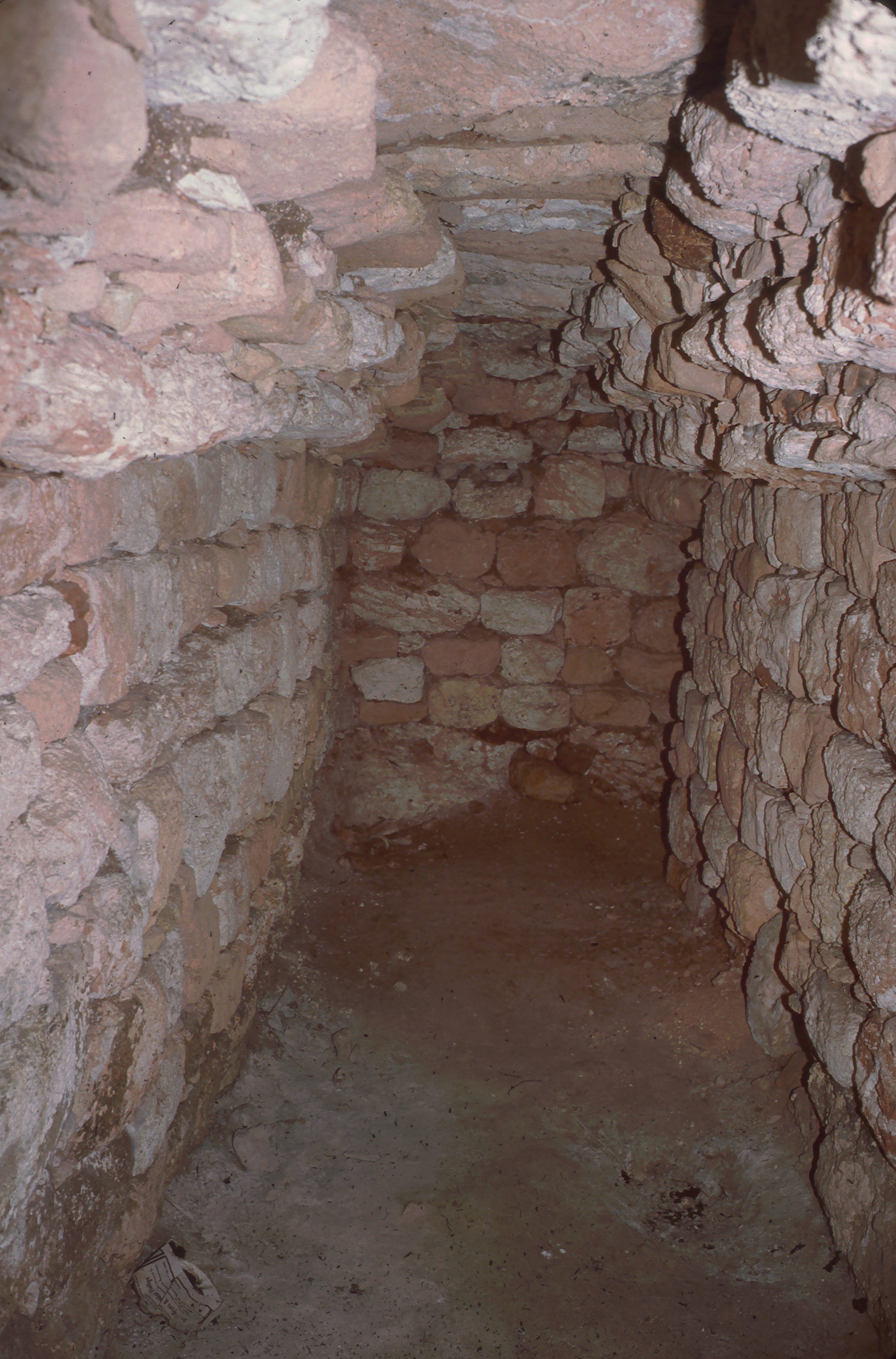 Interior gallery of the Satunsat labyrinth at Oxkintok, Yucatán
The most famous structure at Oxkintok is the Satunsat, also called Tzat Tun Tzat — a Maya phrase meaning "place where it is easy to get lost." It is a rectangular, three-level building designed to replicate a cave complex, with narrow vaulted tunnels connected by small gates and stairways. The three levels are thought to represent the Maya cosmos: the underworld (Xibalba), the middle world, and the celestial realm.
Only two other labyrinths like this have been found in southern Mexico — at Yaxchilán and Toniná, both in Chiapas — making this a genuinely rare architectural form. Archaeologists once misidentified the building as a dungeon, then as a natural cave. Spanish-led excavations between 1986 and 1991 under Miguel Rivera Dorado revealed its true purpose. Ventilation shafts in the structure align with specific positions of the sun, supporting the theory that the labyrinth was used for ritual initiation — probably involving darkness, disorientation, and an eventual emergence into light.
Important: The interior is currently closed to visitors for safety reasons. Tourists used to get lost inside, which is exactly what the structure was designed to make happen. You can walk around the exterior and peer into the entrance, but do not attempt to enter. Bring a flashlight if the closure policy changes — the interior passages are genuinely dark.
Grupo Ah Canul — The Northern Acropolis
 Structures CA-5 and CA-6 in the Ah Canul group at Oxkintok, Yucatán
The Ah Canul group covers roughly 15,000 m² and is the largest architectural complex at Oxkintok. It sits on the north side of the Great Plaza and contains some of the site's most important buildings.
Palacio Pop is the oldest pyramid at Oxkintok, dating to 300–500 CE. Excavations revealed a painted floor and a circular altar, both unusual features for the Puuc region. Palacio Ch'ich is a Terminal Classic building with ten rooms and a portico facade in classic Puuc style, flanked by two human statues at the entrance. Palacio del Diablo (the Devil's Palace) stands nearby — a small building notable for a skeleton-like figure at its doorway, with two openings in its head and raised hands.
Structures CA-5 and CA-6 deserve particular attention. CA-5 is known as the Palace of the Moon because paintings of the moon series were found on a lintel inside. CA-6 is the Palace of the Initial Series — hieroglyphic inscriptions on its doorways point to a date of 487 CE, one of the earliest Long Count dates recorded in the Yucatán. These inscriptions, along with the anthropomorphic stone columns on the eastern side of the group, are among the most significant at the site. The columns depict robust figures wearing decorated garments, mesh vests, and chest armour.
Grupo May — The Pyramid
 The main pyramid (MA-1) in the Ah May group at Oxkintok, Yucatán
The Ah May group contains the tallest structure at Oxkintok — simply called La Pirámide. It has more than a dozen rooms and was built in multiple phases: the earliest construction dates to the Early Classic (300–500 CE), with expansions and modifications during the Late Classic (500–750 CE). The pyramid shows the clearest evidence of Oxkintok's long building history, with earlier construction visible on its eastern side.
Two nearby buildings, MA-2 and MA-3, are believed to have been noble residences, though the presence of grinding stones suggests some domestic labour also took place here. The Ah May group is the best-restored area of the site and rewards careful attention — walk around the back of the pyramid to see the exposed earlier construction phases.
Grupo Dzib — The Arch and the Ball Court
 Puuc-style arch at the entrance to the Ah Dzib group at Oxkintok, Yucatán
The Ah Dzib group is the least excavated of the three main complexes, but it contains some of the most photogenic structures at Oxkintok. A Mayan arch in classic Puuc style marks the entrance — similar to the arches at Kabah and Labná, and a good spot for photographs.
Beyond the arch, you will find a Pok-ta-Pok ball court where a circular goal stone inscribed with the date 714 CE was unearthed during restoration. A temazcal (ritual steam bath) stands nearby — it was likely used for purification after ball games and for other ceremonial purposes. The Palace of Chaac, dedicated to the Maya rain god, is the main building in this group.
The Dzib area consists of four plazas built at different levels, which gives a sense of how the Maya adapted their architecture to the subtly undulating terrain of the Puuc hills. This is the part of Oxkintok where you can most clearly see unexcavated mounds — the tops of pyramids still buried under earth and vegetation, waiting for future archaeological work.
Getting There
Oxkintok is in the municipality of Maxcanú, 55 km south of Mérida. The drive takes about one hour.
By rental car: Take Federal Highway 180 south toward Campeche. At approximately km 57, take the turn toward Muna (32 km). Continue 11 km toward the Calcehtok caves, then take the deviation for the west branch of the road. After 4 km you reach the site. The road from Maxcanú to Oxkintok was under rehabilitation as of late 2025 (a 3.55 km reconstruction project by the Yucatán state government), so check road conditions before you go — the access track has been rough in the past.
By public transport: You can take a bus to Maxcanú from Mérida's terminal (ADO and other lines serve this route, around 40–60 MXN, roughly 50 minutes). From Maxcanú, you would need a taxi to reach the site — about 10 km. Confirm the return arrangement with the driver, as taxis are not always available at the site.
By tour: Some operators in Mérida offer combined Oxkintok + Ruta Puuc day tours. These are not as common as standard Ruta Puuc tours, so you may need to request one specifically.
There is no public transport directly to the site entrance.
Practical Info
- Opening hours: Daily 8:00–17:00, last entry at 16:00
- Entrance fees: 80 MXN (Mexican nationals), 145 MXN (foreign visitors) — cash only. Free entry on Sundays for Mexican nationals and residents with ID, children under 13, adults over 60, and students with valid ID
- Allow: 2–3 hours for a thorough visit; 1.5 hours minimum
- Facilities: Free parking (unpaved), restrooms at the entrance. No food or drink vendors on site — bring your own water and snacks for the car
- Rules: No food inside the site, no smoking, no pets
Combining With the Ruta Puuc
Oxkintok sits at the western end of the Puuc region, geographically separate from the main 40-km Ruta Puuc corridor (Uxmal → Kabah → Sayil → Xlapak → Labná). It is 46 km from Uxmal via the Maxcanú–Muna road.
You can visit Oxkintok and Uxmal in one day, but it will be rushed: 2–3 hours at Oxkintok, a one-hour drive, then 3–4 hours at Uxmal leaves little time for Kabah, Sayil, or Labná. A better approach is to spread the Puuc region across two days. Day one: Oxkintok in the morning, Uxmal in the afternoon (stay overnight near Uxmal). Day two: Kabah, Sayil, Xlapak, and Labná.
You can also combine Oxkintok with the Calcehtok caves, which are just 1.5 km off the access road. The caves contain stalactites, stalagmites, and Maya artifacts, and guided visits are available.
What to Bring
- Water — at least 2 litres per person. There is very little shade and no vendors on site
- Hat and sunscreen — the open plazas offer minimal cover
- Sturdy closed-toe shoes — the ground is uneven limestone and loose gravel, and you will be climbing on some structures
- Insect repellent — mosquitoes are present, especially after rain
- Cash — entrance fees are cash only, and the nearest ATM is in Maxcanú
Common Mistakes to Avoid
- Skipping the guide. There is minimal signage at Oxkintok. A local guide can point out details you would walk right past — the ventilation shafts in the Satunsat, the hieroglyphs on CA-6, the exposed construction phases on La Pirámide. A certified guide based in Maxcanú charges around 200 MXN. Book ahead if possible, as guides are not always on-site.
- Going midday. The site has almost no shade and the Puuc hills, while slightly cooler than Mérida, still get very hot by noon. Arrive at 8:00 AM when the gates open for cooler temperatures and better photography light.
- Assuming the Satunsat is open. The labyrinth has been closed to entry for safety for several years. Do not plan your visit around going inside it.
- Rushing through. Oxkintok rewards slow exploration. The unexcavated mounds, the chultuns (cisterns), and the sacbeoob (white roads) connecting the groups are easy to miss if you are moving fast.
- Forgetting the return. If you arrived by taxi from Maxcanú, make sure your driver is coming back. There is no taxi stand at the site.
Seasonal Notes
The dry season (November–April) is the best time to visit. The access road is more reliable, the heat is less punishing in the morning hours, and the site is easier to navigate on foot. During the rainy season (May–October), afternoon downpours are common and the unpaved sections of the access road can become difficult. The road rehabilitation from Maxcanú should improve this once completed.
If you visit during the equinox (March or September), the sunrise aligns through the arch of the Dzib group — a detail that highlights how carefully the Maya positioned their buildings in relation to celestial events.
Who This Suits
Oxkintok is a strong choice for travellers who have already visited Chichén Itzá and Uxmal and want a deeper understanding of Maya architectural evolution. The site is particularly rewarding if you have an interest in how the Puuc style developed — you can see the progression from Early Oxkintok through Proto-Puuc to mature Puuc, all in one location.
It is also one of the better options in Yucatán if you want to experience a Maya site without crowds. Families with older children will manage the walking and climbing fine, but the lack of shade and the rough terrain make it less suitable for toddlers or anyone with mobility limitations.
Photographers should prioritise the early morning: the light on the Ah Canul group and the Dzib arch is best between 8:00 and 10:00 AM, and you may have the entire site to yourself.
This is not the best option if you are short on time and can only visit one Puuc site — that should be Uxmal. But if you have a second day in the region, or if you are driving the Ruta Puuc over two days, Oxkintok deserves a morning of your time.