Printable guide
Palacio de Gobierno in Mérida: Murals, History & Visitor Guide
Updated
A practical guide to Palacio de Gobierno in Mérida: what the building is, how to read Fernando Castro Pacheco's murals, when to go, and how to combine the visit with Plaza Grande.

Palacio de Gobierno is one of the easiest cultural stops to miss in Mérida because it does not announce itself as a conventional museum. It is a working government building on the north side of Plaza Grande, facing the cathedral, and the entrance can look more official than touristic. Walk through the doorway, however, and the building opens into a courtyard, stairways, arcades, and a large series of murals by Yucatecan painter Fernando Castro Pacheco.
The visit is free and central, but it is not a quick photo stop if you want to understand what you are seeing. Castro Pacheco’s paintings present a forceful, state-centred interpretation of Yucatán’s history: Maya society, the Spanish conquest, colonial power, resistance, independence, the Revolution, agrarian reform, and the lives of rural workers all appear in the sequence. Some scenes are beautiful. Others are deliberately unsettling. The building works best when approached as public history rather than decoration.
Is Palacio de Gobierno worth visiting?
Yes, especially if you are already walking around Mérida’s historic center. The palace gives you three things in one compact stop: a civic building with a useful architectural contrast to the cathedral, a free view into Yucatán’s official historical imagination, and a chance to see a major cycle of twentieth-century Mexican mural painting without paying museum admission.
It is particularly worthwhile for travelers who have already seen the outside of Plaza Grande and want more context. The cathedral and colonial houses show layers of urban history, while the palace’s murals show how that history has been narrated in modern Yucatán. The murals are not a neutral textbook. They compress centuries into symbolic figures, dramatic gestures, flags, weapons, fields, and faces. That makes them rewarding, but it also means you should not treat every painted scene as a literal chronology.
The visit is less compelling if you are looking for a quiet contemporary art gallery, a fully bilingual museum experience, or a long list of labelled objects. Much of the experience is visual and architectural. Some information may be available in Spanish, and official access can change when government activity, ceremonies, maintenance, or security procedures take priority. Allow flexibility rather than building a timed connection around the palace alone.
The strongest plan is to combine it with Plaza Grande, Mérida Cathedral, Casa de Montejo, the Museo Fernando García Ponce–MACAY area, and the streets around Calle 60. That creates a coherent half-day in Centro instead of an isolated stop.
What is Palacio de Gobierno?
Palacio de Gobierno is the seat of the executive government of the state of Yucatán. It is also a public cultural site because its interior contains murals and historical paintings accessible to visitors. The present building was inaugurated on September 15, 1892, during the Porfirian period. Government sources describe it as an eclectic-classicist building with two floors and a large central courtyard.
Its position matters. The palace occupies the north side of Plaza Grande, also called Plaza Principal or Plaza de la Independencia. Mérida’s cathedral stands across the square to the south, the municipal palace is to the west, and Casa de Montejo is to the southeast. These buildings are not interchangeable examples of “colonial Mérida.” Each represents a different institution and a different relationship with power: church, state government, city government, and the colonial founding family.
The building you see today also carries earlier layers. Like many major civic structures in the region, it belongs to a city shaped by colonial construction, nineteenth-century political change, the henequen economy, and post-Revolutionary ideas of Mexican identity. Its current visual impact comes from the combination of formal public architecture and intensely narrative twentieth-century murals.
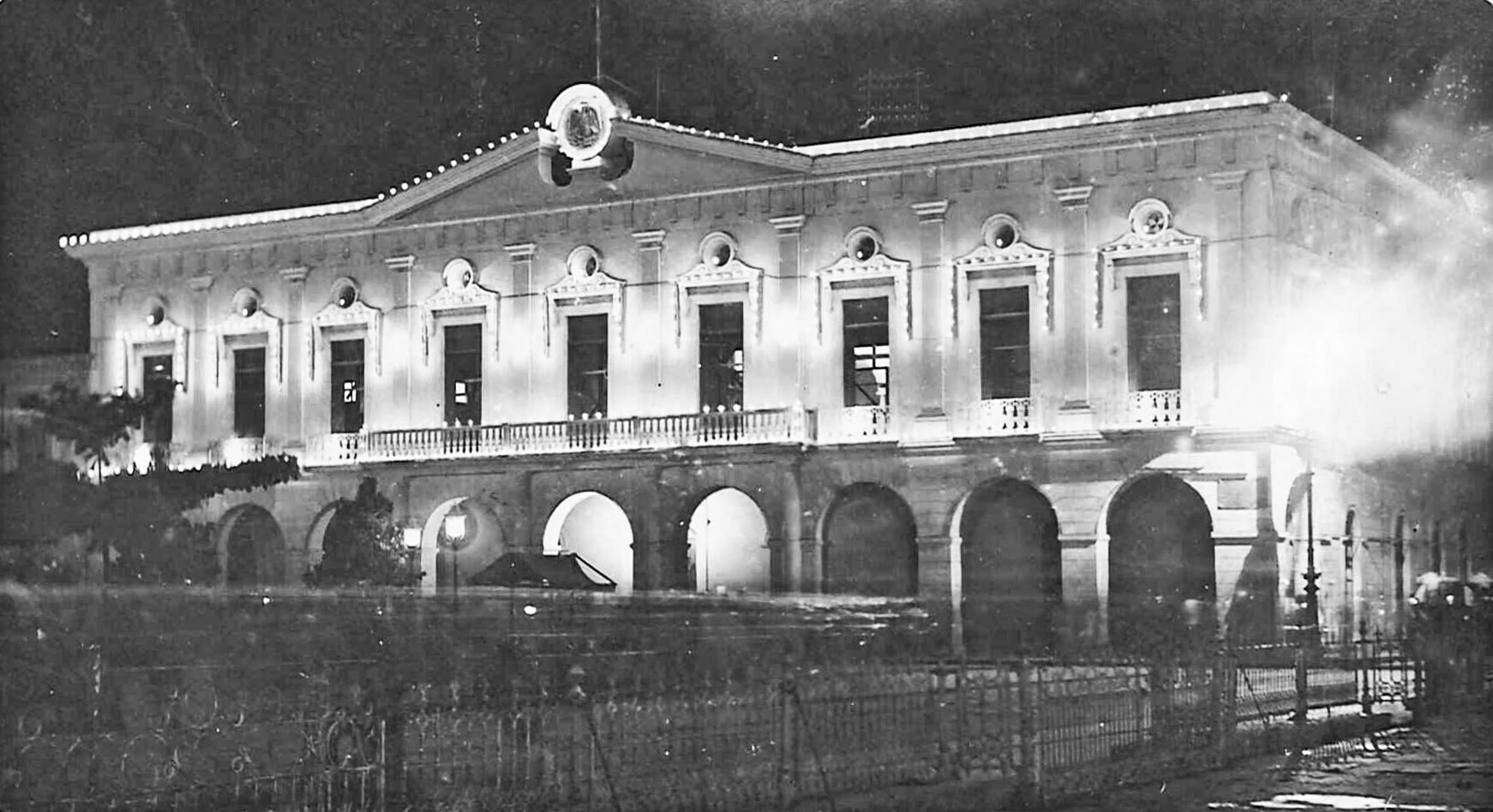 Palacio de Gobierno in Mérida at night in 1913, seen from Plaza Grande
Do not confuse Palacio de Gobierno with a palace open in the same way as a European royal residence. It is an administrative building that permits public visitation to its cultural spaces. Security staff may be present at the entrance. Dress and behave as you would in a working public institution: keep your voice low, follow directions, and do not wander into areas that are not part of the visitor route.
Location and how to find the entrance
The palace is on the north side of Plaza Grande in Mérida Centro. The square is bounded by Calle 60, Calle 61, Calle 62, and Calle 63. The palace’s main façade faces the plaza, so the easiest orientation is to stand in the square facing the cathedral and look directly across it.
The palace is within an easy walking circuit from Parque Santa Lucía, Calle 60, Parque Hidalgo, Mercado Lucas de Gálvez, and Paseo de Montejo’s southern end. From a hotel in Centro, walking is usually the simplest option. Mérida is inland, not a coastal city, so this is a historic-center visit rather than a waterfront attraction. There is no malecón or riverfront to combine with it; the natural pairing is the plaza, streets, museums, markets, and churches of the center.
If you arrive by taxi or rideshare, use Plaza Grande or Palacio de Gobierno as the destination and confirm the drop-off point with the driver. Traffic restrictions and pedestrian activity can affect the exact stopping place. If you are walking, look for the formal civic façade and the entrance facing the square rather than searching for a separate museum sign.
The building is also close to Pasaje de la Revolución, the covered pedestrian passage beside the cathedral, and the Palacio Municipal. These are useful landmarks when the square is busy or when an event changes the usual pedestrian flow.
Hours, admission, and what to expect at the door
Admission is generally free. Current public listings describe daytime access, but hours and visitor procedures can change. Government buildings sometimes close or restrict areas for official work, ceremonies, security needs, public holidays, maintenance, or special events. Check the current official Yucatán government information or ask locally on the day, particularly if the palace is the main reason for crossing the city.
A free entry does not mean an unstructured entry. There may be a security check or a guard who directs visitors toward the public areas. Carry only what you need, avoid bringing bulky luggage, and do not assume that every corridor is open. Photography may be tolerated in the visitor areas, but obey posted rules and staff instructions. Flash can be intrusive in a painted interior and may be prohibited.
The palace is not a climate-controlled blockbuster museum. Mérida’s heat and humidity are part of the practical calculation, especially when walking across the open plaza or climbing stairs. The interior may feel cooler in shaded areas, but comfortable shoes still matter. If you are sensitive to heat, visit earlier in the day and take a break indoors elsewhere before continuing your walking route.
Allow roughly thirty to sixty minutes for a focused visit. History-minded travelers may stay longer, moving slowly through the murals and returning to details on the staircase or upper galleries. If a section is closed, the visit can be much shorter. Treat any duration as a planning range rather than a guaranteed itinerary.
The architecture: a civic frame for the murals
The palace’s architecture is more restrained than the paintings inside. Its formal façade establishes the building as an institution, while the central courtyard provides light and air. Arches, columns, galleries, stairways, and painted surfaces create a sequence of thresholds. You do not enter one dark exhibition hall; you move through a working civic building whose public spaces have been turned into a historical narrative.
The courtyard is a useful place to pause before concentrating on the murals. Look at how the galleries overlook the open center and how the building balances symmetry with everyday movement. Officials, staff, visitors, and security procedures all remind you that this is still government space. The cultural experience is embedded in administration rather than separated from it.
The staircase is important because it turns the act of moving upward into part of the story. Large scenes surround the route, and the change in viewpoint alters what you notice. From the lower level, you may see an entire composition as a dramatic block of colour. Closer to the upper floor, faces, hands, weapons, bodies, and symbols become easier to inspect.
Architectural details can be easy to overlook when the murals demand attention. Give yourself a few minutes to look at the floor, the proportions of the courtyard, the railing, and the relationship between the arcades and the painted surfaces. The palace is not just a container for art. The building’s civic scale gives the murals their public authority.
 Arcade of Palacio de Gobierno on Plaza Grande in Mérida, Yucatán
Fernando Castro Pacheco and the mural cycle
Fernando Castro Pacheco was born in Mérida in 1918 and became one of the most important artists associated with Yucatán. He worked as a painter, muralist, illustrator, printmaker, and sculptor. His public work is closely tied to regional identity, but it also belongs to a broader Mexican tradition in which murals carried history into schools, government buildings, and other shared spaces.
The Palacio de Gobierno cycle is commonly described as comprising twenty-seven murals distributed through the two floors. Accounts differ in how individual panels or connected compositions are counted, so the useful point for a visitor is not to chase a perfect numbered inventory. Instead, notice the cycle as a continuous argument about Yucatán: a people and landscape subjected to violence and unequal power, but also capable of resistance, organisation, labour, and political transformation.
Castro Pacheco’s figures are often monumental. Bodies fill the picture plane. Limbs and tools create diagonals. Earth colours, deep reds, greens, ochres, and dark shadows give the scenes physical weight. The effect is not delicate. Even when a composition represents an idealised past, it tends to feel embodied and political.
His Maya figures are not merely picturesque background characters. They are central subjects, workers, fighters, families, and historical agents. That is one reason the murals remain significant. At the same time, the cycle is a modern interpretation made within the political culture of the twentieth century. A visitor should hold both facts together: the paintings give visibility and dignity to Maya and rural experience, while still arranging a complicated history through a particular state-sponsored narrative.
Do not reduce the artist to a simple local equivalent of Diego Rivera. Mexican muralism is a broad field, and Castro Pacheco’s style has its own colour, line, and regional focus. If a guide or label mentions artistic influences, use them as a starting point rather than assuming the palace is an imitation of another muralist’s work.
How to read the murals without rushing
Begin at a distance. Find the overall direction of the composition before trying to identify every person. Ask where the eye is pulled: toward a face, a raised arm, a weapon, a flag, a landscape, or a mass of figures. Then move closer to look at the smaller relationships between people and objects.
Next, notice the difference between historical event and symbol. A painting may evoke conquest, resistance, or reform without functioning like a dated scene in a museum timeline. Flames, chains, tools, fields, and bodies can stand for a period or a condition. If a scene is not clearly labelled, describe what you see rather than inventing a precise event or title.
Pay attention to who occupies the centre. The murals frequently shift attention away from rulers alone and toward communities, labour, and collective struggle. Hands are especially important: hands holding tools, weapons, books, flags, or one another can express work, conflict, education, and solidarity.
Look for the tension between beauty and violence. Strong colour and powerful drawing can make a scene visually attractive even when it represents loss or oppression. That contrast is part of the experience. You do not have to treat the murals as cheerful decoration simply because visitors enjoy photographing them.
Finally, connect the interior to the square outside. The cathedral, government palace, municipal palace, and colonial houses form a physical lesson in the institutions that shaped Mérida. The murals then add a modern state narrative to that architectural setting. Seeing both layers makes the visit more meaningful than viewing the paintings in isolation.
History in the murals: Maya civilisation and the conquest
The cycle reaches back to the Maya past, but it should not be read as a simple “before and after” story in which Maya history ends at the arrival of the Spanish. Yucatán’s Maya communities, languages, traditions, and political life continued through the colonial period and remain part of the state today. The palace’s sequence may compress that continuity, but the visitor should not.
The Maya past appears through monumental figures, landscapes, ritual or social imagery, and references to knowledge and community. These images can prompt questions about how modern Yucatecan identity is built from archaeology, living culture, and political memory. They are not a substitute for an archaeological museum or a community-led cultural experience, but they offer a powerful public statement about the importance of Maya history.
The conquest is presented with drama and conflict. This is not the place to repeat a vague story of peaceful “discovery.” The Spanish invasion brought military violence, religious transformation, land redistribution, disease, and new systems of labour and hierarchy. The long history of colonial rule cannot be reduced to a single moment in 1542, the year commonly associated with the Spanish founding of Mérida.
When viewing conquest imagery, notice how power is represented through posture, scale, weapons, and the direction of movement. Who stands? Who falls? Who is armed? Who is being observed? These questions are more useful than searching for a tourist-friendly legend. They also help you see that the cycle is concerned with political memory, not merely local colour.
The palace sits on a square shaped by colonial urban planning and institutions. That setting can make the conquest scenes feel more immediate. You are not looking at a detached historical illustration; you are looking at a twentieth-century interpretation displayed inside one of the state’s most prominent buildings, across from one of Mérida’s most important churches.
Resistance, the Caste War, and the danger of oversimplifying
Yucatán’s history includes repeated Maya resistance, including the nineteenth-century Caste War, a long and complex conflict that began in 1847 and reshaped the peninsula. Visitors may encounter broad references to rebellion or struggle in the palace. The imagery is emotionally direct, but the conflict itself deserves more care than a short caption can provide.
The Caste War was not simply a timeless clash between “Maya” and “Spanish.” It involved changing regional alliances, land pressure, racialised political systems, local elites, arms flows, religious movements, shifting military control, and the participation of different communities with different interests. It continued for decades and had consequences far beyond the battlefield.
Castro Pacheco’s figures of resistance can be read as an affirmation of dignity and political agency. They can also invite a question about how a state in the twentieth century chooses to represent rebellion inside its own government palace. Public murals often make a region’s difficult past visible while also organising it into a story that supports contemporary identity.
That tension is not a reason to skip the visit. It is a reason to look carefully. The murals are most interesting when they make you aware of the politics of remembering. If you want deeper historical background, pair the palace with a reputable museum visit or a local guide who can distinguish Maya history, colonial rule, nineteenth-century conflict, and modern state-building instead of blending everything into one dramatic narrative.
Independence, Revolution, and agrarian reform
The cycle moves from colonial and regional conflict toward the formation of Mexico as a modern nation. Independence, the Revolution, rural labour, land, and agrarian reform appear as part of a broader story of social transformation. These sections often feel less like a tourist introduction and more like a civic lesson about who should control land and how ordinary people become part of national history.
Yucatán’s nineteenth- and twentieth-century history cannot be separated from land and labour. The henequen economy created wealth for some and demanding work for many others. Railways, plantations, export markets, debt, and changing labour systems altered rural communities and Mérida’s urban landscape. Even when a mural does not label every economic context, tools, fields, fibres, and workers point toward those realities.
Felipe Carrillo Puerto is an important figure in Yucatecan political memory. As governor in the early 1920s, he supported policies associated with Maya rights, education, and agrarian reform before his execution in 1924. Lázaro Cárdenas, president of Mexico from 1934 to 1940, is associated nationally with agrarian reform and the expropriation of the oil industry. When the two appear together in the palace’s historical imagery, the connection is a statement about land, rural communities, and the political promise of reform.
Again, do not take the painted sequence as a complete history. It is a selection shaped by the era in which it was made and the institution that displays it. But it is a valuable selection because it places Maya and rural life inside the centre of a government building rather than leaving the state’s history to portraits of governors and military heroes alone.
 Calle 61 and Plaza Grande in Mérida in 1899, with the Governor's Palace at left and horse-drawn carriages in the street
The upper floor and the Salón de la Historia de Yucatán
If access permits, continue upstairs rather than stopping at the entrance or courtyard. The upper level provides a different view of the architecture and the murals. From the galleries, you can understand how the cycle wraps around the building and how the courtyard changes the light.
Accounts of the palace identify a Salón de la Historia de Yucatán with additional paintings by Castro Pacheco. The room and its presentation may change with conservation, renovation, official use, or exhibition decisions, so avoid assuming that every described object will be visible on every visit. The larger point is that the palace contains more than the dramatic staircase: the upper spaces deepen the narrative and reward a slower circuit.
Woodwork, framed paintings, and formal interiors give the salon a more ceremonial feel than the open courtyard. This shift matters. The palace moves you from public circulation into a room designed to stage history. Look at how the paintings and furniture work together to create authority. The room does not merely store images; it tells you that the state has chosen these people and themes to represent Yucatán.
From the upper balcony or gallery, you may also gain a useful view toward Plaza Grande and the cathedral. Do not treat it as a guaranteed observation deck. Access, safety rules, and the exact route can vary. If the balcony is open, be considerate of other visitors and keep away from restricted edges.
GuideFestival de la Torta de Kibi 2026 in Progreso: What Travelers Should KnowPlan a simple food-focused day trip to Progreso for the Festival de la Torta de Kibi 2026, with practical notes on what to eat, how to get there, what to combine nearby and what to confirm before you go.Open
Photography and visiting etiquette
The murals are photographable subjects, but the building is still a public workplace. Move aside from stairways when composing a picture, especially when staff or other visitors need to pass. Avoid blocking a narrow gallery for a long time. A wide-angle phone lens can help in the staircase, but step back before using it so you do not distort the painting unnecessarily.
Turn off flash unless staff explicitly permit it. Flash is distracting in a quiet public interior and can be unsuitable for artworks. Do not touch walls, frames, railings, or painted surfaces. Keep children close on stairs and explain that the palace is not a play space even though entry is informal.
A respectful visit also means avoiding theatrical poses in front of scenes depicting suffering, execution, conquest, or forced labour. You can photograph the art without turning every historical image into a cheerful backdrop. If you hire a guide, listen for distinctions between what is documented, what is symbolic, and what is the guide’s interpretation.
Spanish phrases help because the entrance and any temporary instructions may be handled in Spanish. “¿Se puede tomar fotos?” means “May I take photos?” “¿Por dónde se entra?” means “Where is the entrance?” and “¿Está abierto el segundo piso?” means “Is the second floor open?” A simple greeting and a patient tone go a long way.
Best time to visit
Go earlier in the day if you want a calmer walk across Plaza Grande and a better chance of seeing the interior before the strongest heat. Morning also works well if you are building a historic-center route toward the markets or museums. Midday can be practical for a cool, cultural pause, but the square itself may feel hot and bright when you arrive.
Late afternoon can produce attractive light on the plaza and cathedral, but it is less predictable for public-building access. Official activity, closures, or changing visitor procedures matter more than the quality of the light. If you want the palace specifically, prioritize access over photography.
Avoid treating Sundays, public holidays, or civic celebration dates as ordinary days. The square may host events, flags, performances, demonstrations, ceremonies, or crowd-control measures. These can make the setting lively but may alter the visit. Verify locally when the date is important.
Mérida is hot for much of the year. Drink water, wear breathable clothing, and plan shade breaks. The palace is a good stop in a walking circuit because it offers an indoor cultural interval, but you still need to cross open streets and the plaza. Comfortable footwear is more useful than formal clothing.
A practical one-hour visit plan
Start outside on Plaza Grande. Face the palace and take in its civic scale before entering. Notice how its position relates to the cathedral and the other sides of the square. This takes only a few minutes but gives the murals a spatial context.
At the entrance, follow staff directions and ask about any areas currently open. Begin with the courtyard and arcades. Look up and across rather than immediately photographing the first wall. Identify the main circulation route and decide whether the staircase and upper floor are accessible.
Move slowly through the staircase murals. First take in the whole composition, then choose two or three details: a face, a hand, a tool, a weapon, a flag, or a landscape. Ask what the artist is making central and what is pushed to the edge. Avoid trying to remember every panel.
Continue upstairs if permitted. Look back toward the courtyard and across to the plaza. Spend time in the historical salon if it is open, then return downstairs without rushing. The final view should connect the interior story to the institutions outside.
Leave through the same public route and take a shaded pause on a nearby street or in another appropriate public space. Do not stand in the entrance taking a long group photo. If you still have energy, continue to the cathedral, Casa de Montejo, or a market rather than adding a second palace section to the same visit.
How to combine it with nearby sights
Plaza Grande and Mérida Cathedral
These belong together geographically but offer different experiences. Plaza Grande is the city’s civic meeting space, while the cathedral represents a major religious institution and a long colonial history. Visit the plaza first, enter the palace, and then look back across the square. The contrast helps you understand why the palace’s murals are concerned with power, identity, and historical memory.
 Mérida Cathedral on Plaza Grande, seen across the square from Palacio de Gobierno
For a deeper cathedral visit, check current access rules separately. Religious services can affect visitor movement. Read the Mérida Cathedral visitor guide before setting your route.
GuideMérida Cathedral: History & Visitor GuideA practical guide to Mérida Cathedral, or Catedral de San Ildefonso: its layered history, architecture, Cristo de las Ampollas, respectful visiting, and the best way to place it in a Centro Histórico walk.Open
Casa de Montejo
Casa de Montejo is on the south side of the square and provides a different perspective on the colonial founding of Mérida. Its façade and rooms are connected to the Montejo family, while Palacio de Gobierno presents a later civic and regional narrative. Seeing both in one walk makes it easier to notice who is celebrated, who is represented, and how the city’s institutions changed over time.
Plan the Casa de Montejo visit as a separate stop rather than assuming that one building explains the other.
GuideCasa de Montejo, Mérida: Complete Visitor GuidePlan a thoughtful visit to Casa de Montejo in Mérida: what the façade means, what to see inside, how long to stay, current practical details, and what to combine with it.Open
Markets and central streets
After the palace, walk toward the central markets if you want everyday movement and food rather than another formal monument. Mercado Lucas de Gálvez and the surrounding central streets are practical places to observe commerce, ingredients, transport, and daily city life. They are not extensions of the palace’s mural narrative, and that is exactly why the combination works: public history followed by ordinary urban activity.
Go with patience and awareness of belongings. Markets can be crowded, hot, and busy. If you are carrying camera equipment, keep it secure and avoid photographing people closely without permission.
Parque Santa Lucía and Calle 60
Parque Santa Lucía, Calle 60, and the streets leading south from the plaza make a manageable continuation for travelers staying in Centro. This area has restaurants, cultural venues, shops, and evening activity, but do not invent a fixed schedule for the day. Check current opening times for any particular venue and let the palace remain the anchor of the historical section.
Paseo de Montejo
Paseo de Montejo is farther north and works as a separate leg of a Mérida day, especially if you are interested in nineteenth-century and early twentieth-century architecture. It is not waterfront and should not be described as a seaside promenade: Mérida is inland. You can connect it by walking if the heat suits you, or use local transport for the return.
GuidePaseo de Montejo: A Complete Guide to Mérida’s Grand AvenuePlan a thoughtful walk along Paseo de Montejo in Mérida, from the historic mansions and Palacio Cantón to Monumento a la Patria, Sunday Biciruta, museums, transport, and nearby stays.Open
Should you take a guided tour?
You can visit independently. The palace is central, free, and compact. Independent visitors often enjoy having time to look without following a group, particularly when the murals prompt personal questions rather than a fixed list of dates.
A guide becomes useful when you want historical context, Spanish interpretation, or help relating the paintings to the Caste War, henequen economy, Revolution, Carrillo Puerto, and modern Yucatecan politics. Choose a guide who can acknowledge uncertainty and complexity. A guide who labels every dramatic figure with an unsupported story may make the visit sound confident while making it less accurate.
A Mérida city tour can be a practical option if you have limited time and want the palace placed alongside the cathedral, Plaza Grande, Paseo de Montejo, and other central landmarks. Verify the current itinerary before booking because city-tour routes change. Compare Mérida tours on GetYourGuide and see Mérida experiences on Viator. These are broader experiences; neither replaces time to study the murals at your own pace.
Where to stay for an easy visit
If Palacio de Gobierno is part of a walking-focused Mérida trip, Centro is the most convenient base. Staying near the historic grid makes early visits, plaza walks, markets, and evening cultural programming easier. Santa Ana and the streets around Paseo de Montejo can also work, but the walk to Plaza Grande becomes longer and the heat matters more.
Choose by the kind of trip you are actually taking. A central room is useful for a short stay without a car. A northern base may suit travelers who prioritise larger modern hotels, parking, or day-trip departures, but you will rely more on taxis or rideshare for the historic center. An accommodation with a courtyard or pool can make the midday heat easier, but check current reviews for noise, air-conditioning, stairs, and water pressure rather than assuming that every historic building has the same facilities.
Check current Mérida accommodation rates on Booking.com · Compare Mérida stays on Trip.com
Accessibility and family considerations
The historic building includes stairs, and the visitor route may not provide equal access to every level. Conditions can change depending on which areas are open. Travelers using wheelchairs, walking aids, or strollers should ask at the entrance about the accessible route before committing to the visit. Do not assume that an old civic building has a lift or a step-free way to every mural.
For families, the murals offer a good opportunity to practise looking rather than rushing. Give older children a simple task: find repeated colours, identify tools and forms of work, or compare the way different figures are positioned. Younger children may enjoy the courtyard but need close supervision on stairs and around railings.
The subject matter includes violence, conquest, oppression, and death. Decide in advance how much context your children need. It is better to name the difficult subject calmly than to pretend the paintings are only colourful scenes. A short visit followed by an open plaza break usually works better than demanding museum-style concentration for an hour.
Common mistakes to avoid
Do not arrive expecting a royal palace with lavish furnishings in every room. The building’s importance is civic and historical, and the murals are the main reason to enter.
Do not describe the paintings as a complete, objective history of Yucatán. They are a major public interpretation by a Yucatecan artist, displayed in a state building. That distinction improves the visit.
Do not confuse the palace with Mérida’s Palacio Municipal. Both are on Plaza Grande, but they are different buildings and institutions. If you are meeting a guide, specify Palacio de Gobierno on the north side of the square.
Do not rely on an old blog for current hours. Free government sites can have changing procedures. Check locally, especially around holidays and civic events.
Do not plan the palace as a coastal attraction. Mérida has no beach, malecón, riverfront, or ocean view. If you want the Gulf after a city visit, plan a separate trip to Progreso, Celestún, or Sisal.
Do not rush through the murals while treating them as a backdrop for selfies. Read the direction of the cycle, notice who is represented, and give other visitors room.
Frequently asked questions
Is Palacio de Gobierno in Mérida free?
Yes, visitor admission is generally free. Public access can still be affected by official work, security, maintenance, holidays, or special events, so verify current conditions locally.
How long do you need at Palacio de Gobierno?
Allow thirty to sixty minutes for a normal visit. A focused look at the courtyard, staircase, upper galleries, and historical paintings can take longer if all areas are open.
Are the murals by Diego Rivera?
No. The murals at Palacio de Gobierno are associated with Fernando Castro Pacheco, a major Yucatecan painter and muralist. His work belongs to Mexico’s broader mural tradition but has its own regional style and historical focus.
Can you take photographs inside?
Photography rules can vary. Ask at the entrance, follow posted instructions, turn off flash unless permitted, and do not block stairways or disturb staff. Never touch the murals or frames.
Is Palacio de Gobierno suitable for children?
It can be, especially for children who enjoy visual stories, but the murals include difficult themes and the building has stairs. Keep the visit short and discuss the images in age-appropriate language.
What should you visit after the palace?
Plaza Grande and Mérida Cathedral are the natural next stops. Casa de Montejo, the central markets, Pasaje de la Revolución, Parque Santa Lucía, and Calle 60 can extend the walk depending on heat and opening conditions.
Can you visit Palacio de Gobierno without a tour?
Yes. Independent access is straightforward when public areas are open. A guided city tour is useful if you want interpretation or have only a short time in Mérida, but independent visitors can spend longer with the murals.
The practical verdict
Visit Palacio de Gobierno when you are in Mérida Centro, but enter with the right expectation: this is a working government building whose public rooms contain a powerful, selective account of Yucatán’s past. Start with the architecture, take your time with the staircase and upper galleries if they are open, and read the murals as both art and political memory. Then step back into Plaza Grande and compare the palace’s modern civic story with the cathedral, Casa de Montejo, and the everyday streets around the square. That combination gives you a more honest understanding of Mérida than a quick list of monuments ever will.
A quieter version of the visit is simple: go early, look slowly, ask permission before photographing, and leave enough time to sit in the square afterward. The palace is small enough for an unhurried stop and important enough to reward one.