Printable guide
Sisal vs Celestún: Which Yucatán Beach Town Fits Your Trip?
Updated
Sisal and Celestún are both quiet Gulf Coast towns within 90 minutes of Mérida — but they suit very different trips. This comparison covers beaches, wildlife, food, transport, and who should go where.

Sisal and Celestún sit on Yucatán's Gulf Coast, both within easy reach of Mérida, both quiet, both surrounded by mangroves and shallow turquoise water. On paper they sound interchangeable. In practice, they suit completely different travellers.
Sisal is the closer, smaller, more laid-back of the two — a Pueblo Mágico with a white-sand beach, a historic lighthouse, and almost no tourist pressure. Celestún is the famous one: the town that puts you on a boat past thousands of pink flamingos inside a UNESCO-recognised biosphere reserve. One is for swimming and doing not much at all. The other is for wildlife and early-morning expeditions.
Here is how to decide which one deserves your time.
Getting There
Both towns are reached from Mérida by Highway 281, but they branch in different directions.
Sisal is roughly 55 km northwest of Mérida — about 1 hour 10 minutes by car. The route goes through Hunucmá and then follows a well-marked turn-off to the coast. The road is paved and in decent condition, with occasional potholes on the final stretch. Public transport is limited: there are a couple of direct buses per day (departures around 08:30 and 17:00) costing roughly MXN 35–90, or you can take a colectivo to Hunucmá and connect from there. A taxi from Mérida runs around MXN 450–550.
Celestún is roughly 90 km west of Mérida — about 1 hour 30 minutes by car. Highway 281 heads straight there. Buses depart from the Terminal Noreste roughly every hour throughout the day, costing MXN 80–120 for the two-hour ride. A taxi or private transfer costs MXN 800–1,000.
The bottom line: Sisal is noticeably closer and cheaper to reach. If you are short on time or travelling on a tight budget, the difference in distance and bus cost is significant. Both drives are straightforward on good roads — no 4WD needed.
The Beaches
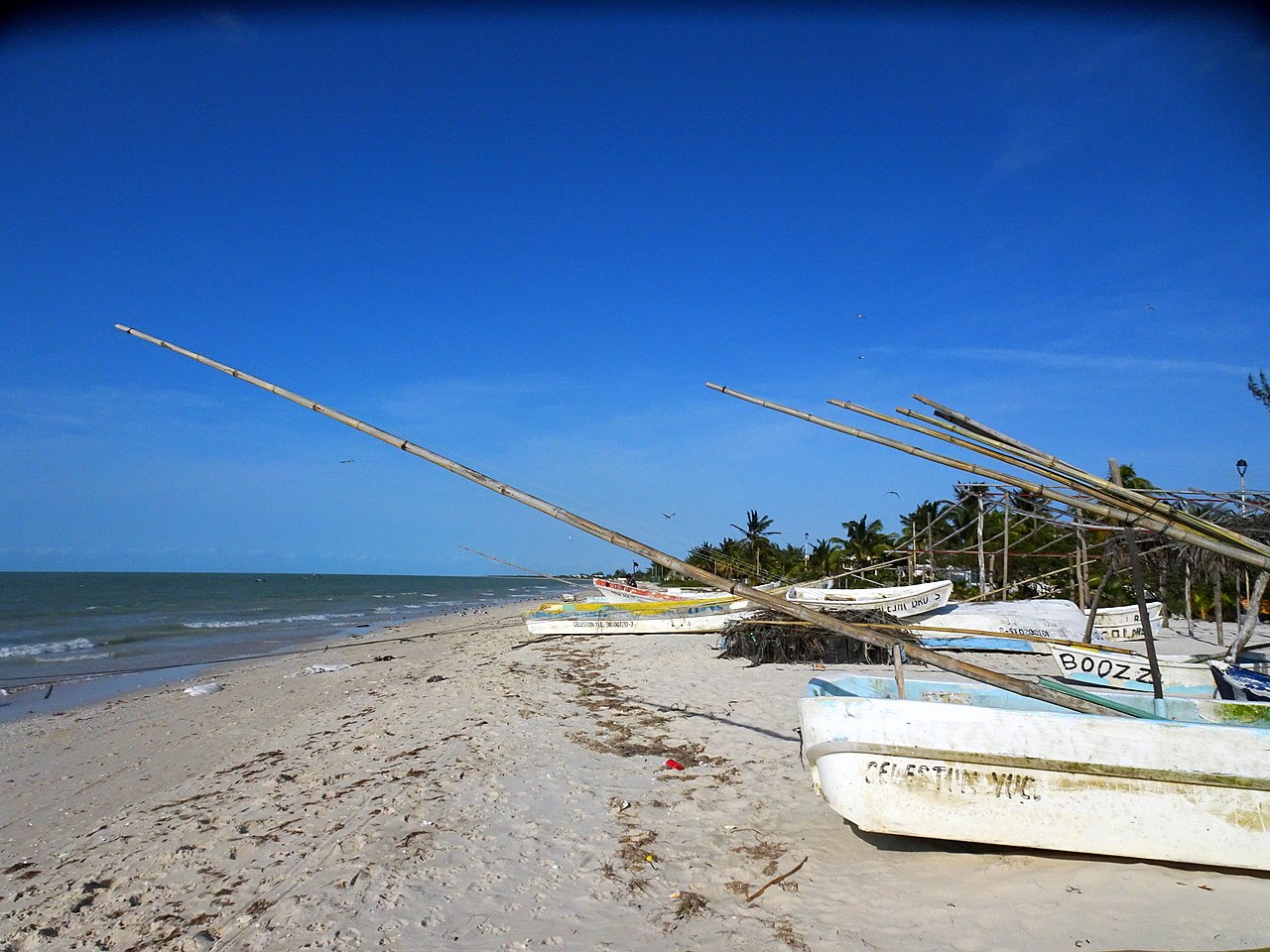 Beach in Celestún, Yucatán, on the Gulf Coast
This is where the two towns diverge sharply.
Sisal has a wider, finer, whiter beach. The sand is soft and powdery, the slope into the water is gentle, and the turquoise shallows are calm enough for small children. A few palapas line the sand near the pier, there are portable restrooms, and the water is generally clear. Seaweed (sargassum) is rare here — occasional drift lines in late summer, but quickly cleared. On weekdays, you may have the beach almost to yourself. Weekends draw Mérida families, but it never feels crowded.
Celestún also has a long, pleasant beach, but the sand is slightly coarser, with more shell fragments. The water ranges from clear-green to turquoise depending on recent rains — it can be muddier after storms. Sargassum is more of an issue here, especially from September through November, though locals clear it daily from the main stretch. Shade is limited — there are a few palapas near the dock, but if you plan to spend the day on the sand, bring your own beach tent or umbrella. Swimming is fine but less sheltered than at Sisal.
If the beach is your primary reason for visiting, Sisal wins on sand quality, swimability, and infrastructure. Celestún's beach is perfectly fine, but it is not the main draw — the flamingos are.
Wildlife and Nature
 Flamingos and cormorants in the Celestún biosphere reserve, Yucatán
This is Celestún's territory. The Ría Celestún Biosphere Reserve is a 600 km² wetland that hosts one of the largest American flamingo colonies in the world — estimates range from 15,000 to 35,000 birds at peak season (November through March). Boat tours depart from the town bridge throughout the day. A shared lancha (up to 8 passengers) costs roughly MXN 1,800–2,000 per boat for a 1.5–2 hour tour that includes the flamingos, a mangrove tunnel, and a freshwater spring where you can swim. Private boats cost more. The tours are the main reason most people visit Celestún, and they deliver — the sight of hundreds of pink birds feeding in the shallows is genuinely striking.
Beyond the flamingos, the reserve is home to over 300 bird species, crocodiles basking on mangrove roots, and sea turtles. The mangrove tunnel at Dzinitún is a highlight, with water coloured red and green by tannins and sunlight. Kayak and paddleboard rentals are available inside the lagoon for calmer paddling.
Sisal has wildlife too, but at a smaller scale. Flamingos fly overhead seasonally (November–April), but there is no permanent colony. Small boat tours into the Ciénega de Sisal wetlands cost around MXN 300–500 per person or MXN 800–1,200 per boat, covering mangroves, birdwatching, and a freshwater spring. The El Palmar State Reserve, just north of town, offers guided hikes through protected wetlands. You might spot herons, pelicans, osprey, and the occasional crocodile, but the experience is quieter and less dramatic than Celestún's massed flamingo gatherings.
If wildlife photography or birdwatching is your priority, Celestún is the clear winner. If you want nature at a gentler pace without committing to a boat tour, Sisal still delivers.
History and Atmosphere
 The old maritime customs house in Sisal, Yucatán
Sisal has the stronger historical story. It was once the primary port for exporting henequén (sisal fibre) worldwide — the "green gold" that built Mérida's mansions. The Fort of Santiago, built to protect the port from pirates, still stands near the beach. The red-and-white lighthouse, added in 1845, is the town's most recognisable landmark. The former customs house (Aduana) has been restored as a cultural centre. Empress Carlota of Mexico landed here in 1865. You can walk between all of these in a relaxed 20-minute stroll. The town centre has a small plaza with old cannons, confidant chairs, and a gazebo. It feels like a place that was once important and is now quietly fading — which is part of its appeal.
Celestún is a working fishing village first and a tourist destination second. There is a 19th-century lighthouse and a small municipal museum, but the town's identity revolves around the dock and the boat tours, not colonial history. The streets are quieter, the buildings less ornate, and the atmosphere is more functional. If you want a town you can explore on foot with a sense of history, Sisal has more to walk through.
Food
Both towns offer fresh Gulf seafood at reasonable prices, but the scenes differ.
In Sisal, a handful of beachfront palapas serve ceviche, fried fish, shrimp cocktails, and pescado tikín-xic (fish in achiote and orange sauce). Prices run MXN 70–150 per main dish. The restaurants are small, family-run, and close early. Options are limited — there are perhaps four or five places to eat in the whole town — but what they serve is fresh from the boats that morning.
In Celestún, the food scene is slightly larger and slightly more expensive, oriented around the boat-tour crowd. Restaurants near the dock serve bigger plates (MXN 120–180) — ceviche de camarón, pescado a la talla, and tostadas de ceviche from street stalls for MXN 30–50. There are more options, but they also feel more geared to day-trippers. Quality is good, but the food is not the reason you came.
Neither town has a fine-dining scene, and neither needs one. Bring cash for both — card payment is rare outside the larger restaurants.
Accommodation
Sisal has three or four small hotels and a handful of Airbnbs. Rates run MXN 1,200–2,200 per night for a double room. Free beach camping is allowed (bring your own gear). Some locals rent shade tents for MXN 150–250. Accommodation is simple and functional.
Celestún has a similar number of guesthouses and eco-lodges, priced MXN 1,400–2,500. Airbnb listings are more limited. There is no official campground. A few locals allow tent-camping on their property for a small fee.
 Mangrove wetlands of the Ciénega de Sisal, Yucatán
Neither town has a wide range of places to stay, and neither is a resort destination. If you plan to sleep over, book ahead — especially on weekends and during Semana Santa. For most visitors, both towns work as day trips from Mérida.
Practical Differences
| Need | Sisal | Celestún |
|---|---|---|
| ATMs | 1 ATM near the pier | 1 ATM near bus station; often low on cash |
| Cell signal | Good 4G throughout town | OK in centre; weak near mangroves |
| Grocery | Small abarrotes store near the beach | Mini-market near the dock |
| Petrol | One station on the road into town | None in town — fill up in Hunucmá |
| Medical | Centro de Salud (basic clinic) | Centro de Salud (first aid only) |
| Parking | Free street parking near the pier | Free municipal lot near bus station |
For both towns, carry more cash than you think you need. ATMs in small Yucatecan coastal towns are unreliable, especially on weekends.
Who Should Go Where
Choose Sisal if:
- You want a low-effort beach day with calm, clear water
- You are travelling with young children and need gentle swimming
- You are on a tight budget (closer, cheaper to reach, free camping)
- You want to explore a historic port town on foot
- You prefer doing very little — walk, swim, eat, read under a palapa
- You are interested in kiteboarding (November–July wind season)
Choose Celestún if:
- Seeing flamingos in the wild is a priority
- You are a birdwatcher or wildlife photographer
- You want a structured boat tour through mangroves and freshwater springs
- You are happy to pay more for a nature-focused experience
- You do not mind a longer drive from Mérida
Visit both if: you have two days and a rental car. They are different enough that doing Sisal on day one (beach, lighthouse, mangrove paddle) and Celestún on day two (flamingo boat tour, beach afternoon) gives you the full Gulf Coast experience without repetition.
Seasonal Notes
Both towns share the same climate pattern: dry and pleasant from November through April, hot and humid from May through October. Rainy season peaks June–September.
The main seasonal difference is the flamingos. Celestún's colony is largest from November to March. After that, many birds migrate east toward Río Lagartos. You will still see some flamingos at Celestún year-round, but the numbers drop significantly by May. If flamingos are your reason for visiting, plan for winter or early spring.
Sisal's flamingo flyovers follow a similar seasonal pattern, but they are less reliable simply because the flocks are passing through rather than nesting.
Sargassum affects both beaches, but Celestún more so — especially September through November. Check recent conditions before you go during those months.
Weekends and holiday periods (Semana Santa, July–August school holidays) bring local families to both towns. If you want the quietest experience, go midweek.
Combining With Other Destinations
Neither Sisal nor Celestún sits near Yucatán's other major attractions, so both are typically standalone day trips from Mérida. Some possibilities:
- Sisal + Hunucmá — the road passes through Hunucmá, which has a small colonial church worth a brief stop
- Celestún + beach drive — the coastal road south from Celestún runs toward the Campeche border; scenery is flat and remote
- Neither combines well with the Puuc route, Valladolid, or Chichén Itzá in a single day — they are on the opposite side of Mérida
If you have limited time in Yucatán and must pick one beach day, the choice is straightforward: Sisal for the beach, Celestún for the flamingos.