Printable guide
Cenotes for Beginners: What to Expect and Where to Swim in Yucatán
Updated
A first-timer’s guide to Yucatán cenotes: what they are, what swimming feels like, safety, etiquette, transport, and easy cenotes to start with.

The first cenote is often the one travelers overthink.
You have seen the photographs: blue water below limestone walls, tree roots hanging through an opening in the roof, perhaps a narrow staircase disappearing underground. What the photographs do not tell you is whether the water is freezing, how deep it is, whether you need to be a strong swimmer, whether cave cenotes feel claustrophobic, or how you actually get back out.
The reassuring answer is that visiting a cenote does not need to be an expedition.
Yucatán has everything from small village cenotes with a wooden ladder and little else to organized visitor complexes with changing rooms, restaurants, life jackets, guides and paved parking. For a first visit, there is no prize for choosing the most difficult one.
Start somewhere comfortable. Learn what a cenote feels like. Then decide whether you want to go deeper into Homún, Cuzamá and the smaller communities where the experience becomes more rustic.
 Swimming in a cenote in Temozón, Yucatán
For most first-time visitors, Cenotes Santa Bárbara in Homún, Cenote San Ignacio near Mérida, Hacienda Mucuyché, Cenote Zací in Valladolid, Cenote Oxman and Cenote Hubiku are sensible places to begin.
One important distinction before we go further: in this guide, accessible mostly means easy to organize and straightforward for a first-time visitor. It does not necessarily mean wheelchair accessible or step-free. Cenotes are natural limestone formations. Stairs, wet stone, deep water and uneven surfaces remain common even at developed sites.
The quick answer: which cenote should a beginner choose?
If you simply want a recommendation, start here.
| Cenote | Best for | Base | What to expect |
|---|---|---|---|
| Cenotes Santa Bárbara | Best all-round introduction | Mérida | Several cenote styles, life jackets, internal transport, changing rooms and restaurant |
| Cenote San Ignacio | Nervous first-timers | Mérida | Structured cave-cenote experience with extensive facilities |
| Hacienda Mucuyché | Comfortable guided experience | Mérida | Hacienda setting, two contrasting cenotes and a swimming canal |
| Cenote Zací | Travelers without a car | Valladolid | Large semi-open cenote within walking distance of the city centre |
| Cenote Oxman | Confident swimmers | Valladolid | Dramatic open cenote, hanging roots, deep water and hacienda facilities |
| Cenote Hubiku | Ek Balam day trips | Valladolid / Temozón | Large cavern, visitor facilities and straightforward organized access |
If you are nervous about natural water, San Ignacio is one of the easiest introductions.
If you want to understand how different cenotes can look, Santa Bárbara is stronger because you see several styles in one visit.
If you want a polished half-day rather than a rustic cenote outing, choose Mucuyché.
If you are already staying in Valladolid and do not have a car, Zací is exceptionally easy to add to the day.
What exactly is a cenote?
A cenote is a natural opening into Yucatán's groundwater system.
The peninsula is largely made from porous limestone. Rainwater filters into the ground rather than forming the large surface rivers found in many other parts of the world.
As water moves through the limestone, it slowly enlarges cracks and cavities. Over very long periods these spaces can become caves, tunnels and underground chambers. When part of the roof collapses, the groundwater below may become visible from the surface.
That opening is what we commonly call a cenote.
This explains something important about swimming in one: you are not simply entering an isolated natural swimming pool. You are entering part of a much larger underground water system.
Some cenotes connect directly into extensive cave networks. Others are linked hydrologically even when a swimmer cannot see any obvious passage.
That is one reason the water can be remarkably clear. It is also why protecting cenotes from sunscreen, oils, sewage, chemicals and rubbish matters.
Why are there so many cenotes in Yucatán?
Limestone dominates much of the peninsula, creating what geologists call a karst landscape.
Instead of rivers cutting across the surface, much of the water disappears underground.
The result is a landscape hiding enormous amounts of freshwater beneath what can look, from above, like ordinary scrub forest, agricultural land and small towns.
There are thousands of cenotes and karst depressions across Yucatán.
One of the most interesting concentrations is the broad Ring of Cenotes, associated with fractures around the buried Chicxulub impact structure.
You do not notice this geological story while driving through the countryside. You see limestone roads, low forest, villages and fields.
Then you walk through a gate, descend a staircase and suddenly find a large body of freshwater beneath your feet.
That contrast is part of the experience.
The main types of cenote
Cenotes are often grouped into a few broad visual categories. The boundaries are not perfect, but they are useful when deciding what sort of first experience you want.
Open cenotes
An open cenote has lost much or most of its original roof.
They can look almost like circular natural swimming pools sunk into the earth. There is usually more daylight, more vegetation and less of the enclosed feeling associated with cave cenotes.
For nervous first-time visitors, open cenotes are often easier psychologically.
Semi-open cenotes
These retain part of their limestone roof but have a large opening to the sky.
You get a mixture of cave atmosphere and natural daylight. Roots and vines often grow down toward the water.
This is one of the classic Yucatán cenote scenes: sunlight above, dark limestone around you and freshwater below.
Closed or cavern cenotes
These sit mostly underground beneath an intact limestone roof.
Access may involve stairs through a relatively small entrance before the space opens into a larger chamber. Stalactites, roots and rock formations can surround the water.
They are atmospheric, but travelers who dislike enclosed spaces should know what they are booking.
Cave and underground systems
Some cenotes are entrances into much larger flooded cave networks.
This is where ordinary swimming and cave exploration need to be clearly separated.
A visitor floating inside a marked swimming area is one thing. Entering submerged passages is another.
Do not swim into underwater tunnels simply because you can see an opening. Cave diving requires specialist training, equipment and local knowledge.
For a beginner, stay inside the established swimming area.
What does swimming in a cenote actually feel like?
The first surprise is usually the depth.
Many cenotes do not have a beach-style edge where the water slowly reaches your knees, waist and shoulders. You descend a staircase or ladder, reach a platform and enter water that may already be several metres deep.
You often cannot see the bottom even when the water itself is clear.
That can feel strange for the first minute.
A life jacket removes much of the anxiety. Instead of worrying about staying afloat, you can drift and look around.
The second surprise is the temperature.
Cenote water feels cool when you first enter, particularly after walking outside in Yucatán heat. Most people adjust quickly. Inside cavern cenotes the air itself can also be noticeably cooler.
The third surprise is the sound.
Voices echo. Water moves against limestone. Birds may appear around open roofs. In cave cenotes you may see bats high above you.
They are normal parts of the environment.
 Cenote Santa Bárbara near Homún
You are also unlikely to have the completely solitary experience suggested by some travel photography unless you deliberately seek out a quiet cenote at the right time of day.
At popular beginner-friendly sites, expect other swimmers.
Do you need to know how to swim?
Not always, but you need to respect deep water.
Many developed cenotes require life jackets whether you can swim or not.
For a nervous swimmer, this is useful rather than restrictive. A life jacket lets you float without constantly treading water. In a deep cenote this can actually be more relaxing than swimming in the sea.
Non-swimmers should choose a managed site with:
- compulsory or readily available life jackets
- visible staff
- proper entry platforms
- handrails
- changing facilities
- a clearly defined swimming area
Santa Bárbara and San Ignacio are better first choices than an isolated village cenote reached by a steep ladder.
If you are genuinely frightened of deep water, there is nothing wrong with entering slowly, staying near the steps and getting out after ten minutes.
A cenote visit does not need to become an endurance test.
Are cenotes safe?
Well-managed cenotes are generally straightforward places to visit, but they are natural environments rather than hotel pools.
The main risks are ordinary ones:
- deep water
- slipping on wet limestone
- jumping from unsafe places
- poorly maintained stairs or ladders at smaller sites
- losing footing while entering the water
- children moving beyond arm's reach
- entering cave areas that are not intended for recreational swimming
The simplest rule is to use the infrastructure provided.
If life jackets are mandatory, wear one.
If a jumping platform is closed, do not improvise another one.
If staff tell you not to enter part of a cave, do not enter it.
If you are visiting a small community cenote without lifeguards or substantial infrastructure, the burden of judgment is more heavily on you.
For your first cenote, choosing somewhere organized makes sense.
Why do cenotes make you shower first?
The shower is not ceremonial inconvenience. It protects the water.
Sunscreen, insect repellent, perfume, body oils, makeup and moisturizers all wash from your skin once you begin swimming.
Many cenotes therefore require visitors to shower before entering. Some prohibit sunscreen and repellent in the swimming area entirely.
The easiest routine is:
- Wear sun protection while traveling.
- Shower thoroughly when you reach the cenote.
- Swim.
- Dry off and change.
- Reapply sunscreen and mosquito repellent once you have finished swimming.
This works particularly well if you visit ruins in the morning and use a cenote afterwards.
Cenotes and Maya culture
Cenotes should not be treated solely as natural swimming holes.
For Maya communities, water, caves and openings into the earth have held practical and spiritual importance for centuries.
In a region with few surface rivers, cenotes were important freshwater sources. They were also part of sacred landscapes.
Archaeological research has documented offerings, ritual activity and human remains in caves and cenotes across the peninsula. The details vary by site, period and community, so it is better to avoid reducing the whole subject to the tourist phrase that every cenote was simply a "portal to the underworld."
Some were water sources. Some were ritual spaces. Some had several roles.
Many remain important parts of living communities today.
Treat them accordingly. Do not remove stones, damage formations, enter closed areas or leave rubbish behind.
Cenotes Santa Bárbara, Homún
Best overall introduction from Mérida
If you have never visited a cenote and want someone else to have solved most of the logistics, Santa Bárbara is one of the easiest places to start.
The complex sits in Homún, one of Yucatán's principal cenote communities, roughly an hour from Mérida depending on where you begin.
The useful thing for a beginner is variety. Instead of choosing one cenote type from a photograph, you move through several different settings.
Transport within the property is organized, life jackets are compulsory, and there are bathrooms, changing rooms, showers, parking, rest areas and food.
 Cenotes and Restaurant Santa Bárbara in Homún, Yucatán
That matters more than it sounds.
At a rustic cenote you may spend part of the day deciding where to leave your clothes, whether a ladder feels safe or how you are getting back to town. At Santa Bárbara, you can concentrate on the swimming.
One particularly useful feature is Pool Cocom, an open cenote with assisted access intended for visitors who may not be able to manage the more difficult stairs elsewhere in the complex.
That does not make the entire property universally accessible. Other areas still involve steps and natural surfaces.
Choose Santa Bárbara if: you want a proper cenote day with several swims and solid facilities.
Skip it if: you want solitude or a very small community-run cenote.
Allow: around half a day, longer if you eat there.
Read our full Cenotes Santa Bárbara guide.
GuideCenotes Santa Bárbara, Homún: 2026 Visiting GuideCenotes Santa Barbara is a cenote park near Homún, about 45–50 km north of Mérida in the Yucatán. The site offers access to four cenotes—Cascabel, Chacsinkín, Xooch’ and Pool Cocom—together with restrooms, changing rooms, showers, Wi‑Fi, free parking, a restaurant, lifeguards and mandatory life jackets. Tickets are sold as day‑passes that include cenote entry, a life jacket and internal transport by bicycle, combi shuttle or, in some packages, the Expreso Santa Barbara motorized train; lunch can be added for an extra fee. Prices are not fixed in the article, so travelers should check current online or walk‑up rates before booking. The park opens roughly 9:00 AM to 5:00 PM, with facilities staying open until about 6:00 PM. The best arrival window is 9:00–10:00 AM, especially on weekends and holidays. From Mérida the drive takes 50–70 minutes; public buses, colectivos or shared vans can reach Homún, followed by a short mototaxi ride to the park. Visitors usually spend 3–5 hours inside, plus 2–2.5 hours total driving time. Guests can expect a family‑friendly, organized day: life jackets are provided, transport moves groups between cenotes, and Pool Cocom has an elevator for people with disabilities, older adults or pregnant visitors. The other cenotes require stairs. Tips include arriving early to avoid crowds, confirming whether all four cenotes are included on the day of visit, bringing cash in pesos for small purchases and mototaxis, and choosing transport (bike, combi or train) that suits the group’s fitness and weather conditions. The park is suited to families, first‑time cenote swimmers and mixed‑mobility groups, but less ideal for those seeking solitude, a very low‑cost experience or a completely independent itinerary.Open
Cenote San Ignacio, Chocholá
Best for nervous swimmers and an easy half-day
San Ignacio is west of Mérida near Chocholá and is one of the simplest cenote trips from the city.
This is not the place to go if you want your first cenote to feel remote. It is a developed ecotourism park.
For beginners, that is precisely the appeal.
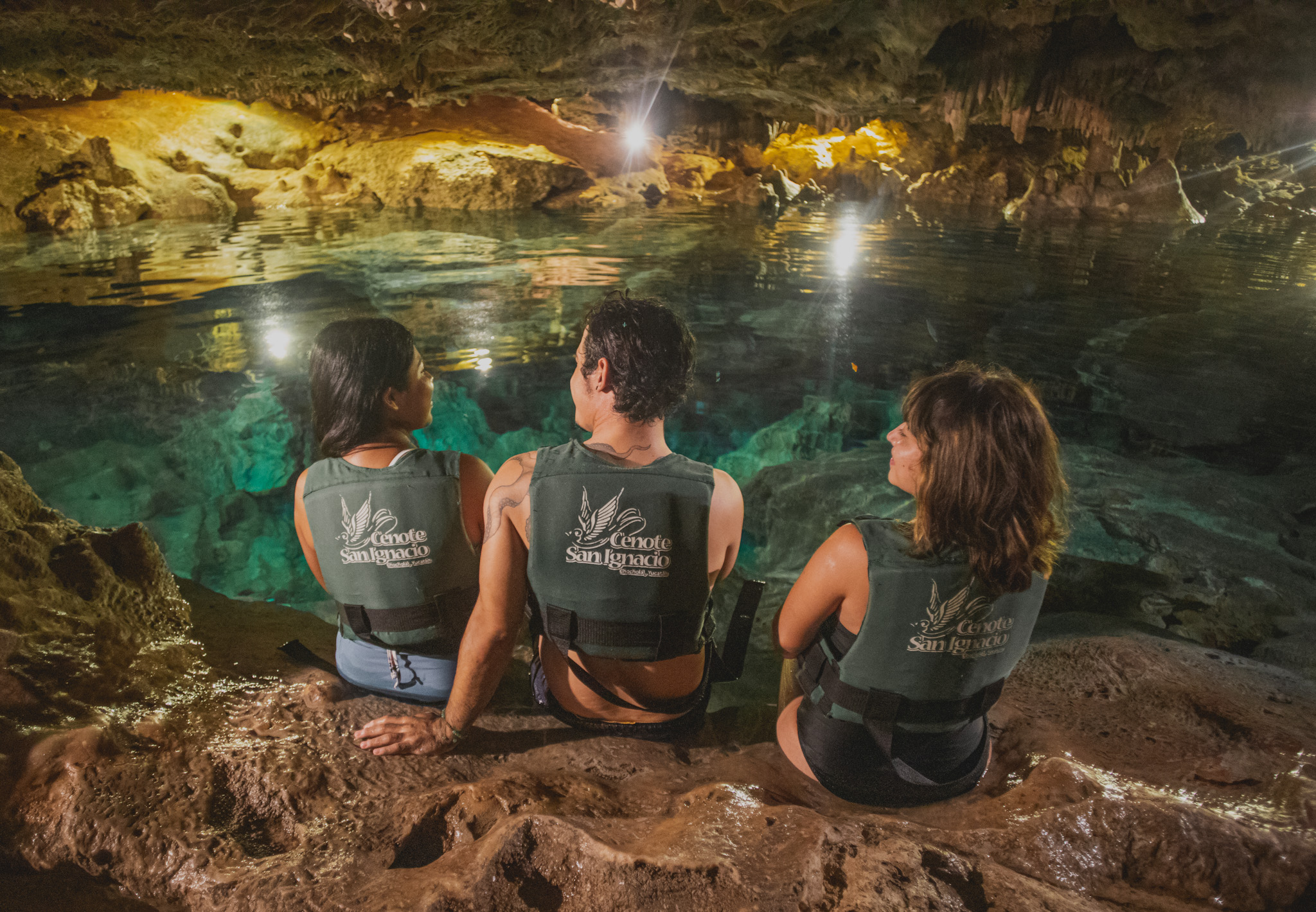 Visitors sitting beside the water inside Cenote San Ignacio
There are changing areas, showers, life jackets, restaurants, places to sit and organized access to the water.
The main cenote is enclosed beneath limestone, so you still get the underground atmosphere associated with Yucatán without having to organize a rural cenote route.
San Ignacio works particularly well if someone in the group is slightly anxious and wants staff and facilities nearby.
It also works when you only have half a day available.
Choose San Ignacio if: comfort, supervision and easy logistics matter more than rustic atmosphere.
Skip it if: you are trying to keep costs as low as possible or want a quiet village experience.
Allow: around 2–3 hours, or longer if you use the wider park facilities.
Read our full Cenote San Ignacio guide.
GuideCenote San Ignacio Guide: How to Visit from Mérida, Tickets & What to ExpectCenote San Ignacio is a managed ecotourism park with a cave cenote, pools, hammocks, restaurant, showers, changing rooms, life‑jackets and optional night swimming, located in Chocholá, Yucatán, west of Mérida. From Mérida centre the drive takes about 35–45 minutes; from the airport 25–35 minutes, from the city’s western periférico 20–30 minutes. A typical visit lasts 2–3 hours, longer if you add lunch, the pool area or the Night Pass. Tickets are listed as General Pass $470 MXN (adult) / $370 MXN (child 4–12), Adventure Pass $660 MXN / $560 MXN, and Night Pass $560 MXN / $370 MXN; resident rates are available with ID. The park opens 10:00–18:00 for daytime visits and 18:00–22:00 for night swims. Getting there is easiest by rental car, private driver or pre‑booked taxi; public transport is possible but inconvenient, especially for a return trip after night swimming. The pass includes cave access, the Emerald River and Heart of Water areas, pool, hammocks, life‑jackets, showers, changing rooms, restaurant service and guided entry; the Adventure Pass adds zip‑line, suspension bridge and inflatable‑tube activities, while the Night Pass provides illuminated evening access. Visitors should expect a clean, organized setting with artificial lighting inside the cave, making it suitable for nervous swimmers and families. Bring swimsuit, towel, water shoes, change of clothes, cash or card and a waterproof pouch; avoid heavy sunscreen before entering. Arrive early on weekdays for fewer crowds, and arrange return transport in advance if you stay for the night swim.OpenHacienda Mucuyché
Best polished cenote experience
Mucuyché is a different proposition.
Rather than paying to enter a single cenote and swimming independently, you move through a structured hacienda-and-cenote experience.
The route typically combines the historic property, Cenote Carlota, a narrow canal and Cenote Azul Maya.
 Cenote water and stone path at Hacienda Mucuyché
That gives first-time visitors several perspectives on Yucatán's underground water without needing to navigate a cluster of village cenotes independently.
It is particularly good for couples, families and travelers who prefer a guided experience.
The drawback is freedom. You are following a timed route rather than arriving at a simple cenote and staying until you feel ready to leave.
Mucuyché pairs naturally with Uxmal if you have a rental car or private driver. Visit Uxmal early before the heat becomes heavy, then swim afterwards.
Choose Mucuyché if: you want comfort, history and cenotes in one organized experience.
Skip it if: you mainly want inexpensive swimming.
Allow: around 2–3 hours for the experience itself, longer with lunch.
Read our Hacienda Mucuyché guide.
GuideHacienda Mucuyché Guide: Cenotes, Tickets, Tours and Day Trip TipsA straightforward guide to visiting Hacienda Mucuyché near Mérida, with cenote tour tips, transport notes, prices, timing, restaurant advice and what to combine nearby.OpenCenote Zací, Valladolid
Best cenote without a car
Zací solves one of the biggest cenote-planning problems: transport.
It is inside Valladolid.
From the main square you can simply walk there.
 Swimmers inside Cenote Zací in Valladolid
That makes it a good first cenote for travelers arriving by bus, staying in Valladolid without a rental car or fitting swimming into a slow city day.
The cenote itself is large and semi-open.
Do not confuse easy transport with easy swimming, however. The water is deep, and reaching it involves stone steps and wet surfaces.
Zací is therefore more practical than it is physically accessible.
The advantage is that you can spend an hour there and then return directly to Valladolid for lunch, the market, Calzada de los Frailes or the Convent of San Bernardino de Siena.
Choose Zací if: you are in Valladolid and want the simplest possible first cenote.
Skip it if: someone in your group struggles with stairs or you want a quiet rural setting.
Allow: roughly 45 minutes to 2 hours.
Read our full Cenote Zací guide.
GuideCenote Zací Guide: How to Visit Valladolid’s In-Town CenoteCenote Zací is an urban, semi‑open limestone cenote located in central Valladolid, about an 8–12‑minute walk east of the main plaza on Calle 36 between Calles 37 and 39. It is open during daylight hours, typically from around 9:00 am to 5:00 pm, though visitors should confirm the exact times on the day of travel. Admission costs MXN 150 for adults and MXN 75 for children; cash in pesos is recommended as card acceptance may vary. No car is needed if you are staying in Valladolid, and the walk from the plaza is flat though sidewalks can be uneven; from Mérida the drive takes roughly two hours, making the cenote best combined with other Valladolid attractions. A visit usually lasts between 45 minutes and two hours and includes access to the pool, the stone steps and pathways, and the on‑site restaurant area. Swimming is allowed, but the water is deep, so confident swimmers, life jackets for children, and careful supervision are advised. Bring a swimsuit, towel, sandals or water shoes with grip, and a dry bag for valuables; avoid sunscreen, oils or glass bottles in the water. Expect a busy, managed environment with slippery stone surfaces, and plan for cooler mornings or late afternoons to avoid heat and crowds. The cenote pairs well with nearby sites such as the main plaza, San Servacio Church, Mercado Municipal and Calzada de los Frailes, making it a convenient stop in a day exploring Valladolid.OpenCenote Oxman, Valladolid
Best for a more dramatic first swim
Oxman sits at Hacienda San Lorenzo Oxman a short drive outside Valladolid.
It looks closer to the cenote many people imagine before arriving in Yucatán: a large opening, high limestone walls, blue-green water and roots descending from above.
 Swimmer jumping into Cenote Oxman near Valladolid
The surrounding hacienda operation adds changing areas, food, a pool and places to relax.
This makes Oxman easy logistically. The water itself is another matter.
It is deep, and you descend by stairs. It suits travelers who are already reasonably comfortable around water better than someone having their first encounter with deep-water swimming.
Go early if you want a quieter experience.
Choose Oxman if: swimming is the main reason you are going and you want a visually dramatic cenote.
Skip it if: deep water or substantial stairs make you uncomfortable.
Allow: around 1.5–3 hours if you also eat or use the surrounding facilities.
Read the complete Cenote Oxman guide.
GuideCenote Oxman Guide: Hacienda Cenote Near ValladolidCenote Oxman, also called Cenote San Lorenzo Oxman, is an open‑air sinkhole set on the grounds of Hacienda San Lorenzo Oxman just outside Valladolid in the Yucatán. The cenote is generally open daily from about 7:00 am to 5:00 pm, though hours may change for maintenance, private events, weather or holidays, so checking the current listing is advised. Entrance costs roughly 200–400 MXN per adult, with the exact price depending on whether you choose the basic cenote entry or a package that adds pool use or restaurant credit; children pay a lower rate. Cash in small pesos bills is recommended because card acceptance can vary. From Valladolid centre the site is a 10–15 minute drive; you can reach it by taxi, rental car, scooter, bicycle, private driver or as part of an organized tour. Driving times from other major points are 45–55 minutes from Chichén Itzá, 35–45 minutes from Ek Balam, about 2 hours from Mérida or Cancún, and 1.5–2 hours from Tulum. A typical visit lasts 1.5–3 hours, depending on whether you stay only to swim or also use the pool, restaurant and changing facilities. Visitors should expect a deep, cool pool with hanging roots, platforms and a rope swing that makes the water lively and noisy when groups arrive. Arriving early, before larger day tours, gives calmer water, better light for photos and less waiting for the swing. The stairs down to the water are moderate and can be wet, so they are not ideal for limited mobility; bring swimwear, towels, sandals or water shoes, sunscreen for before and after swimming, a waterproof phone pouch and cash in pesos. Life jackets may be required for weaker swimmers, and children need close supervision. The hacienda provides bathrooms, changing areas, a restaurant/bar and, depending on the ticket, pool access. For families, the pool offers a safer alternative to the deep cenote, while older children often enjoy the rope swing. Early morning is the best time for photography, especially from the staircase and rim platforms. Combining Oxman with a Valladolid cultural walk, nearby cenotes such as Suytun, or ruins like Chichén Itzá makes for a convenient half‑day itinerary.OpenCenote Hubiku, near Temozón
Best after Ek Balam
Hubiku, near Temozón, is a useful introduction to a large cavern cenote.
The chamber is broad, the visitor operation is established and the facilities make the stop straightforward.
 Cenote Hubiku near Temozón, north of Valladolid
It works especially well after Ek Balam.
Visit the archaeological site early, before the exposed areas become hot, then continue toward Hubiku for a swim and lunch.
This produces a sensible day rather than racing between several disconnected attractions.
Hubiku does receive tour groups, so it is not the place to look for solitude.
For a first-timer, however, a busier developed cenote can be preferable to discovering halfway through the day that the quiet cenote you chose has no changing room, no life jackets and a ladder you do not want to climb.
Choose Hubiku if: you want an easy swim attached to an Ek Balam day.
Skip it if: you dislike cavern settings or organized tour stops.
Read our Cenote Hubiku guide.
What about Ik Kil?
Ik Kil is one of the most famous cenotes in Mexico and extremely easy to combine with Chichén Itzá.
It also receives large numbers of visitors.
There is nothing wrong with going. The infrastructure is substantial, the setting is impressive and transport is easy to arrange.
But if you have several days in Yucatán, we would not necessarily choose it as your only cenote.
Think of Ik Kil as the convenient Chichén Itzá option, particularly when the alternative is not swimming at all.
If you are based in Mérida or Valladolid and have more freedom, you have plenty of other choices.
What about Suytun?
Suytun is famous for the circular platform beneath a shaft of light.
It is one of the most photographed cenotes around Valladolid.
That does not automatically make it the best cenote for swimming.
If your main goal is photography, it may be exactly what you want.
If your goal is to spend an hour floating and enjoying the water, choose somewhere such as Oxman, Santa Bárbara or Hubiku instead.
A recurring mistake in Yucatán planning is choosing cenotes entirely from photographs without asking what the actual visit is like.
Cenotes with children
Cenotes can be excellent family experiences.
They also demand more supervision than a conventional swimming pool.
The essential thing to understand is that family-friendly does not mean shallow.
Many cenotes are extremely deep. There may be no gradual entry and nowhere for a small child to stand.
For younger children, prioritize:
- compulsory life jackets
- visible staff
- proper stairs
- railings
- bathrooms
- changing rooms
- somewhere dry to sit
- an easy exit if the child decides they do not want to swim
Santa Bárbara is one of the stronger options. San Ignacio is another.
Do not plan three or four cenotes in one day with small children simply because they appear close together on the map. Every stop involves changing, showering, walking, entering the water and getting dry again.
One good cenote is enough.
For more options, see our guide to the best cenotes for families.
Cenotes and limited mobility
This requires more care.
Many websites describe cenotes as "accessible" when they really mean easy to reach by road.
Those are not the same thing.
A typical cenote can involve:
- steep staircases
- narrow passages
- wet limestone
- ladders
- uneven paths
- floating platforms
- few places to sit
If anyone in your group has significant mobility limitations, confirm the exact route with the cenote before traveling.
At Santa Bárbara, Pool Cocom is specifically designed to provide an easier option for people who may not be able to manage the stairs used at the other cenotes.
That still does not make the entire Santa Bárbara route step-free.
For wheelchair users or anyone unable to transfer independently, contact the site directly and describe the person's needs rather than simply asking, "Is it accessible?"
Can you visit cenotes without a rental car?
Yes, but the answer changes depending on where you stay.
From Valladolid
This is easiest.
Zací is walkable.
Several other cenotes are close enough for taxis, bicycles or short private-driver trips.
Valladolid is therefore the better base if you want several cenote possibilities without renting a car.
From Mérida
San Ignacio is close enough for a taxi, driver or organized excursion.
Homún can be reached using local transport, but moving between smaller cenotes once you arrive requires more planning.
Santa Bárbara simplifies this because the internal transport is part of the visitor operation.
For a completely car-free trip, see our guide to the best cenotes without a car in Yucatán.
Tours
A tour makes sense when the transport problem is larger than the cenote problem.
For example:
- Mérida to Homún
- Mérida to Uxmal and Mucuyché
- Mérida to Chichén Itzá and a cenote
- Valladolid to Ek Balam and a cenote
If you are paying for a tour, look at the pace.
A day containing Chichén Itzá, Valladolid, two cenotes, lunch, shopping and a long return drive may technically fit on paper but still feel rushed.
What should you bring to a cenote?
Keep it simple.
Bring:
- swimwear
- a towel
- dry clothes
- sandals or water shoes with grip
- cash in Mexican pesos
- drinking water
- a small waterproof pouch if you need your phone near the water
- a bag for wet clothing
Keep valuables to a minimum.
Do not bring expensive jewelry if you can avoid it.
A waterproof phone case is useful, but make sure it closes properly before trusting it with your phone.
GoPro-style cameras can work well in open cenotes. Inside darker caves, photographs often look considerably less impressive than the place itself.
For a more detailed packing and logistics guide, read How to Visit Cenotes in Yucatán.
Do you need water shoes?
Not always, but footwear with grip is useful.
Wet limestone can be slippery, and inexpensive flip-flops are not ideal on steep steps.
If a cenote requires bare feet around the immediate swimming platform, follow the site's rules.
You do not need specialist adventure footwear for the developed sites listed in this guide.
What is the best time of day to visit?
Morning is the safest general recommendation.
You get cooler temperatures above ground, fewer large groups at popular cenotes and more flexibility if plans change.
For some enclosed cenotes, the famous shaft of sunlight appears only at particular times.
That can be worth planning around if photography is the priority.
But there is a tradeoff: the famous light beam may attract everyone else at exactly the same time.
For a first cenote, prioritize a calm swim over perfect photography.
Can you visit cenotes in the rain?
Usually, yes.
An underground cenote can actually be a useful activity during light rain.
Conditions above ground matter more when there is lightning, outdoor stairs become unusually slippery, access roads deteriorate or the operator closes the site.
Do not assume that being underground makes every storm irrelevant.
Follow local instructions.
How many cenotes should you visit in one day?
For most travelers: one or two.
Three can work in Homún or another cluster where the cenotes are close together and the route is designed around multiple swims.
Otherwise, cenote hopping becomes surprisingly repetitive from a practical point of view.
Drive. Park. Pay. Change. Shower. Swim. Dry. Change again. Drive. Repeat.
If this is your first trip to Yucatán, it is usually better to combine one strong cenote with something different.
Three easy first-time cenote days
From Mérida: Uxmal + Hacienda Mucuyché
Start early.
Visit Uxmal before the strongest heat. Continue to Mucuyché for the guided hacienda and cenote experience.
This is easiest with a rental car or private driver.
It gives you archaeology in the morning and cool water later rather than trying to walk ruins after swimming.
From Mérida: Santa Bárbara + Homún
Leave Mérida in the morning and make Santa Bárbara the principal activity.
Swim through the cenote route, eat in Homún or at the complex, then return to Mérida in the afternoon.
Do not feel obliged to add several independent Homún cenotes simply because you are already there. Santa Bárbara is substantial enough for a first cenote day.
From Valladolid: city morning + Zací or Oxman
Spend the cooler part of the morning walking Valladolid.
Have breakfast or an early lunch.
Then choose Zací if you want to remain in town, or Oxman if you want a more substantial swimming experience and do not mind taking a taxi or driving.
Return for an evening walk along Calzada de los Frailes.
Simple days often work better than heroic itineraries.
Which cenote should nervous swimmers choose?
Start with San Ignacio or Santa Bárbara.
Both have established visitor systems and life jackets.
If the enclosed cave atmosphere worries you more than the swimming itself, choose an open or semi-open setting rather than forcing yourself into a cave cenote because it looks dramatic online.
Avoid choosing a remote ladder-access cenote simply because photographs show nobody else there.
You can always do that later.
Which cenote should strong swimmers choose?
Oxman is a good next step around Valladolid.
Homún also opens up considerably once you are comfortable with deeper water, stairs and more rustic facilities.
At that point, start looking beyond the large visitor complexes.
There are many locally operated cenotes where your entrance fee goes directly into small community businesses. The experience can become quieter and more personal, but also less standardized.
Which cenote is best if you only have one day?
From Mérida, choose Santa Bárbara if cenotes are the focus of the day.
Choose Mucuyché if you want cenotes mixed with history and a more structured experience.
From Valladolid, choose Oxman for swimming or Zací for pure convenience.
If you are already visiting Chichén Itzá, choose a nearby cenote rather than driving several extra hours simply to reach one with a better social-media reputation.
A beginner's rule that makes cenote days easier
Do not chase the "best" cenote.
There probably is not one.
The huge open cenote full of vines is different from the dark blue cavern reached through a narrow staircase.
A village cenote with simple facilities is different from a restored hacienda with guides and changing rooms.
A family-friendly park is different from a 30-metre-deep cavern reached by a long staircase.
The useful question is:
Which cenote fits the day I am already planning?
That usually leads to a better trip.
Frequently asked questions
Are cenotes freshwater?
Most inland Yucatán cenotes expose groundwater and are predominantly freshwater at recreational swimming depth. In deeper coastal cave systems, freshwater can meet underlying saltwater.
Are there fish in cenotes?
Yes. Small fish are common in many cenotes.
Do not feed or handle them.
Are there bats?
Sometimes, particularly in cave cenotes.
They usually remain around the roof and cave openings and are not interested in swimmers.
Can you jump into cenotes?
Only from places where the operator specifically permits jumping.
Never decide that a ledge is safe simply because the water appears deep.
Can children swim in cenotes?
Yes, at appropriate managed cenotes with life jackets and close adult supervision.
Remember that the water may be extremely deep even near the entrance.
Can non-swimmers visit cenotes?
Yes.
Choose a developed cenote, wear a life jacket and remain near established access points.
You can also enjoy many cenotes without swimming.
Do cenotes have lockers?
Large visitor complexes often do.
Small community cenotes may not.
Bring as little as possible.
Can I wear sunscreen?
Many cenotes require visitors to remove sunscreen, repellent, creams and oils before swimming.
Shower first and reapply sun protection after you leave the water.
Are cenotes cold?
They usually feel cool compared with Yucatán's outdoor temperature.
Most visitors adjust quickly once they are in the water.
Are cenotes claustrophobic?
Open cenotes are not.
Closed cave cenotes can feel enclosed, although the chambers themselves may be enormous.
If you dislike caves, begin with an open or semi-open cenote.
Is a cenote worth visiting if I do not want to swim?
Yes, although choose carefully.
Some cenotes have viewpoints, hacienda grounds, restaurants or geological interest. Mucuyché makes more sense for a non-swimmer than driving a long distance solely to a small swimming cenote.
The bottom line
You do not need to be adventurous to visit a cenote.
For your first one, choose comfort over novelty.
Santa Bárbara is the strongest all-round introduction from Mérida.
San Ignacio is particularly good when someone is nervous about the experience.
Mucuyché works for travelers who want a guided, polished half-day.
Zací is exceptionally convenient if you are already in Valladolid.
Oxman is a better choice once you know you are comfortable in deep water.
Hubiku fits naturally into an Ek Balam day.
After that first swim, Yucatán opens up.
Homún alone has enough cenotes to fill several days, while smaller communities throughout the state offer everything from simple village pools to enormous underground caverns.
There is no need to see them all.
Choose one that fits your route, arrive without too much on the schedule afterwards, shower before entering and spend some time actually floating in it.
For quick route questions, use the free Yucatán Guide WhatsApp assistant. If transport, children, accessibility or a multi-stop day makes the planning more complicated, Human Trip Support and the Trip Plan & Booking Portal can help check the route before you commit to it.