Printable guide
Cenote Chukum-Ha Guide: Tickets, Zip Lines and Visiting from Valladolid
Updated
A practical guide to Cenote Chukum-Ha near Valladolid, including current ticket prices, opening hours, swimming, zip lines, transport and day-trip combinations.
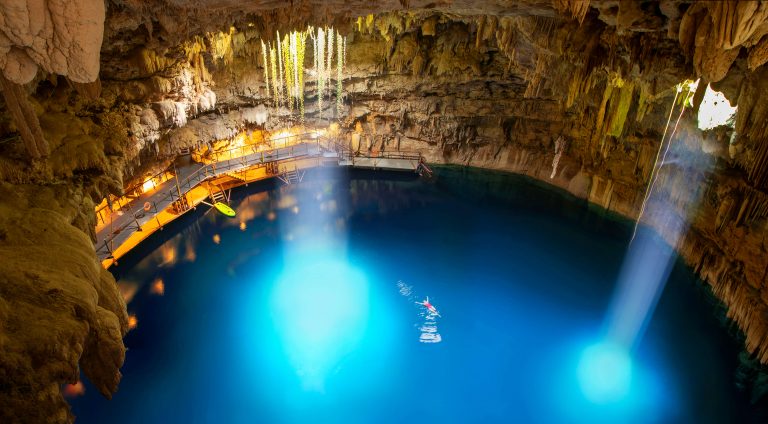
Cenote Chukum-Ha is a large semi-open cavern cenote east of Valladolid, reached along the road between Tikuch and Yalcobá. It has deep blue water, several openings in the limestone roof, developed swimming platforms, aquatic zip lines and places to jump into the pool.
This is one of the more organized cenote experiences around Valladolid. Parking, lockers and life jackets are included with admission, while a higher-priced ticket adds a regional buffet. The infrastructure makes Chukum-Ha straightforward for families, groups and first-time cenote visitors.
The trade-off is that it does not feel like a small village cenote. It costs more than many locally operated swimming holes, and the atmosphere can change quickly when a tour group arrives.
Visit near opening for a calmer swim. Visit closer to midday if you want a better chance of seeing the strongest shafts of sunlight entering the cavern.
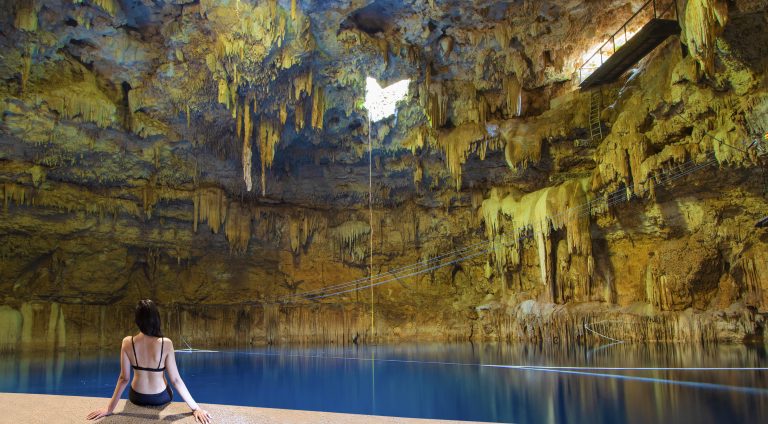 Wide view over the blue water and limestone chamber at Cenote Chukum-Ha
Cenote Chukum-Ha at a glance
| Detail | What to know |
|---|---|
| Location | Carretera Tikuch–Yalcobá, kilometre 3, east of Valladolid |
| Cenote type | Large semi-open cavern cenote |
| Published hours | 9:00 AM to 5:00 PM daily |
| Adult day pass | MXN 350 |
| Adult pass with buffet | MXN 550 |
| Child day pass | MXN 250 for children aged 5–10 |
| Child pass with buffet | MXN 350 for children aged 5–10 |
| Time needed | Around 1.5–2.5 hours |
| Best base | Valladolid |
| Best for | Swimming, adventure activities, families and photography |
| Less suitable for | Travelers seeking a quiet community cenote or a low-cost swim |
| Easiest transport | Rental car, private driver or pre-arranged taxi |
| Included with admission | Parking, life jacket and locker |
| Food | Regional buffet available with the full pass |
Prices and hours can change. Check the official Hacienda Chukum prices page before making a tightly timed journey.
Is Cenote Chukum-Ha worth visiting?
Chukum-Ha is worth visiting if you want a substantial underground swimming experience without giving up practical facilities.
The cavern is wide enough for a proper swim, rather than only a quick photograph. The zip lines and jumping platforms give older children and adventurous adults something to do beyond floating in the water. Lockers, parking and food make the visit easier to manage than at a small rural cenote.
Choose Chukum-Ha if you want:
- A large cavern with deep blue water
- Zip lines and marked jumping points
- Lockers and life jackets included
- Easy parking
- Food available on site
- A comfortable first cenote experience
- A stop that fits into a Valladolid or Chichén Itzá route
You may prefer another cenote if you want:
- A quiet community-run experience
- Minimal commercial development
- A very cheap entrance fee
- Shallow water for small children
- A completely natural edge without platforms or railings
- An easy visit by public transport
The entrance price is higher than at many village cenotes. You are paying partly for the organized facilities and adventure activities, not only for access to the water.
Why is it called Chukum-Ha?
The cenote is commonly advertised as both Cenote Chukum and Cenote Chukum-Ha.
The official venue says it was named for the chukum trees growing around the property. Chukum is a native tree associated with Yucatán’s dry forest, and its bark has traditionally been used to create the warm earth-toned finish seen on walls, pools and modern Yucatecan architecture.
The cenote itself sits beneath a broad limestone vault. Several natural openings allow sunlight, rainwater and hanging vegetation to enter the chamber.
What is the cenote like?
Chukum-Ha is a cavern cenote with a roof that remains mostly intact. Small openings in the ceiling produce narrow columns of light, while developed walkways follow part of the limestone wall above the water.
The venue describes the chamber as approximately 40 metres across. It feels spacious once you reach water level, particularly when compared with smaller enclosed cenotes around Valladolid.
The water is deep. There is no sandy beach, gradual shoreline or conventional shallow children’s section. Entry is from the constructed platforms, ladders and permitted adventure points.
Artificial lighting illuminates parts of the rock, but much of the cavern remains dark. This contrast between the amber limestone, blue water and overhead light is what gives Chukum-Ha its strong visual character.
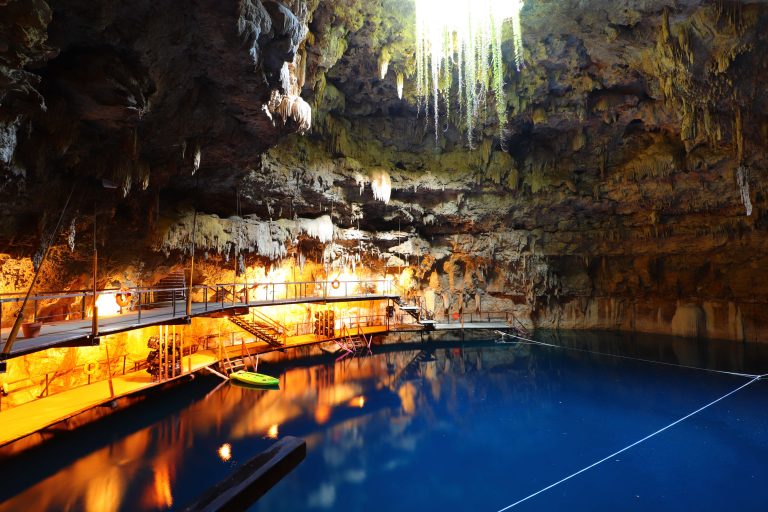 Developed walkway and swimming area inside the Chukum-Ha cavern
Swimming at Cenote Chukum-Ha
Chukum-Ha is a good choice for travelers who actually want to swim.
The pool is broad enough to move away from the entrance platform, although ropes and activity equipment may divide parts of the water. The cavern can feel considerably darker once you swim beyond the brightest roof openings.
Life jackets are included with admission. Follow the rules given by staff even if you are a confident swimmer. The water is deep, and freshwater does not support the body as strongly as seawater.
Before entering:
- Shower when instructed
- Remove sunscreen, insect repellent and body oils
- Secure valuables in a locker
- Check which platforms are currently open
- Follow the lifeguard’s directions
- Use a life jacket when required
Do not jump from unmarked rocks or railings. Water depth alone does not make an improvised jump safe.
GuideCenote Hool Kosom Guide: Swimming, Prices and the Homún Cenote RouteA practical guide to Cenote Hool Kosom near Mérida, including swimming, current price guidance, opening hours, transport and nearby Homún cenotes.Open
Zip lines and jumping platforms
Chukum-Ha is designed as an adventure cenote rather than only a quiet swimming pool.
Activities commonly include:
- Aquatic zip lines crossing part of the cavern
- Jumping platforms at different heights
- Ladder or step access for visitors who do not want to jump
- Ropes in the water for resting
Availability can depend on water level, maintenance and current safety conditions. Check with staff before assuming every activity will operate during your visit.
The lower entry points are usually enough for cautious visitors. There is no need to use the highest platform to enjoy the cenote.
Water shoes can help on the wet walkways, although staff may have specific rules about footwear around the pool.
The light beams and photography
Narrow shafts of sunlight can enter through openings in the roof and illuminate sections of the water.
The strongest light is generally more likely around the middle of a bright day, when the sun is high. The exact position and intensity depend on:
- The season
- Cloud cover
- Water level
- Time of day
- The angle of the sun
- Conditions inside the cavern
Do not build your entire visit around reproducing one photograph. The beams may be weaker, in a different position or briefly obscured by clouds.
For photography:
- Arrive late morning or around midday for stronger overhead light
- Arrive near opening for fewer people in the frame
- Use a waterproof case with a secure wrist strap
- Avoid blocking ladders or activity areas
- Keep flashes and bright lights away from other swimmers
- Do not climb formations for a better angle
The contrast between dark rock and bright water can be difficult for phone cameras. Lowering exposure slightly can preserve more detail in the illuminated areas.
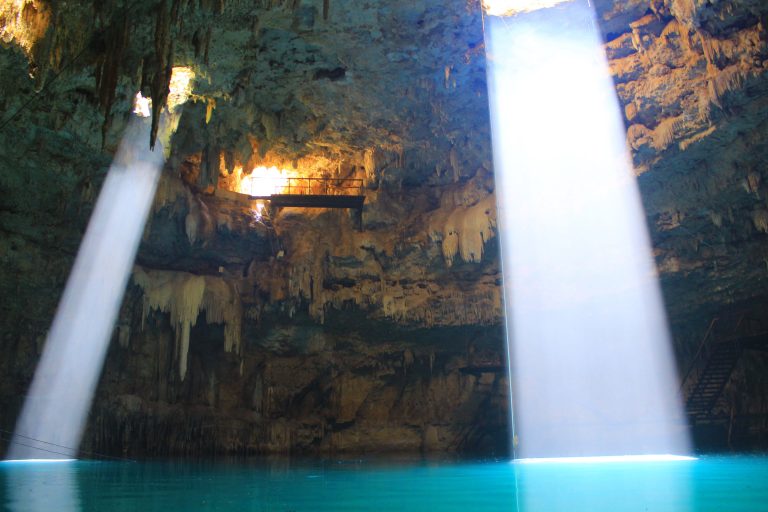 Columns of sunlight entering the water at Cenote Chukum-Ha
Current ticket prices
The official published prices for Cenote Chukum-Ha are:
Day pass
- Adults: MXN 350
- Children aged 5–10: MXN 250
The day pass includes:
- Cenote access
- Parking
- Life jacket
- Locker
Full pass with buffet
- Adults: MXN 550
- Children aged 5–10: MXN 350
The full pass includes:
- Cenote access
- Parking
- Life jacket
- Locker
- Regional buffet
The official price page does not clearly publish the current policy for children under five. Ask the venue directly before visiting with a toddler.
Bring Mexican pesos even if you expect to pay by card. Mobile signal and card terminals outside Valladolid can be inconsistent, and cash remains useful for drinks, tips or purchases at the gift shop.
Towels are not listed among the included items, so bring your own unless the venue confirms a rental service.
Is the buffet worth adding?
The buffet is mainly a convenience.
It allows you to swim, change and eat without driving back into Valladolid. That can be useful for families, groups and travelers continuing through eastern Yucatán.
The full pass costs MXN 200 more than basic adult admission. Whether it represents good value depends on how much you want to eat and where the rest of your day is taking you.
Choose the buffet when:
- You want a simple lunch without another stop
- You are traveling with children
- Your group has different food preferences
- You are continuing toward another attraction
- Convenience matters more than finding a particular restaurant
Skip it when:
- You want to eat in Valladolid
- Regional food is an important part of your day
- You only want a short swim
- You are visiting outside your normal meal time
- Someone in your group has dietary requirements that need careful checking
Ask about vegetarian dishes and allergies before purchasing the full pass.
Best time to visit
For fewer people
Arrive between 9:00 AM and 10:00 AM.
The water and cavern will be cooler, but you have a better chance of swimming before larger groups arrive.
For the strongest sunlight
Visit between late morning and early afternoon on a clear day.
This is normally the better period for visible overhead beams, but it can also be the busiest part of the day.
For a later, quieter visit
An arrival around 3:00 PM can work well on an ordinary weekday.
Do not leave it too late. You need time to pay, change, shower, descend, swim and return to the surface before the venue closes at 5:00 PM.
Weekdays are generally easier than Sundays, Mexican public holidays and school holiday periods.
How long should you spend there?
Allow around 1.5 to 2 hours for admission, changing and a comfortable swim.
Allow 2.5 to 3 hours if you are:
- Eating at the buffet
- Traveling with children
- Using the zip lines repeatedly
- Taking underwater photographs
- Visiting with a larger group
- Changing slowly before continuing elsewhere
Chukum-Ha does not normally require half a day. It works best as one part of a broader route around Valladolid.
Facilities
Chukum-Ha is more developed than many rural cenotes.
The complex is set up with:
- Parking
- Ticket area
- Lockers
- Life jackets
- Toilets
- Changing and washing areas
- Restaurant
- Gift shop
- Developed stairs and walkways
- Staffed activity areas
Keep phones, car keys, passports and wallets inside a locker rather than leaving them with clothing beside the water.
The developed facilities are a strength for families and first-time visitors. Travelers looking for a more rustic or locally managed swimming hole may find the complex overly organized.
How to get to Cenote Chukum-Ha
The cenote is on the Tikuch–Yalcobá road at kilometre 3, east of Valladolid.
Use the current map pin rather than relying only on the written address. Rural road signs can be easy to miss, particularly when approaching from a side road.
From Valladolid
Allow approximately 20 to 25 minutes by car from central Valladolid.
A rental car is the simplest option. A pre-arranged taxi also works, but settle the return plan before the driver leaves.
Ask the taxi driver to quote for:
- A one-way journey
- Waiting during the visit
- A fixed return pickup
- A combined Chukum-Ha and Valladolid-area route
Do not assume an app-based car or another taxi will be waiting at the entrance.
Public transport toward Yalcobá may be able to leave you near the access road, but schedules and return transport are less predictable. Ask locally where the current colectivo departs and tell the driver you are going to Hacienda Chukum.
This is possible for flexible travelers, but it is not the easiest cenote near Valladolid without private transport.
Read our Valladolid travel guide for help choosing where to stay and how to organize nearby day trips.
GuideBest Day Tours from Valladolid: Ruins, Cenotes, Wildlife, and Small TownsCompare the most useful day trips from Valladolid, including Chichén Itzá, Ek Balam, cenotes, Río Lagartos, Las Coloradas, Izamal, and smaller Yucatán towns.Open
From Mérida
Allow roughly 2 hours 15 minutes to 2 hours 45 minutes by car, depending on your route, traffic and starting point.
Chukum-Ha is too far from Mérida for a standalone swim. Combine it with:
- Chichén Itzá
- Valladolid
- An overnight stay in Valladolid
- Another carefully selected eastern Yucatán stop
A private driver makes sense for families and groups that do not want to manage the long return drive.
Do not combine Chichén Itzá, several cenotes, Valladolid, Ek Balam and a return to Mérida in one supposedly relaxed day. It may fit into a tour schedule, but most of the day will be spent moving or watching the clock.
GuideThe Best Yucatán Road Trip Ideas: 4 Incredible Day Routes from MéridaThe article presents four full‑day road‑trip routes that all start and finish in Mérida, each combining Maya ruins, cenotes, beaches, towns or haciendas. The classic route (Uxmal + Ruta Puuc + cenote + hacienda) involves about 3.5 hours of driving between 08:00 and 19:00. Stops are Hacienda Yaxcopoil (09:00‑10:00), Uxmal archaeological zone (10:30‑13:00), a lunch break at The Lodge at Uxmal or The Pickled Onion (13:15‑14:15), an optional visit to Kabah or Labná (14:30‑15:30), and swimming at Cenote Kankirixché (16:00‑17:30) before returning to Mérida (18:30‑19:00). The wildlife‑and‑coast itinerary runs from 08:00 to 18:30 with roughly 2.5 hours of driving. It includes a boat tour of Celestún’s flamingo colonies and mangroves (09:00‑11:00), beach lunch (11:15‑13:00), a short mangrove boardwalk (13:15‑14:00) and an optional cenote stop at Cuzamá, Chaksinkín or San Antonio Mulix (15:00‑17:00). The magical‑towns route (07:00‑21:00, about 4 hours driving) covers a morning walk in Valladolid (09:30‑12:00), a cenote visit at Ik Kil or Saamal (12:00‑13:30), and an afternoon in the Yellow City of Izamal (15:30‑18:00) before heading back. The off‑the‑beaten‑path trip (08:30‑18:30, ~3 hours driving) visits two Tecoh cenotes (09:00‑11:30), the working Hacienda Sotuta de Peón (12:00‑15:00) and the quieter Hacienda San Antonio Millet (15:30‑16:30). All itineraries assume a private or rented car; some cenotes require cash (100‑250 MXN) and rural roads can be rough, so an SUV is advisable. Lunches are at local restaurants, and most stops include self‑guided exploration; the Sotuta de Peón hacienda adds a guided truck ride, fiber‑processing demos and a private cenote swim. Visitors should start early to avoid heat, carry reef‑safe sunscreen, swimwear, water and snacks, and verify opening hours for archaeological sites before departing.Open
From Chichén Itzá
Allow approximately one hour, depending on traffic through Valladolid and the route taken.
A sensible day is:
- Visit Chichén Itzá early
- Drive east toward Valladolid
- Continue to Chukum-Ha for swimming and lunch
- Spend the late afternoon and evening in Valladolid
This order places the ruins before the strongest heat and the cenote near the warmest part of the day.
Read our Chichén Itzá opening hours and ticket guide before planning the morning.
GuideBest Chichén Itzá Tours from Cancún: How to Choose the Right Day TripCompare the main Chichén Itzá tour options from Cancún, including group tours, private drivers, direct buses, early arrivals, cenote stops, Valladolid, inclusions, drawbacks, and practical planning advice.Open
From Cancún, Playa del Carmen or Tulum
Chukum-Ha can be visited from the Caribbean coast, but expect a long day.
A rental car, private driver or organized tour is more practical than trying to connect several public transport services.
Remember that Yucatán and Quintana Roo use different clock times. Valladolid and Chukum-Ha are one hour behind Cancún, Playa del Carmen and Tulum. Check which time zone your tour or booking uses.
A coast-based excursion makes sense when transport, ruins, lunch and a cenote are included in one booking.
It is less appealing if you dislike:
- Very early hotel pickups
- Long van journeys
- Multiple pickup stops
- Timed swimming sessions
- Returning after dark
Staying in Valladolid for one or two nights produces a calmer visit.
Do you need a tour?
You do not need a guide inside Cenote Chukum-Ha.
Visit independently when you have:
- A rental car
- A pre-arranged taxi
- A private driver
- A Valladolid base
- A clear route and enough time
Choose a tour when you:
- Are staying on the Riviera Maya
- Do not want to drive
- Want Chichén Itzá and a cenote in one package
- Prefer transport and lunch to be handled
- Are comfortable following a fixed schedule
A private driver offers more control than a shared tour. It is often the better choice for families, small groups and travelers who want to arrive before or after the main tour period.
Our getting around Yucatán guide compares rental cars, taxis, tours and private drivers.
Is Cenote Chukum-Ha good for families?
Chukum-Ha can work well for families because it has parking, lockers, life jackets, toilets, food and staff on site.
It is best suited to children who:
- Are comfortable in deep water
- Will wear a life jacket
- Can follow safety instructions
- Can manage wet stairs and platforms
- Will not run near the water
- Are comfortable inside a dark cavern
Parents should know:
- There is no shallow beach entrance
- The water is deep
- Platforms can become slippery
- Zip lines and jumps require supervision
- A life jacket does not replace close attention
- The cavern can become noisy when groups arrive
Small children who do not enjoy cool water, caves or life jackets may get less from the visit.
Bring a dry change of clothes and a small plastic or waterproof bag for wet swimwear.
Accessibility
The surface complex is developed, but reaching the cenote and water involves stairs, damp surfaces and constructed platforms inside a cavern.
Chukum-Ha is not a straightforward swimming stop for someone who cannot manage stairs independently.
Contact the venue before visiting with:
- A wheelchair user
- Someone with limited balance
- An older traveler who struggles with steps
- A visitor recovering from injury
- Anyone who needs handrail or seating information
Do not assume that accessible parking means the cenote pool itself can be reached without stairs.
What to bring
Bring:
- Swimsuit
- Towel
- Dry clothes
- Water shoes or sandals with good grip
- Mexican pesos
- Refillable water bottle
- Waterproof phone pouch
- Small bag for wet clothing
- Any necessary medication
Leave unnecessary valuables at your accommodation.
Apply sunscreen and insect repellent after swimming rather than immediately before entering the water. Shower thoroughly when asked so oils and chemicals do not enter the groundwater.
What to combine with Chukum-Ha
Valladolid
Valladolid is the most natural combination.
You can visit the cenote in the morning and return for lunch, museums, the Calzada de los Frailes and an evening walk around the centre.
Alternatively, spend the morning in Valladolid and visit Chukum-Ha closer to midday for stronger overhead light.
GuideValladolid Travel Guide: What to Do, Where to Stay and How to Plan Your TripValladolid is a small colonial town in eastern Yucatán, roughly halfway between Mérida and Cancún and within an hour’s drive of Chichén Itzá and Ek Balam. The guide suggests staying two nights for most itineraries, with three nights better for families or those who want to visit several cenotes or make day trips to Río Lagartos, Las Coloradas or Cobá. Getting there is easy by rental car, ADO bus, Tren Maya or private driver; the bus station is central, while the train station lies outside the historic centre and requires a taxi or shuttle. Within the town the historic centre, Calzada de los Frailes and the main square are all walkable, but a car, taxi, colectivo, bicycle or scooter is needed for most cenotes and ruins. Typical activities include a morning walk around the main square, visiting Iglesia de San Servacio and the municipal palace, strolling the colourful Calzada de los Frailes, and touring the Convent of San Bernardino de Siena. Cenote Zací, just outside the centre, offers a convenient swim; the local market provides cheap breakfast and snacks. Visitors should plan to start early at ruins and cenotes to avoid the heat, bring cash in small bills, wear grip sandals for cenote water, and respect church dress codes. In the hotter months (April‑May) a hotel with a pool is advisable, and the most comfortable weather is from November to March.Open
Chichén Itzá
Chichén Itzá and Chukum-Ha make a full but logical route when you are traveling from Mérida or staying overnight in Valladolid.
Start at the ruins early, swim around midday and finish in Valladolid rather than driving straight back after a long day.
GuideComplete Guide to Chichén Itzá: Tickets, Hours, Tours, Cenotes & TipsChichén Itzá is the world‑famous Maya archaeological zone located near Pisté in the municipality of Tinum, Yucatán, and is typically accessed from Valladolid, Mérida, Cancún, Playa del Carmen or Tulum. The site is generally open daily from 08:00 to 16:00 with the last entry recorded at 15:00, although visitors should verify the exact hours before travelling. Admission is split between a federal INAH fee of MXN 105 and a state fee of MXN 592 for foreign adults (MXN 697 total) or MXN 205 for Mexican nationals (MXN 310 total); discounts may apply for children, students, seniors or Yucatán residents who present valid ID. Reaching the ruins takes about 40–45 minutes from Valladolid, 1.5–2 hours from Mérida, and 2.5–3 hours from Cancún or Playa del Carmen; travel can be done by rental car, taxi, colectivo or organized tour, with tours often including the entrance fee. A visit usually requires 2.5–4 hours for a quick overview, or 4–5 hours if the on‑site museum and a more relaxed pace are desired. Visitors are advised to arrive at opening to avoid the heat, crowds and vendor pressure that build up later in the morning. Early arrival provides cooler weather, better lighting for photos and shorter queues at El Castillo and the Sacred Cenote. Bring plenty of water, sun protection and cash in pesos; many tours bundle transport, guide services and cenote stops, so check the inclusions carefully. Staying overnight in Valladolid or Pisté makes an early start easier, while a guide is not mandatory but recommended for first‑time visitors who want contextual information.OpenCenote Suytun
Suytun is also east of Valladolid and can be combined geographically with Chukum-Ha.
The two cenotes offer different experiences:
- Suytun: Better known for its stone platform and staged light-beam photograph
- Chukum-Ha: Better for swimming, jumping and adventure activities
Visiting both can work for cenote-focused travelers. For most people, one developed cavern cenote followed by Valladolid will create a more varied day.
Read our Cenote Suytun guide before choosing.
GuideCenote Suytun Guide: How to Visit from Valladolid, Best Time for Photos & Practical TipsCenote Suytun is a photographed cenote east of Valladolid on the road toward Ticuch, best reached from Valladolid Centro in about a 10–15 minute drive. It is open daily from morning until late afternoon, with the last entry before closing; visitors should verify the exact schedule, especially during holidays or private events. Entrance is paid in pesos, and ticket options may include basic entry, food packages, day passes or guided add‑ons, so bring enough cash for a higher‑than‑average fee. The site is accessed by stairs and wet stone surfaces, making it unsuitable for those with mobility concerns. A typical visit lasts 45 minutes to 1.5 hours, enough for the iconic photo, a brief swim and a quick look around. Arriving early gives cooler weather, fewer people and a calmer experience, while late morning to early afternoon improves the chance of the famous light‑beam but brings larger crowds. The circular platform that frames the photo can be partially or fully submerged depending on water level, so recent visitor photos are worth checking. Swimming is allowed but the cenote is not ideal for a long, quiet dip; life jackets may be required. Bring a swimsuit, towel, grip sandals, a dry bag, water and cash, and avoid applying sunscreen or lotion before entering. Families should keep children close, move slowly on the steps and limit the visit if the goal is a quick photo rather than an extended swim. Combining Suytun with a walk or lunch in Valladolid, or with nearby cenotes such as Zací, Xkeken or Samulá, makes for an easy half‑day itinerary.Open
Other Valladolid cenotes
Chukum-Ha is only one of many options around the city.
Choose:
- Chukum-Ha for adventure activities and organized facilities
- Suytun for the famous platform photograph
- Zací for easy access from central Valladolid
- Samulá or Xkekén for classic underground caverns near Dzitnup
- Oxmán for a more relaxed hacienda stop
- X’Canché for a community-based cenote beside Ek Balam
Our Valladolid cenotes guide compares the main options by cost, transport, swimming and atmosphere.
Suggested Chichén Itzá and Chukum-Ha itinerary
A comfortable route ending in Valladolid:
- 7:30 AM: Leave Valladolid or the Chichén Itzá area
- 8:00 AM to 10:30 AM: Visit Chichén Itzá
- 10:30 AM: Drive toward Chukum-Ha
- 11:30 AM to 1:30 PM: Swim and use the adventure activities
- 1:30 PM to 2:30 PM: Buffet lunch or continue into Valladolid
- 3:00 PM onward: Explore Valladolid
- Evening: Dinner and overnight stay in town
From Mérida, add the journey to Chichén Itzá at the beginning and expect a long day.
Avoid adding Ek Balam unless you are comfortable with a very compressed itinerary.
Common mistakes to avoid
Do not arrive at midday expecting the cenote to be empty. This is also the most attractive period for light and tour itineraries.
Do not assume the light beams are guaranteed. Clouds and season affect them.
Do not rely on an old entrance price. The official published prices are higher than many older blogs and videos suggest.
Do not leave your taxi return unarranged.
Do not expect shallow water for young children.
Do not enter with sunscreen, repellent or body oil still on your skin.
Do not attempt jumps from unmarked areas.
Do not overload the day with Chichén Itzá, Ek Balam, several cenotes and a rushed walk around Valladolid.
Planning help
Chukum-Ha is straightforward when you have a car or driver and are already spending time around Valladolid. It is less convenient as an isolated public-transport trip.
For quick questions about timing, transport or choosing between Chukum-Ha and another Valladolid cenote, use the free Yucatán Guide WhatsApp assistant.
For the next step, use the Plan hub to compare itineraries, transport and practical resources already available.
Frequently asked questions
Is Cenote Chukum-Ha open every day?
The venue currently publishes opening hours of 9:00 AM to 5:00 PM every day. Confirm before traveling during holidays, severe weather or maintenance periods.
How much does Cenote Chukum-Ha cost?
The published adult day pass is MXN 350. The adult pass including the regional buffet is MXN 550.
Children aged 5–10 currently pay MXN 250 for the day pass or MXN 350 with the buffet.
What is included in the ticket?
The basic ticket includes cenote access, parking, a life jacket and a locker. The full ticket also includes the regional buffet.
Can you swim at Cenote Chukum-Ha?
Yes. Chukum-Ha has a large developed swimming area inside the cavern.
Are there zip lines?
The venue is known for aquatic zip lines and jumping platforms. Individual activities can close temporarily for maintenance or safety reasons.
Is Chukum-Ha suitable for children?
It can be suitable for closely supervised children who are comfortable with deep water, stairs and life jackets. There is no shallow beach entrance.
How far is Chukum-Ha from Valladolid?
The cenote is approximately 15 kilometres from Valladolid. Allow around 20–25 minutes by car from the centre.
Can you visit without a car?
It may be possible to take transport toward Yalcobá and ask to be left near the entrance, but the return is less reliable. A pre-arranged taxi, rental car or private driver is easier.
Is there food at Chukum-Ha?
Yes. A regional buffet is included with the higher-priced full pass.
Is Chukum-Ha better than Suytun?
Choose Chukum-Ha for swimming, zip lines and jumping. Choose Suytun if the circular platform photograph is your main priority.
Final advice
Visit early if you want fewer people. Visit closer to midday if you want a better chance of seeing strong shafts of sunlight inside the cavern.
Bring a towel, pesos and dry clothes. Arrange your transport back before entering, particularly if you are coming by taxi.
Chukum-Ha works best as part of a Valladolid stay or a route that begins at Chichén Itzá and ends in town. It is a developed and comparatively expensive cenote, but the large cavern, included facilities and adventure activities make it a practical choice for families and travelers who want more than a brief swim.
Image credits
Cenote and cavern images: Hacienda Chukum official gallery.