Printable guide
Cenote Sac Aua Guide: The Island Cenote Near Valladolid
Updated
Practical guide to Cenote Sac Aua near Valladolid, including current visitor prices, opening hours, swimming conditions, transport and Ek Balam itinerary advice.
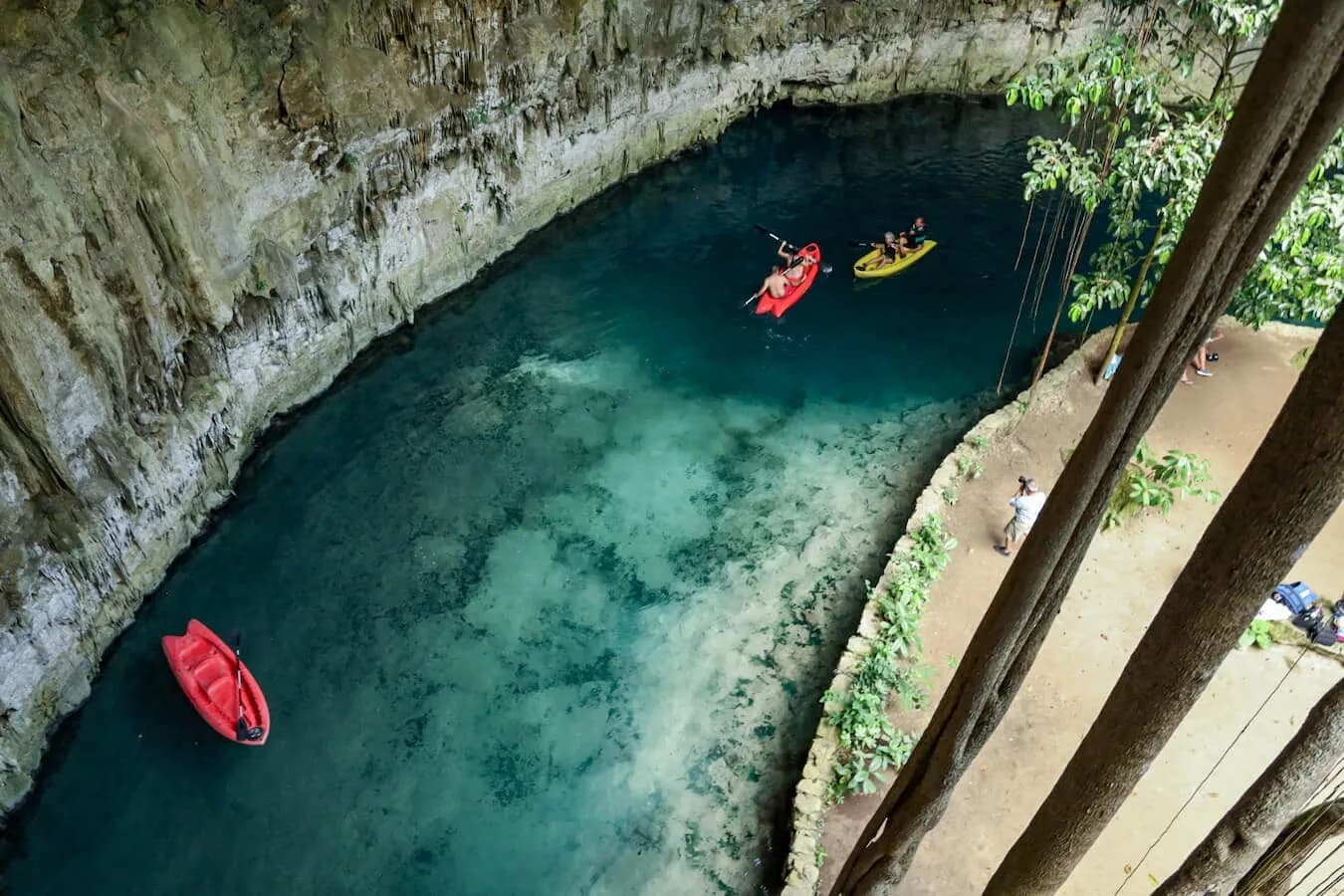
Cenote Sac Aua is a semi-open cenote near the small community of Dzalbay, around 30 kilometres northeast of Valladolid. Its unusual feature is the natural island in the middle: the water forms a broad ring around a mound of collapsed limestone where trees, roots and other vegetation now grow.
It is one of the more visually distinctive cenotes around Valladolid, but it remains far enough from the main Chichén Itzá circuit to avoid some of the large-tour atmosphere found elsewhere.
Sac Aua is worth considering for confident swimmers, photographers and travelers combining a cenote with Ek Balam. It is less suitable for anyone with limited mobility, very little time or no plan for the return journey.
A rental car, experienced scooter rider or pre-arranged driver makes the visit much easier.
Cenote Sac Aua at a glance
| Detail | What to expect |
|---|---|
| Location | Dzalbay, northeast of Valladolid |
| From Valladolid | Around 30–40 minutes by car |
| From Ek Balam | Roughly 25–35 minutes, depending on the route |
| From Mérida | Approximately 2 hours 15 minutes to 2 hours 30 minutes |
| Cenote type | Semi-open cenote with a central island |
| Water | Deep freshwater swimming area |
| Current reported entry | Around MXN 280 for cenote-only admission |
| Opening hours | Official profile currently lists 8:00 AM–4:40 PM |
| Life jackets | Available; follow the rule given by staff |
| Other activities | Guided cavern visit, kayaking and occasional adventure activities |
| Facilities | Bathrooms, changing areas, showers, rest areas and parking |
| Payment | Bring cash in pesos; transfers may be accepted |
| Ideal visit length | 1.5–3 hours |
| Accessibility | Long stairs and uneven paths; not wheelchair accessible |
Prices, packages and closing times have changed several times. Contact the cenote before making a special journey, particularly if you want the cavern tour, kayaking, food or a children’s promotion.
The official Sac Aua social profile currently lists WhatsApp reservations on +52 985 113 5112.
Open Cenote Sac Aua in Google Maps
Is Cenote Sac Aua worth visiting?
Sac Aua is worth visiting when the shape and setting of the cenote matter more to you than finding the lowest possible entrance price.
The staircase descends toward the island rather than simply following the outer wall. From above, you can see the dark ring of water, exposed limestone and trees rising through the opening. The island gives the cenote a different atmosphere from the enclosed caverns and open pools found closer to Valladolid.
It is particularly worthwhile when:
- You are already visiting Ek Balam
- You have a rental car or arranged driver
- You want a quieter alternative to the main tour-bus cenotes
- You enjoy swimming in deep water
- You want a cenote with strong photography angles
- You are interested in adding the guided cavern visit
It may not be the right choice when:
- You are depending entirely on public transport
- You cannot comfortably manage long or steep stairs
- You want a shallow area for small children
- You only have an hour available
- You are looking for the cheapest cenote near Valladolid
- You would rather have polished resort-style facilities
Sac Aua is developed enough to provide basic visitor services, but it still feels more rural than places such as Suytun or the larger hacienda cenotes.
What makes the island unusual?
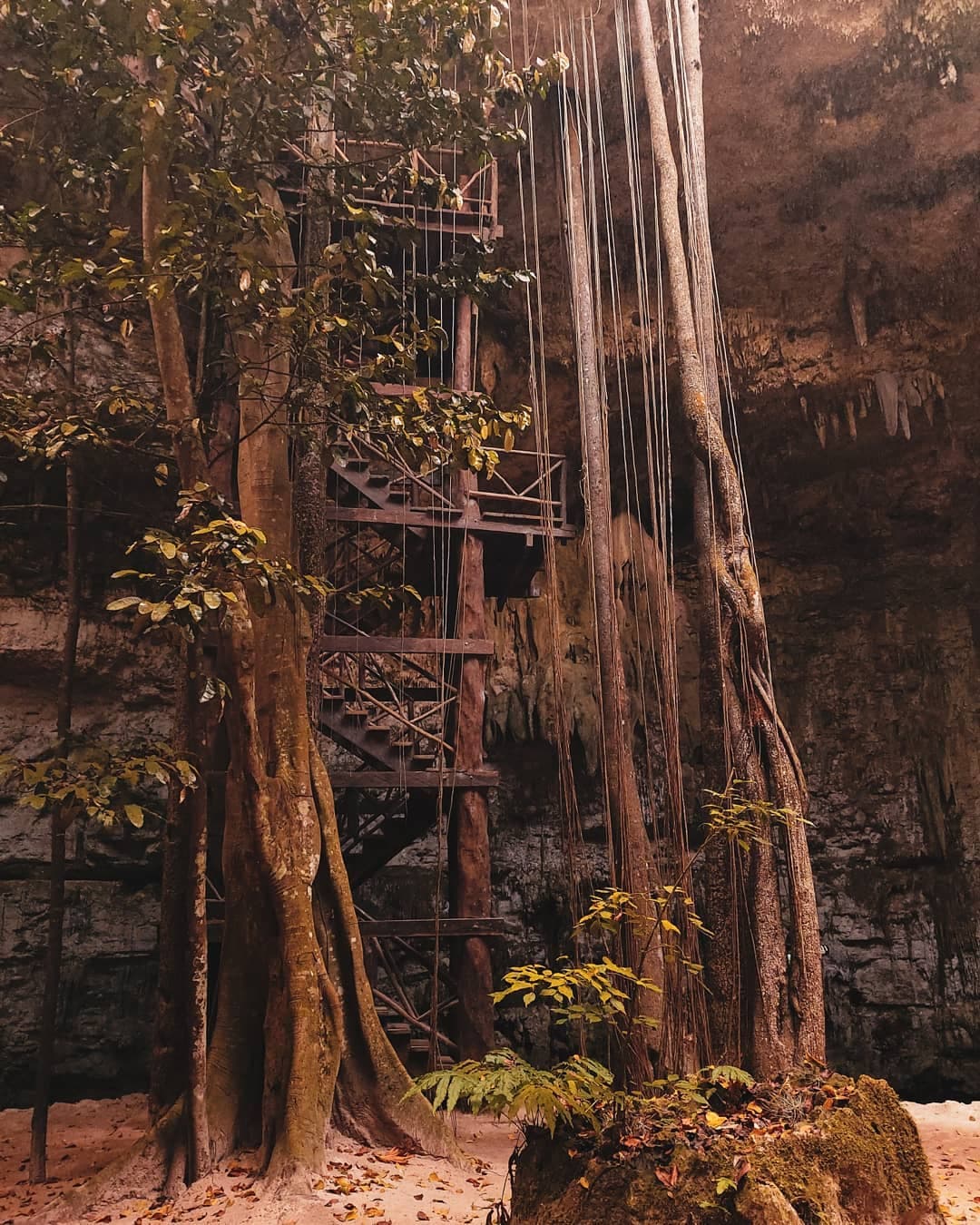 Wooden stairs descending toward the central island inside Cenote Sac Aua
The island is the remains of a section of limestone roof that collapsed into the centre of the cenote. Instead of leaving one completely open pool, the collapse created a raised mound surrounded by water.
Over time, soil and organic material collected on the mound. Trees and other plants became established, with roots extending through the rock and toward the water below.
The result is a ring-shaped swimming area. You can move around much of the island while looking back toward the staircase, limestone overhangs and hanging formations.
Sac Aua is sometimes promoted as the only cenote in Yucatán with an island. It is safer to describe it as the region’s best-known island cenote. Cenotes continue to be documented across the peninsula, and promotional claims are not the same as geological surveys.
What swimming at Sac Aua is like
The water around the island is deep. Published descriptions place different sections between roughly one and twelve metres, so it should not be treated like a shallow natural pool.
There are entry points from the island and a small jumping platform. Conditions and permitted jumping areas may change, so follow staff instructions rather than entering from an unmarked rock or ledge.
The water is cool throughout the year. It feels refreshing after Ek Balam or a hot drive through the interior, although children and people sensitive to cold may prefer several shorter swims.
Visibility can be good when the water is calm. Natural light enters through the opening above, but areas beneath the remaining roof are darker. The colour of the water changes according to the hour, cloud cover and number of swimmers.
Life jackets have sometimes been described as optional and sometimes included with entry. Use one if you are not a confident swimmer, are supervising children or plan to stay in the water for a long time.
Do not assume that clear water means easy swimming. There is no broad beach-style entrance, and the depth increases quickly.
The staircase and descent
Reaching the island involves a substantial wooden staircase.
The descent is part of the experience and provides some of the best views, but the return climb can feel demanding in humid weather. Take your time, use the handrails and keep both hands free where possible.
The surfaces near the water can become wet and slippery. Water shoes or sandals with secure straps are more useful than loose flip-flops.
People with knee problems, balance difficulties or limited stamina should assess the staircase from above before committing to the full descent.
Young children should remain beside an adult throughout the stairs and near the edge of the island.
Kayaking
Kayaks moving through the ring of water at Cenote Sac Aua
Kayaks are often available for moving around the cenote’s circular swimming area.
They are useful for visitors who want to see the darker sections beneath the rock without swimming the complete ring. They can also make the cenote easier to photograph from different angles.
Kayaking may cost extra even when admission has already been paid. Recent visitors have reported separate rental fees, while older packages sometimes included use of a kayak.
Ask what is included before paying. Do not assume the most expensive package automatically includes every activity.
The Aktun Maya cavern visit
Sac Aua also offers access to a nearby cavern commonly promoted as Aktun Maya.
The visit is normally guided and is separate from simply swimming in the cenote. Guides explain the formations and the cultural importance attached to caves and underground water in the region.
Tourism descriptions mention ceramic fragments, animal remains and signs of ceremonial activity. These should be interpreted through the guide rather than handled or approached independently.
The cavern tour can add value if you have not previously visited a dry cave in Yucatán. It also provides a cooler activity away from the midday sun.
The path may include sand, slopes, darkness and uneven limestone. Wear closed shoes or water shoes with grip rather than walking in barefoot.
Tours may be conducted primarily in Spanish. Ask about language availability when buying the ticket.
Sac Aua prices
Recent January 2026 visitor reports place cenote-only admission at around MXN 280 per adult.
Combination prices are less consistent. Promotions have included the cenote and cavern visit for only slightly more than basic admission, while larger packages may add food, kayaking or other activities.
A sensible working budget is:
| Expense | Suggested budget |
|---|---|
| Basic cenote admission | Around MXN 280 |
| Cenote and cavern package | Confirm locally |
| Kayak rental | Budget around MXN 100–150 |
| Meal and drink | Budget around MXN 150–300 |
| Driver or taxi | Agree before departure |
Treat these as planning figures rather than guaranteed rates.
Children’s discounts and free-child promotions appear periodically. Confirm the current age limits directly rather than relying on an old photograph or social-media post.
Bring enough cash for admission, activities, food and the return journey. Recent visitors have reported payment by cash or bank transfer, but card facilities should not be assumed.
Opening hours
Sac Aua’s official social profile currently lists operating hours of 8:00 AM to 4:40 PM.
Older tourism pages continue to show 9:00 AM–5:00 PM or 9:00 AM–6:00 PM. This is why it is worth checking directly before traveling.
Do not arrive shortly before closing. You need time to park, pay, walk through the site, change, shower and descend the stairs.
Try to arrive by:
- 8:30–10:00 AM for a quieter visit
- Before 2:30 PM if you want the cenote and cavern tour
- Before 3:00 PM if you are visiting only to swim
The final cavern tour or last water entry may finish before the published closing time.
GuideChichén Itzá Opening Hours and Tickets: 2026 Prices, Last Entry and TipsCurrent Chichén Itzá opening hours, 2026 ticket prices, last-entry time, parking costs, Sunday rules, night-show tickets, and practical advice for an easier visit.Open
Best time to visit
Go early if you want softer light, cooler weather and fewer visitors.
Late morning can also work well after an early visit to Ek Balam. The cenote becomes a useful place to cool down once the archaeological zone starts feeling hot.
Weekdays are usually calmer than weekends. Expect more visitors during Easter week, Mexican school holidays, summer weekends and the Christmas–New Year period.
Rain does not automatically ruin the visit. Part of the pool remains beneath the rock, although heavy rain can make paths and stairs more slippery.
For photographs, the contrast between the bright opening and darker cave can be difficult around midday. A phone with good exposure control or high-dynamic-range mode is usually more practical than carrying heavy camera equipment.
How long to spend
Allow at least 90 minutes for admission, changing and a proper swim.
Two hours is more comfortable if you want photographs, a kayak or time to rest on the island.
Allow up to three hours when adding the cavern tour and lunch.
Sac Aua is not a good 30-minute roadside stop. The walk, staircase and changing process take time even before entering the water.
How to get to Cenote Sac Aua
Sac Aua is outside Dzalbay, northeast of Valladolid. The final approach passes through rural roads and small communities.
Download the map area before leaving Valladolid. Mobile reception may become less reliable away from the main highway.
From Valladolid
The drive normally takes around 30–40 minutes.
A rental car is the simplest option. Leave Valladolid toward Temozón and the Ek Balam area, then follow navigation toward Dzalbay and Sac Aua.
Look for local signs as you enter the community. The final entrance is outside the main settlement and can be easy to pass if you are driving quickly.
Parking is available at the site.
From Ek Balam
Sac Aua works particularly well after Ek Balam.
Depending on the route and current road condition, allow approximately 25–35 minutes between the archaeological zone and the cenote.
Visit the ruins first. Ek Balam is exposed and becomes hotter as the morning progresses, while swimming makes more sense later.
Our Valladolid to Ek Balam guide covers transport and route planning for the archaeological zone.
From Mérida
Allow approximately 2 hours 15 minutes to 2 hours 30 minutes each way.
Sac Aua is too far from Mérida to justify as a single swimming stop. Combine it with Ek Balam, Valladolid or another cenote in the same area.
A rental car or private driver is strongly preferable. The public-transport connections would consume too much of the day.
From Cancún, Playa del Carmen or Tulum
Treat Sac Aua as part of a full interior Yucatán day rather than a quick cenote excursion.
The most sensible route is usually:
- Drive toward Valladolid
- Visit Ek Balam or Valladolid
- Continue to Sac Aua
- Return before dark or stay overnight in Valladolid
This is a long self-drive day from the Caribbean coast. A private driver is easier for families and groups, while an overnight stay removes the pressure to rush back.
Car, scooter, taxi or tour?
Rental car
A car is the best overall option.
It gives you control over your arrival time and makes it easy to combine Sac Aua with Ek Balam, Xcanahaltun or Valladolid. It also solves the problem of finding transport after swimming.
Keep valuables out of sight and do not leave passports, electronics or cash in the vehicle.
Scooter
An experienced rider can reach Sac Aua from Valladolid by scooter.
This can be economical for one or two people, but the route includes faster roads, rural turns and occasional heavy vehicles. Do not use the day as your first scooter lesson.
Wear a proper helmet, carry water and return before dark.
Taxi or private driver
A taxi can work, but agree on the entire journey before leaving Valladolid.
Confirm:
- Total price
- Waiting time
- Whether the driver will remain on site
- Additional charges for Ek Balam or another cenote
- The exact return time
- Whether payment must be in cash
Do not rely on finding a passing taxi outside Sac Aua.
A private driver is the easier option for families, older travelers and groups building a complete Ek Balam day.
Public transport
Public transport is possible in theory but inconvenient in practice.
Services toward small communities can be irregular, and the cenote entrance is not a major transport hub. Even when you reach Dzalbay, you may still need to walk or arrange a local ride.
This is not the best option if you have fixed plans later in the day.
Our getting around Yucatán guide explains the differences between rental cars, colectivos, taxis and private drivers.
Is Cenote Sac Aua good for families?
Sac Aua can work well for families with school-age children who are comfortable around deep water.
The central island provides somewhere to rest between swims, and life jackets are available. The unusual shape also makes the visit more interesting than simply entering a rectangular swimming area.
The main concerns are:
- Deep water
- A long staircase
- Wet and uneven surfaces
- Limited stroller access
- Cool water
- A jumping area
- The possibility of a long wait for unarranged transport
An adult should remain within reach of younger swimmers. Do not depend entirely on a life jacket or assume that staff are watching one particular child.
Families with toddlers may find a more developed cenote with easier paths and clearly controlled access less tiring.
Bring dry clothes and a warm layer for children who become cold quickly.
Accessibility and mobility
Sac Aua is not wheelchair accessible.
The route includes an outdoor path, a large wooden staircase and irregular ground on the central island. There is no lift or step-free route to the water.
People with reduced mobility may still be able to enjoy the upper area, restaurant or rest spaces, but they should contact the site before purchasing a full admission package.
Pregnant visitors should consider the heat, distance from medical services, stairs and slippery ground. There is no need to descend or swim in order to accompany a group to the upper facilities.
Facilities
Recent visitors describe the following facilities:
- Parking
- Bathrooms
- Changing areas
- Showers
- Life jackets
- Lockers or secure-storage options
- Hammocks and rest areas
- Food service
- Guided cavern visits
- Kayak rental
The operation remains smaller and more rural than the large cenote parks around Chichén Itzá.
Bring your own towel. Do not assume towels, waterproof phone cases or swimming equipment will be available for rent.
Lock away valuables rather than leaving phones, wallets and car keys unattended on the island.
Food at Sac Aua
Food packages and an on-site restaurant are often available.
The menu and opening arrangements can vary according to the day, visitor numbers and package purchased. Confirm whether your ticket includes a meal, drink or neither.
Eating on site is convenient when continuing through the rural cenote route. Travelers who want more restaurant choice may prefer lunch in Temozón or Valladolid.
Do not plan your entire day around a specific dish unless the kitchen has confirmed it in advance.
What to bring
Bring:
- Swimsuit
- Towel
- Water shoes or secure sandals
- Dry clothes
- Reusable water bottle
- Cash in pesos
- Waterproof phone pouch
- Small wet-clothing bag
- Hat for the upper paths
- Insect repellent for after swimming
- Offline map or downloaded directions
Avoid expensive jewellery and large bags.
Do not apply sunscreen, body oil, perfume or insect repellent immediately before entering the cenote. Shower thoroughly and follow staff instructions. Cenotes connect with Yucatán’s vulnerable groundwater system.
Our guide to visiting cenotes in Yucatán explains swimming rules, environmental care and what first-time visitors should expect.
What to combine with Cenote Sac Aua
Ek Balam
Ek Balam is the strongest pairing.
Visit the archaeological zone near opening time, before the exposed pathways become too hot. Continue to Sac Aua for a late-morning or early-afternoon swim.
This creates a full but manageable day from Valladolid.
GuideEk Balam Guide: Climbing the Acropolis and Swimming Cenote XcanchéA complete guide to visiting Ek Balam in Yucatán: climb the Acropolis for jungle views, see the preserved stucco carvings, and cool off in Cenote Xcanché. Includes entrance fees, transport from Valladolid, and practical tips.Open
Cenote Xcanahaltun
Xcanahaltun is one of the closest major cenotes to Sac Aua.
It offers a more enclosed cavern experience, contrasting with Sac Aua’s open centre and island. Visiting both makes sense for travelers specifically interested in cenotes.
Most people should allow a full day rather than rushing between them.
GuideCenote Xcanahaltun Guide: Cave Swimming Near ValladolidPractical guide to visiting Cenote Xcanahaltun near Valladolid, including current price guidance, opening hours, transport, swimming, facilities, accessibility and nearby cenote routes.Open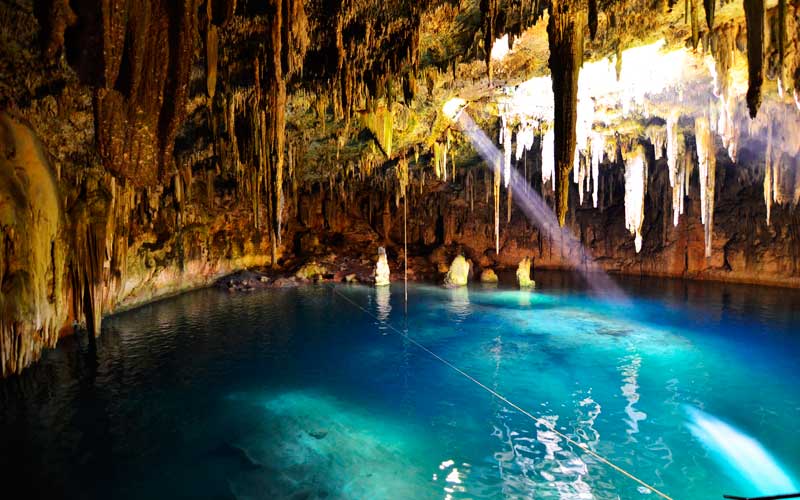
Cenote Palomitas and Agua Dulce
These cenotes are also in the wider Yalcobá and Dzalbay area.
Palomitas provides a much more enclosed underground setting. Read our Cenote Palomitas guide before deciding whether the two experiences are different enough for your day.
GuideCenote Palomitas Guide: Cave Swimming Near ValladolidCenote Palomitas is a closed‑cave cenote located near Yalcobá, just outside Valladolid, offering a deep blue pool beneath limestone walls and a managed entrance that eases access compared with more remote rural sites. The typical admission price is about 150 MXN per person and the site is usually open from 8:00 am to 5:00 pm, though visitors should confirm the exact ticket contents—whether it includes only Palomitas, a combined entry with Cenote Agua Dulce, life jackets, lockers, showers or kayak rental—because packages can vary. Cash in pesos is required; card payment should not be expected. Reaching the cenote is most convenient by rental car, scooter, private driver or an organized tour; the drive from Valladolid takes roughly 30 minutes, with a short unpaved stretch before the parking area. Public transport is possible but involves a colectivo toward Yalcobá followed by a local taxi or walk, making it less practical. A typical visit lasts 1 to 1.5 hours, longer if you combine Palomitas with Agua Dulce or another nearby cenote. Visitors should arrive early for cooler weather and fewer swimmers, bring swimwear, towels, water shoes, a dry bag and extra cash for optional services, and use a life jacket if not comfortable in deep water. The cave’s low light makes photography challenging; a phone or camera that handles low‑light conditions works best. Families can enjoy the site if children are confident swimmers and are closely supervised on wet steps and platforms. Combining Palomitas with nearby attractions such as Ek Balam, Sac Aua or Valladolid itself creates a relaxed half‑day or full‑day itinerary, but the cenote is not advisable for travelers with very limited time or without a transport plan.Open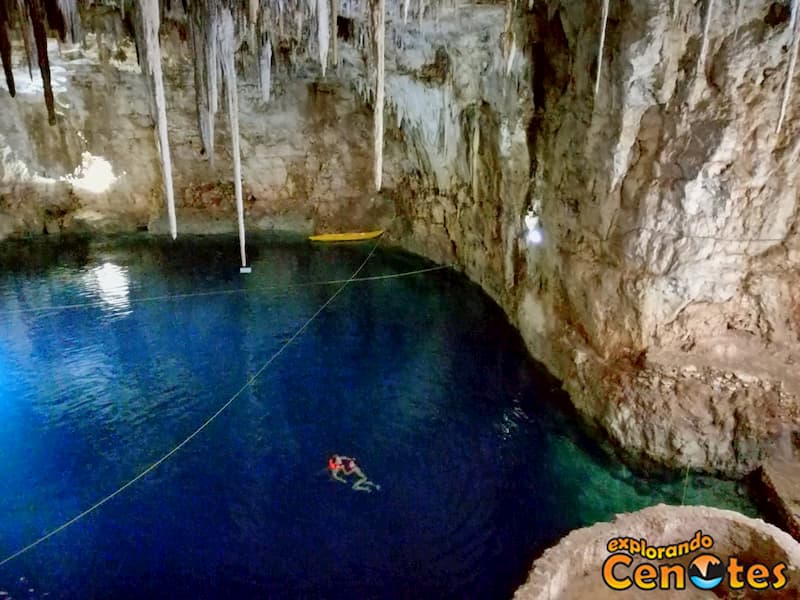
Valladolid
Valladolid is the most practical overnight base.
Return for dinner, spend the evening around the centre and avoid a long drive back toward Mérida or the Caribbean coast after swimming.
Our Valladolid travel guide covers hotels, food, parking and longer stays.
GuideValladolid Travel Guide: What to Do, Where to Stay and How to Plan Your TripValladolid is a small colonial town in eastern Yucatán, roughly halfway between Mérida and Cancún and within an hour’s drive of Chichén Itzá and Ek Balam. The guide suggests staying two nights for most itineraries, with three nights better for families or those who want to visit several cenotes or make day trips to Río Lagartos, Las Coloradas or Cobá. Getting there is easy by rental car, ADO bus, Tren Maya or private driver; the bus station is central, while the train station lies outside the historic centre and requires a taxi or shuttle. Within the town the historic centre, Calzada de los Frailes and the main square are all walkable, but a car, taxi, colectivo, bicycle or scooter is needed for most cenotes and ruins. Typical activities include a morning walk around the main square, visiting Iglesia de San Servacio and the municipal palace, strolling the colourful Calzada de los Frailes, and touring the Convent of San Bernardino de Siena. Cenote Zací, just outside the centre, offers a convenient swim; the local market provides cheap breakfast and snacks. Visitors should plan to start early at ruins and cenotes to avoid the heat, bring cash in small bills, wear grip sandals for cenote water, and respect church dress codes. In the hotter months (April‑May) a hotel with a pool is advisable, and the most comfortable weather is from November to March.Open
Suggested Ek Balam and Sac Aua itinerary
From Valladolid
- Leave Valladolid around 7:15–7:30 AM
- Reach Ek Balam close to opening
- Spend approximately 2–2.5 hours at the ruins
- Drive toward Sac Aua
- Arrive in the late morning
- Swim and add the cavern tour if available
- Eat locally or return through Temozón
- Reach Valladolid by mid-to-late afternoon
This is a balanced day with enough time for both places.
From Mérida
- Leave Mérida before 6:30 AM
- Visit Ek Balam in the morning
- Continue to Sac Aua around lunchtime
- Swim for 1.5–2 hours
- Stop briefly in Valladolid if energy allows
- Return to Mérida before dark
Adding multiple cenotes will make the day unnecessarily long.
Cenote-focused day from Valladolid
- Start at Sac Aua near opening time
- Continue to Xcanahaltun
- Have lunch in the area
- Add Palomitas only if the group still wants another swim
- Return to Valladolid before evening
Two cenotes are normally enough. The quality of the visit falls quickly when the day becomes a race to collect entrances.
Common mistakes
Relying on an old price: Admission and package rates have changed repeatedly.
Arriving near closing time: Changing, showering and reaching the water take longer than expected.
Assuming cards are accepted: Carry enough cash for the complete day.
Taking an unarranged taxi: Agree on the return before leaving Valladolid.
Underestimating the staircase: The descent is long and the climb back feels harder in humid weather.
Trying to visit four or five cenotes: Two contrasting cenotes produce a better day than several rushed stops.
Treating the legend as established history: Sac Aua is sometimes called the Cenote of the Maidens, but stories of sacrifices should be understood as local legend unless supported by archaeological evidence.
Entering with sunscreen or repellent: Shower first and protect the groundwater.
Leaving valuables beside the water: Use available storage and carry only what you need.
Frequently asked questions
Can you swim at Cenote Sac Aua?
Yes. Swimming is one of the main activities, and the water forms a ring around the central island.
How deep is Cenote Sac Aua?
Different sections have been described as ranging from shallow edges to approximately twelve metres. Treat the main swimming area as deep water.
Why does Cenote Sac Aua have an island?
A section of the limestone roof collapsed into the centre. The accumulated rock and soil formed a raised island where vegetation later became established.
How much does entry cost?
Recent January 2026 visitor reports place cenote-only admission at around MXN 280. Packages and promotions change, so confirm the current price directly.
What time does Sac Aua open?
The official social profile currently lists 8:00 AM–4:40 PM. Older tourism pages show different hours, making same-day confirmation advisable.
Do you need to reserve?
A reservation may not be necessary for basic entry, but contacting the cenote is sensible when you want a cavern tour, meal package or specific activity.
Are life jackets compulsory?
Life jackets are available, but past reports differ on whether they are compulsory. Follow the current rule given by staff.
Can you visit Sac Aua without a car?
It is possible, but difficult. A pre-arranged taxi or driver is more reliable than colectivos or trying to find transport after the visit.
Is Sac Aua close to Ek Balam?
Yes. The two work well together, although the exact drive depends on the rural route used.
Is Cenote Sac Aua suitable for young children?
It is better for children who can manage stairs and are comfortable in deep water. Toddlers require close supervision and may find the route tiring.
Is Sac Aua better than Suytun?
They provide different experiences.
Sac Aua has a natural island, more open water and a rural setting. Suytun has a fully enclosed photographic chamber, a constructed platform and a more organised visitor operation.
Choose Sac Aua for swimming and landscape. Choose Suytun when the famous interior view is the main priority.
The bottom line
Cenote Sac Aua is one of the more unusual swimming places around Valladolid.
The central island, ring of deep water and rural setting make it visually different from the enclosed caverns and polished visitor parks elsewhere in the region. It is especially worthwhile after Ek Balam or as part of a two-cenote route through Dzalbay and Yalcobá.
The drawbacks are practical rather than visual: changing prices, a long staircase, limited accessibility and awkward transport without a vehicle.
Go early, carry cash, confirm the current package by WhatsApp and arrange your return journey before entering. Allow at least 90 minutes, and do not try to force too many other stops into the same day.
For the next step, use the Plan hub to compare itineraries, transport and practical resources already available.