
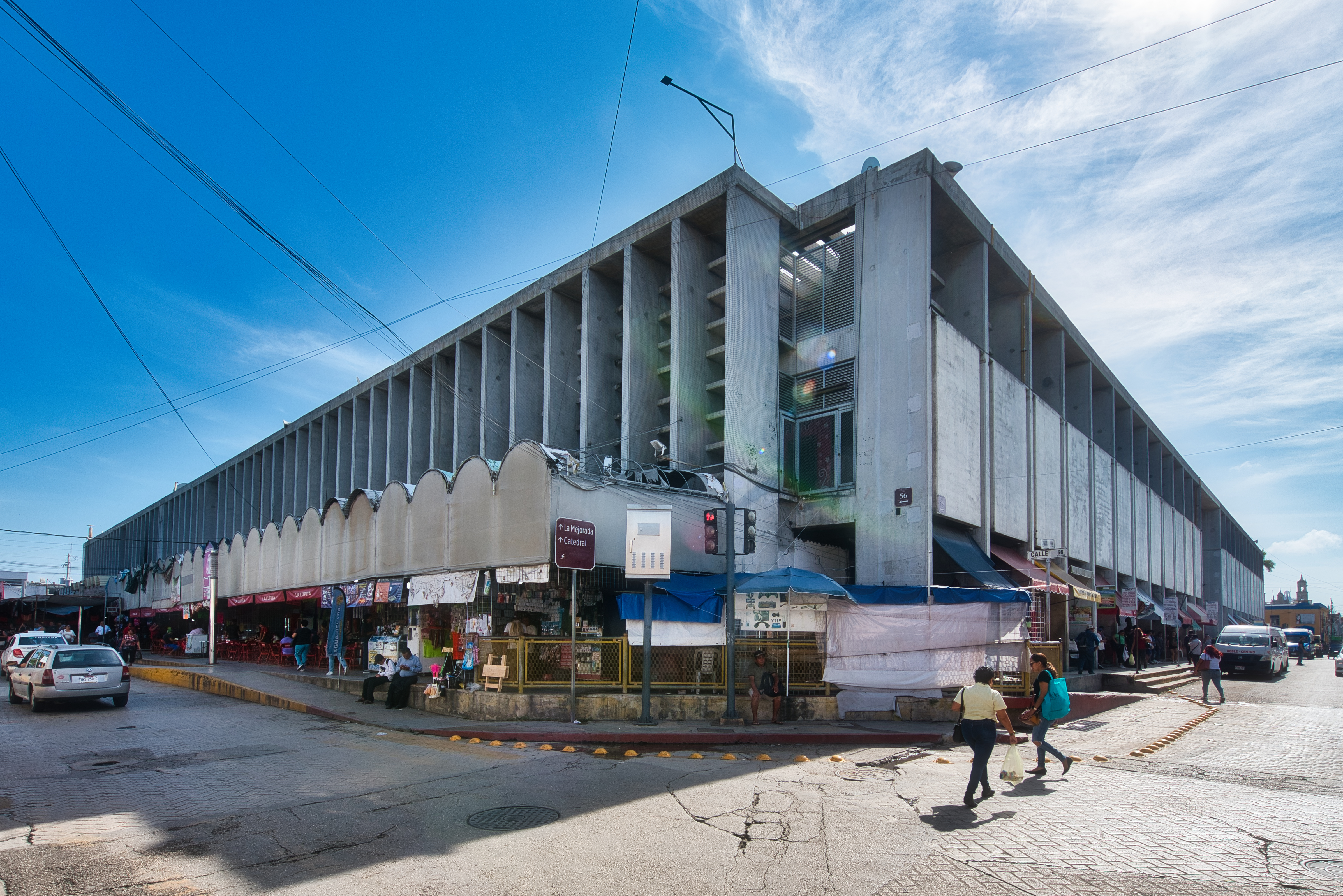
Mercado San Benito is one of the places to go in Mérida when you want the city in working mode rather than sightseeing mode.
The enormous concrete market stands beside the older Mercado Lucas de Gálvez in the southern part of Centro. Inside are produce sellers, butchers, spice stalls, small food counters, clothing, shoes, flowers, household goods and the sort of ordinary purchases that keep a city running.
For travelers, San Benito has one important advantage over its more famous neighbor: it is generally easier to understand.
Lucas de Gálvez feels like a market district that grew into a maze. San Benito was purpose-built as a large market building. The architecture is not particularly beautiful, and parts of the building have long been underused, but the main commercial areas feel broader and more structured.
If this is your first large Mexican market and Lucas feels intimidating, San Benito is a useful place to begin.
If you only have time for one market, however, Lucas de Gálvez remains the stronger all-round visitor experience. The better plan for travelers who enjoy markets is to allow enough time for both.
Mercado San Benito at a glance
| Detail | Practical answer |
|---|---|
| Location | Calle 54 s/n, Centro, Mérida |
| Best time | Roughly 7:30–11:00 AM |
| Current general opening window | Around 6:00 AM–7:00 PM daily; individual stalls keep their own hours |
| Entry | Free |
| Time needed | 45–90 minutes |
| With Lucas de Gálvez | Allow around 1.5–2.5 hours |
| Best for | Produce, ingredients, inexpensive food, everyday shopping and market atmosphere |
| Food | Best in the morning and around lunch |
| Payment | Bring pesos and small notes |
| Car needed | No |
| Parking | Parking is available beneath the market, but driving into this part of Centro can be awkward |
| Tour needed | No; useful only if you want food and cultural interpretation |
| Family-friendly | Possible, but avoid the busiest times and very large strollers |
| Main drawbacks | Heat, smells, raw-meat sections, noise and a busy surrounding street environment |
The published building hours should not be confused with the hours of every individual vendor. A produce seller, breakfast counter and clothing shop may all work different schedules.
For most visitors, morning is the dependable window.
Is Mercado San Benito worth visiting?
Yes, particularly if you are interested in food, ingredients or everyday Mérida.
San Benito is not a polished food hall. There are no carefully designed tasting counters, explanatory boards or visitor routes. It is primarily a municipal market where people come to shop.
That is the point.
You can see fresh herbs used in Yucatecan cooking beside piles of citrus and chiles, watch meat being portioned at traditional butcher counters, buy fruit for an apartment stay and then eat something inexpensive a few aisles away.
It is especially worthwhile for:
- Travelers interested in Yucatecan food
- People staying in an apartment or vacation rental
- Photographers comfortable working in busy public spaces
- Budget travelers
- Visitors who enjoy working markets
- Travelers who find Lucas de Gálvez too confusing
- Anyone buying ingredients for a cooking class or self-catering stay
San Benito is less suitable if you want air conditioning, quiet browsing, clearly marked tourist information or a curated souvenir market.
It can also be a difficult visit for anyone sensitive to exposed meat, poultry, strong market smells or crowded food environments.
If that sounds unpleasant rather than interesting, choose a smaller market such as Santiago or Santa Ana instead. Our guide to the best markets in Mérida compares the main options.
San Benito or Lucas de Gálvez?
The two markets sit beside one another but are not interchangeable.
Understanding the difference makes the area much easier to visit.
| Mercado San Benito | Mercado Lucas de Gálvez | |
|---|---|---|
| Character | Large purpose-built municipal market | Older, denser market complex |
| Layout | More structured | More labyrinthine |
| Crowds | Usually somewhat easier to handle | Generally busier |
| Architecture | Large modern concrete structure | Older working-market fabric |
| Produce and food | Very good | Very good |
| Everyday shopping | Excellent | Excellent |
| Visitor interest | Strong | Stronger overall |
| Best for first visit | Easier introduction | Fuller market experience |
| Time needed | 45–90 min | 60–120 min |
San Benito works particularly well for travelers who want to look at ingredients and move slowly without constantly wondering whether they have left one market and entered another.
Lucas is more interesting if you enjoy the disorder.
The sensible approach is not really to choose between them. Their proximity makes it easy to see San Benito first and then decide whether you still have the appetite for Lucas.
If you only want one, read our full Mercado Lucas de Gálvez guide before deciding.
Where is Mercado San Benito?
Mercado San Benito occupies a large block in Mérida Centro around Calles 54, 56, 67 and 69.
The municipal market administration lists its address as Calle 54 s/n, Centro, Mérida, Yucatán, 97000.
It sits immediately beside the larger Lucas de Gálvez market zone.
From the central Plaza Grande area, most reasonably fit visitors can walk there. The walk is not difficult, but this part of Centro becomes hotter and busier as the morning advances.
If you are visiting in April, May or June, what looks like a short walk on a map can feel considerably longer at midday.
Go early.
When should you visit?
For travelers, roughly 7:30 AM to 11:00 AM is the useful window.
The market itself operates over a much longer day, with current listings generally showing opening around 6:00 AM and closing around 7:00 PM. That does not mean every stall will be equally active for thirteen hours.
Markets run according to what they sell.
Produce appears early. Breakfast food works early. Some meat vendors begin very early. Shops selling clothes or household items may stay active later.
Go early for food
Traditional Yucatecan foods such as cochinita pibil and lechón belong naturally to the morning.
If your main objective is breakfast, arrive before 10:00 AM.
Do not make the common mistake of reaching the market at 2:30 PM and expecting every famous Yucatecan breakfast dish still to be available.
Some counters will remain open. Others will have sold through the day's strongest dishes.
Our Mérida street-food guide explains the city's food clock in more detail.
Go later if you are mainly shopping
Late morning can work well for clothing, shoes, household goods and general browsing.
The trade-off is heat.
Even inside a covered market, Mérida can be uncomfortable by midday. Airflow varies between sections, crowds generate additional heat and the streets outside offer limited relief.
Sundays
The market operates on Sundays, but never assume that Sunday means every individual vendor will be working normally.
If you are visiting specifically for a particular type of purchase, weekday or Saturday morning is the safer choice.
What Mercado San Benito is like
The first impression is usually the building.
San Benito is big.
It was conceived in the early 2000s as a modern answer to some of the commercial pressure around the older market district. The project provided thousands of commercial spaces across several levels as well as parking below.
The scale was ambitious.
Commercial activity never distributed itself evenly through the enormous structure, however, and the upper parts of San Benito have historically been much quieter than its planners envisaged.
For travelers, most of what matters happens around the active lower market areas.
The building is raw concrete rather than picturesque colonial Mérida. Its value is functional: broad spans, permanent stalls, covered circulation and space for a wide range of traders.
 Produce and traditional foods in a Mérida market
Once inside, the market changes character every few aisles.
One section may smell of herbs and citrus. The next may contain butcher counters. Then come plastic goods, flowers, clothing, shoes or a small place serving lunch.
This mixture is what separates San Benito from a tourist food market.
It is not organized around what visitors want to photograph.
It is organized around what people need to buy.
What to eat at Mercado San Benito
Do not go looking for one supposedly compulsory stall.
The better way to eat at San Benito is to walk first.
Look for a counter with regular customers, steady turnover and food being prepared or served continuously. Check what people are ordering. Then ask what is available.
A useful first phrase is:
¿Qué tiene hoy? — What do you have today?
You do not need fluent Spanish.
Cochinita pibil
Cochinita pibil is one of the natural market breakfasts in Yucatán.
Pork is seasoned with achiote and citrus and traditionally associated with slow cooking in a pib, an underground oven. At market counters it commonly appears in tacos or tortas with pickled red onion.
Habanero may be served separately.
Do not assume the onion itself is the dangerous part. The small container of chile on the counter can be considerably stronger.
Lechón
Lechón is another strong morning order.
Compared with cochinita, the appeal is often the contrast between moist pork and pieces of crisp skin.
If both are available, order a taco of each rather than choosing immediately.
That gives you a better introduction to Yucatecan market breakfast without committing to a large plate.
Panuchos and salbutes
These are two of the peninsula's foundational masa dishes.
A panucho uses a tortilla associated with a black-bean filling before frying or crisping.
A salbut is lighter and puffier.
Both can arrive with poultry, lettuce or cabbage, tomato, avocado, pickled onion and chile depending on the vendor.
They look similar enough that first-time visitors often forget which is which.
Eating them side by side fixes that fairly quickly.
Tamales
Market tamales vary.
You may see different masa preparations, fillings and wrappers depending on the day and vendor.
Ask before ordering rather than assuming everything wrapped in a leaf contains the same filling.
Tortas and tacos
If you are not sure what you want, start here.
A taco is the easiest low-commitment order in the market.
A torta is more substantial and makes sense if you already know which filling you prefer.
Fruit and juice
Fruit stalls are a straightforward introduction for anyone who does not want a heavy breakfast.
Look at what is clearly ripe and seasonal rather than arriving with a fixed shopping list.
Depending on the season you may encounter familiar fruit alongside mamey, pitahaya, guanábana, local citrus and varieties that appear less often in supermarkets abroad.
Fresh juices and aguas frescas are also common around Mérida's market districts.
Simple cooked meals
San Benito is not limited to snack food.
You may find small counters serving cooked dishes, soups, stews, eggs, beans, tortillas and inexpensive everyday meals.
Menus can be verbal rather than printed.
Pointing politely is acceptable.
How to choose a food stall
There is no foolproof market-food rule, but some signs are useful.
Choose places where:
- Customers are coming and going steadily
- Cooked food is moving rather than sitting untouched
- Hot food is served hot
- Preparation surfaces appear orderly
- Ingredients are covered where appropriate
- The vendor can clearly explain what you are ordering
The busiest stall is not automatically the best stall, but turnover matters.
If you have serious allergies, a market is more complicated than a restaurant. Shared surfaces, fryers, sauces and utensils are common.
Carry the relevant Spanish wording with you and do not order something whose ingredients cannot be clarified.
What to buy at Mercado San Benito
Food travelers could spend more time shopping than eating.
The market is particularly useful because many ingredients appear in the context in which local cooks actually buy them.
Fruit and vegetables
Produce is one of the easiest sections to explore.
Selection changes with harvests and supply, but expect the fundamentals of a Yucatecan kitchen alongside tropical fruit.
Ask:
¿Está listo para comer? — Is it ready to eat?
This is useful for avocado, mango, mamey and other fruit if you are buying for the same day.
If you are staying in a rental apartment, San Benito is a practical place to buy enough fruit for several breakfasts without relying entirely on convenience stores.
Chiles
You will quickly encounter habanero.
Yucatán uses chile with considerably more nuance than simply making every dish hot. Fresh chiles, sauces and pickled preparations can have very different intensity.
Do not touch cut chile and then rub your eyes.
If buying unfamiliar chiles, ask how they are normally used before buying a large bag.
Recados and achiote
This is one of the most useful things to understand in a Yucatecan market.
A recado is a seasoning mixture or paste forming the base of many regional dishes.
The best known internationally is the reddish achiote-based seasoning associated with cochinita pibil, but Yucatecan cooking uses several recados with different profiles.
A small amount can be concentrated.
Ask the seller:
¿Cómo se prepara?
And:
¿Cuánto uso?
If you want to cook Yucatecan food after returning home, a market conversation about recado is more useful than buying an oversized packet simply because it looks interesting.
Herbs
Watch for the herbs surrounding the vegetables rather than focusing only on unusual fruit.
Cilantro and epazote are familiar examples.
Availability varies, and some ingredients may be known by regional names.
Ask what a herb is used for. Sellers working with regular home cooks can often give a remarkably concise cooking lesson.
Tortillas and masa
Fresh tortillas are a practical purchase rather than a souvenir.
If you are self-catering, buy them close to when you plan to eat them.
Masa products also give useful context to everything you have been eating around Mérida. Panuchos, salbutes, tamales and tortillas are not isolated restaurant dishes. They belong to a much wider everyday corn culture.
Meat and poultry
This section can be confronting for visitors accustomed to packaged supermarket meat.
Traditional butcher stalls may show large cuts openly and poultry can be displayed in ways that are unfamiliar to North American or European shoppers.
This is a working food market.
If exposed meat makes you uncomfortable, there is no reason to force yourself through the section. Move back toward produce and dry goods.
For curious food travelers, however, the butcher area helps explain how differently food supply chains can look outside a modern supermarket.
Spices and dry goods
Look for dried chiles, seasoning, beans, grains, seeds and other pantry goods.
If you are buying something to fly home with, check the agricultural and customs rules of your destination first.
Dried packaged seasoning is generally a more practical travel purchase than fresh produce.
Flowers
Flower sellers add some of the strongest color in the market.
They are also a reminder that San Benito is not primarily arranged around food tourism.
People come here for ordinary celebrations, religious observances, homes and family events.
Clothing and shoes
The non-food sections are easy to underestimate.
You may encounter inexpensive clothing, sandals, work shoes, bags, textiles and everyday accessories.
This is not necessarily the place to assume that anything embroidered is handmade or produced in a Yucatecan village.
Ask.
If origin matters, say:
¿Está hecho en Yucatán?
For more concentrated souvenir shopping, García Rejón is usually easier. San Benito is better when you enjoy finding things incidentally.
Household goods
Plastic containers, cookware, tools, cleaning products, kitchen equipment and small household items are part of the market's practical side.
This makes San Benito surprisingly useful for travelers spending several weeks in Mérida.
Not every visitor needs a hammock.
Sometimes you need a cheap bowl, knife or clothes peg.
Should you bargain?
Not automatically.
For fruit, vegetables, food and ordinary low-cost goods, pay the stated price unless there is a clear reason to ask about quantity pricing.
Aggressively negotiating a small food purchase is unnecessary.
There may be more flexibility with clothing or some higher-value non-food items, particularly if buying several pieces.
Ask politely.
Markets work better when bargaining is treated as a normal commercial conversation rather than a sport.
Bring cash
Cash remains the easiest way to use San Benito.
Some established sellers may accept cards, transfers or other electronic payments, but you should not rely on them.
Bring:
- $20 peso notes
- $50 peso notes
- $100 peso notes
- Coins
Do not arrive with nothing except a $1,000 peso note and expect every breakfast seller to break it at 8:00 AM.
Use an ATM before entering the busiest part of the market if necessary.
A short history of San Benito
The name San Benito reaches much further back than the present market building.
This part of Mérida once formed the area of the Ciudadela de San Benito, a fortified complex associated with the old Franciscan precinct.
Historical accounts place the beginning of construction of the fortified Ciudadela in the seventeenth century. The Franciscan religious complex itself had occupied an older pre-Hispanic mound, giving the site several layers of history even before the modern city market appeared.
The Ciudadela served military purposes and later became a public jail. During the nineteenth and twentieth centuries the complex changed repeatedly and much of the old fabric ultimately disappeared.
 Historic Ciudadela de San Benito in Mérida
The market you see today belongs to a much more recent chapter.
A new San Benito market project was developed at the beginning of the 2000s as Mérida tried to reorganize commerce around the crowded Lucas de Gálvez district and surrounding streets.
Construction began during that period, with the modern market entering operation around 2004.
It was a large intervention: a multi-level concrete building with thousands of planned commercial spaces and underground parking.
The scale turned out to be larger than the demand for upper-level market space.
That helps explain one of San Benito's strangest characteristics today. From outside, it looks capable of swallowing the entire surrounding market district. Once inside, commercial life is much more concentrated than the enormous shell suggests.
That should not be mistaken for failure from a visitor's point of view.
The active portions remain part of one of Mérida's most important commercial areas.
How to navigate the market
Do not attempt to follow a strict stall-by-stall itinerary.
There is no reason to.
Enter the active lower market area, get your bearings and follow whichever section interests you.
A useful order is:
- Browse produce first.
- Look at spices, herbs and pantry ingredients.
- Eat while the morning food counters are still active.
- Explore the non-food aisles.
- Decide whether you want to continue into Lucas de Gálvez.
That last point matters.
Trying to "complete" both markets is exhausting and unnecessary.
Stop when you have seen enough.
How long should you spend?
30–45 minutes
Enough for a quick walk through San Benito without eating.
This works when the market is one stop in a larger Centro morning.
60–90 minutes
The best length for most visitors.
You can browse produce, look at several sections, eat something and slow down enough to understand the market.
Two hours or more
Allow this if you are combining San Benito with Lucas de Gálvez.
Market enthusiasts can spend considerably longer, but most travelers reach sensory saturation before they run out of stalls.
Getting there on foot
You do not need a car.
If you are staying in Centro, walking is generally the simplest option.
Visit in the morning and continue with the rest of your central Mérida plans afterward.
Wear proper shoes.
The market building itself is only part of the experience. Pavements, loading areas, wet surfaces and crowded streets around the district can be less predictable.
Sandals that become slippery when wet are not ideal.
Taxi, Uber or DiDi
A taxi or app-based ride is a sensible choice if you are staying around Paseo de Montejo, farther north or anywhere outside easy walking range.
Use Mercado San Benito as the destination rather than giving a long verbal description.
Depending on traffic and deliveries, the driver may leave you on the edge of the market block rather than immediately beside your preferred entrance.
That is normal.
For the return journey, walk out to a reasonably clear street before requesting the car. Trying to coordinate a pickup in the middle of a congested loading area makes the process harder for everyone.
GuideMérida Airport to Chicxulub Puerto: Taxi, Uber & TransfersChicxulub Puerto is the small beach town east of Progreso on the Gulf coast, while Chicxulub Pueblo is the inland settlement north‑east of Mérida; the two are often confused, so be clear which you want. The cheapest way to Chicxulub Puerto is a direct Noreste bus when the schedule fits, or an Autoprogreso bus to Progreso followed by a local taxi or colectivo eastward; a rental car, Uber, taxi or private driver are the easiest, taking about 45–60 minutes each way. For Chicxulub Pueblo the low‑cost option is a direct Noreste bus from Terminal Noreste, with a taxi or rideshare taking 35–45 minutes. No specific fares are given, but taxis and rideshares cost more than the bus, and private drivers should be asked whether waiting time, extra stops or late returns are included. From central Mérida, the car or rideshare routes run via the Mérida‑Progreso highway and then east along the coast; the bus routes require a short wait at the terminal and confirmation of the last return time. Travel times range from about one hour for the direct bus to 45 minutes by car. Visitors to Chicxulub Puerto can expect a low‑key residential beach, seafood restaurants and the possibility of combining a stop in Progreso. Plan the return before evening, especially if using a taxi or rideshare, and carry small cash for parking, beach services and taxi fares. For Chicxulub Pueblo, expect a quiet town centre with local shops; an hour or two is sufficient unless you have specific appointments. Confirm you are asking for “Chicxulub Puerto” or “Chicxulub Pueblo” at any bus or taxi desk to avoid ending up in the wrong place.Open
Circuito Enlace
Mérida's municipal Circuito Enlace includes Mercado San Benito among its stops.
This free central mobility service is specifically intended for eligible users including older adults, people with disabilities, pregnant women and adults accompanying young children.
Current municipal information lists service from 8:00 AM to 6:00 PM Monday to Friday and 8:00 AM to 2:00 PM Saturday, with no Sunday operation.
For eligible travelers, it can be particularly useful because the market district is one of the places where heat, traffic and uneven pedestrian conditions make a relatively short walk harder than expected.
Check current municipal information before relying on the service, particularly on holidays.
Should you drive?
Not unless the market visit is connected to something else that genuinely requires the car.
Central Mérida is not the place to keep moving a rental car between attractions that are a few blocks apart.
San Benito does have parking associated with the market, including underground parking, which is useful for residents making larger purchases.
For a traveler doing an hour of sightseeing, rideshare or walking is usually simpler.
If you do use the underground parking, take additional care during periods of heavy rain. This low part of Centro can experience significant water accumulation, and underground environments are not where you want to discover how intense a Mérida cloudburst has become.
Visiting during the rainy season
A morning that begins under blue sky can still turn wet quickly during Yucatán's rainy months.
The market itself offers plenty of cover.
The problem is outside.
Street crossings, curbs and entrances can become wet, and surfaces that were unremarkable while dry may become slippery.
If serious rain is falling, wait under cover rather than trying to maintain a sightseeing schedule to the minute.
The market will still be there.
Visiting in the hottest months
April through June can be punishing in Mérida.
Even covered markets become hot.
Start earlier than you think you need to.
Bring water and wear light clothing. Eat breakfast before the worst of the heat. If you plan to continue walking through Centro afterward, give yourself somewhere cool to stop.
This is not the day to wear heavy jeans and carry a large photography backpack.
Is Mercado San Benito safe?
San Benito is a busy central market rather than a place travelers generally need to fear.
Use ordinary crowded-market precautions.
Keep your phone in a secure pocket or zipped bag. Carry only the cash you need. Do not leave a handbag hanging loosely behind you while concentrating on a stall.
A small crossbody bag is easier than a large backpack.
The biggest mistake is often distraction rather than danger. Visitors stop suddenly to photograph something while hundreds of people around them are trying to shop, unload goods or get to work.
Move to the side first.
Photography etiquette
San Benito can be extremely photogenic.
That does not make every person inside it part of a public photoshoot.
Wide photographs of the market environment are one thing.
For a close portrait of a vendor, ask.
¿Puedo tomar una foto?
If someone says no, move on.
If a vendor has allowed you to photograph their stall and you genuinely want something they sell, buying from them is a better interaction than taking ten photographs and disappearing.
Visiting with children
San Benito can work with children who are accustomed to busy places.
Go early and keep the visit relatively short.
Young children may find the butcher and poultry sections upsetting. There is no reason to take them through those aisles simply because they exist.
A compact stroller is easier than a wide one.
The main building is more structured than parts of Lucas de Gálvez, but the surrounding market district still involves curbs, traffic, crowded passages and potentially wet floors.
For a gentler first market trip with children, Mercado Santa Ana may be easier.
Mobility and accessibility
San Benito's purpose-built structure can be easier to understand than the older market next door, and the complex includes accessibility infrastructure.
The surrounding environment is the larger concern.
Pavements, crossings, ramps, street traders and traffic can make a theoretically accessible route less straightforward in practice.
Travelers using a wheelchair or walking aid should consider arriving by taxi or rideshare close to the building rather than attempting a long Centro walk in the heat.
Eligible visitors can also check the Circuito Enlace service before traveling.
Can you visit without speaking Spanish?
Yes.
Basic Spanish improves the experience, but a market transaction does not require a long conversation.
Useful phrases include:
Buenos días.
Good morning.
¿Cuánto cuesta?
How much does it cost?
¿Qué es esto?
What is this?
¿Qué tiene hoy?
What do you have today?
Uno, por favor.
One, please.
Sin chile, por favor.
Without chile, please.
¿Pica mucho?
Is it very spicy?
¿Está hecho en Yucatán?
Is it made in Yucatán?
¿Puedo tomar una foto?
May I take a photo?
Pointing politely fills most of the remaining gaps.
What to combine with San Benito
The obvious addition is Mercado Lucas de Gálvez.
You are already there.
There is little sense in taking a separate taxi across Mérida to visit Lucas on another day unless you deliberately want two different market mornings.
Start with San Benito if you want the easier layout. Continue into Lucas only if you still have the energy.
The wider area also fits naturally into a morning exploring southern Centro. For a broader plan, use our Mérida Centro visiting guide rather than trying to improvise a long route once the heat has arrived.
Should you take a market tour?
You do not need one.
San Benito is easy enough to visit independently.
A guide becomes useful when your objective changes from seeing the market to understanding the food.
A good food guide can explain:
- Different recados
- Regional herbs
- Masa preparations
- Seasonal fruit
- Yucatecan breakfast customs
- Maya and Spanish terminology
- How ingredients are used at home
- Which stalls make sense for tasting that morning
That context can turn an interesting market into a much more useful food experience.
If all you want is breakfast and a walk, go independently.
Common mistakes
Arriving too late for breakfast
The building may still be open.
That does not mean the morning food scene is still at its strongest.
Treating San Benito as a craft market
There are clothes, textiles and other goods, but this is not primarily a curated artisan bazaar.
Come for the working market.
Carrying too much
Leave large backpacks and suitcases at your accommodation.
There is no advantage to hauling your travel life through a market.
Expecting air conditioning
There is cover.
That is not the same thing.
Bargaining over everything
You do not need to negotiate every avocado and taco.
Photographing people without asking
The market is someone's workplace.
Trying to see every aisle
You will learn more by stopping at five interesting stalls than by speed-walking past fifty.
Assuming San Benito and Lucas are the same market
They form one large commercial zone, but they are separate markets with different histories and layouts.
A simple first visit
Arrive around 8:00–8:30 AM.
Enter San Benito and spend the first twenty minutes walking without buying much.
Look at produce and ingredients.
Then choose a busy food counter and order something small: perhaps one cochinita taco and one lechón taco if both are available.
Have a juice or fruit afterward.
Continue into the non-food sections for another twenty or thirty minutes.
At that point, decide whether you want more market.
If yes, continue into Lucas de Gálvez.
If no, leave.
That is enough.
A market does not need to consume half your day to be worthwhile.
Frequently asked questions
What time does Mercado San Benito open?
Current map listings generally show Mercado San Benito operating from around 6:00 AM to 7:00 PM daily. Individual stall hours vary considerably, so morning is the safest time for a full visit.
What is the best time to visit Mercado San Benito?
Around 7:30–11:00 AM. This gives you strong food and produce activity before Mérida reaches the hottest part of the day.
Is Mercado San Benito free?
Yes. There is no admission charge.
Is San Benito better than Lucas de Gálvez?
Not overall.
San Benito is easier to navigate and can feel less overwhelming. Lucas de Gálvez is generally the more rewarding market if a first-time visitor can only choose one.
Seeing both is easy because they are adjacent.
Can I eat breakfast there?
Yes.
Go early and look for busy counters serving cochinita, lechón, tacos, tortas or other morning food.
Can I pay by card?
Sometimes, but do not depend on it.
Carry pesos and small notes.
Is it good for souvenir shopping?
You may find clothing, textiles, shoes, jewelry and other goods, but San Benito is primarily a working market rather than a dedicated souvenir market.
Can I walk there from central Mérida?
Yes.
For many Centro visitors it is an easy enough morning walk. Take the heat seriously and use a taxi or rideshare if walking conditions are uncomfortable.
Do I need a guide?
No.
A guide is useful if you want detailed food history, ingredient explanations or a structured tasting.
How long should I spend?
Around 60–90 minutes for San Benito alone.
Allow roughly two hours or more if you also want to explore Lucas de Gálvez properly.
The practical verdict
Mercado San Benito is worth visiting because it does not need travelers.
It is a large municipal market built for the ordinary commerce of Mérida: fruit, meat, tortillas, spices, shoes, flowers, lunch and the thousand small things people need during a normal week.
That makes it a useful counterpoint to the restored houses, museums and restaurant patios elsewhere in Centro.
San Benito is also easier than its reputation suggests.
Go in the morning. Carry small peso notes. Eat something. Look at ingredients rather than rushing toward the most photogenic stall. Ask before photographing people. Do not worry about seeing the entire building.
And if you finish San Benito wanting more, Lucas de Gálvez is waiting beside it.
For a wider comparison before choosing your market morning, read our complete guide to Mérida's markets and Mérida street-food guide.
If you are fitting the market around other plans in Mérida, the free Yucatán Guide WhatsApp assistant can help with quick logistics. Travelers who want a real person to check a larger itinerary can use Human Trip Support before arranging tours, drivers or longer day trips.

