

Uxmal and Ek Balam are not interchangeable Maya sites.
Uxmal is the stronger choice for monumental architecture, carefully composed plazas and the elaborate stonework of the Puuc region. Ek Balam is smaller and less architecturally complete, but it offers a more physical visit: visitors are normally able to climb the Acropolis, see unusually well-preserved royal stucco and continue to a nearby cenote.
Your starting point matters almost as much as the ruins themselves.
Choose Uxmal when you are based in Mérida. Choose Ek Balam when you are based in Valladolid or the eastern peninsula. When archaeology is the main priority and transport is not a concern, Uxmal is the more substantial site. When climbing a pyramid and swimming afterward are central to the day, Ek Balam is the better fit.
Uxmal vs Ek Balam at a glance
| Question | Uxmal | Ek Balam |
|---|---|---|
| Best base | Mérida | Valladolid |
| Main strength | Puuc architecture and large ceremonial spaces | Climbable Acropolis and preserved stucco |
| Typical visit | 2.5–3 hours | 1.5–2.5 hours |
| Can you climb? | No climbing on the principal monuments | Acropolis access is normally permitted, subject to local restrictions |
| Site scale | Larger and more architecturally complete | Compact and concentrated |
| Crowds | Moderate, with occasional tour groups | Usually quieter, but the Acropolis staircase can become congested |
| Attached swimming option | No | Cenote Xcanché nearby |
| Best nearby addition | Kabah and the Museo Arqueológico del Puuc | Cenote Xcanché, Temozón or Valladolid |
| Best for photography | Architecture, symmetry and carved façades | Jungle views, climbing and stucco details |
| Better with limited mobility | Uxmal, although surfaces remain uneven | Ground-level areas are manageable, but the main attraction requires a steep climb |
| Better for active children | Ek Balam, with close supervision | |
| Better overall archaeological visit | Uxmal | |
| Better adventure-style day | Ek Balam |
The simple decision
Choose Uxmal when:
- You are staying in Mérida
- You want the more important architectural site
- You enjoy carved façades, planned plazas and slow observation
- You prefer not to climb steep pyramids
- You want to combine two archaeological sites in one day
- You are interested in the wider Ruta Puuc
Choose Ek Balam when:
- You are staying in Valladolid
- Climbing a pyramid is important to you
- You want ruins and a cenote in one compact excursion
- You prefer a smaller archaeological zone
- You are traveling with active older children
- You are approaching from Cancún, the Riviera Maya or eastern Yucatán
Do not choose solely on the assumption that Ek Balam will be cheaper. For foreign visitors, its combined archaeological-zone charges are currently higher than those published for Uxmal.
 Acropolis pyramid at Ek Balam, Yucatán
The Acropolis dominates the northern side of Ek Balam. Photo: Sharon Hahn Darlin, CC BY 2.0.
What visiting Uxmal feels like
Uxmal is a city of long façades, broad terraces and carefully controlled views.
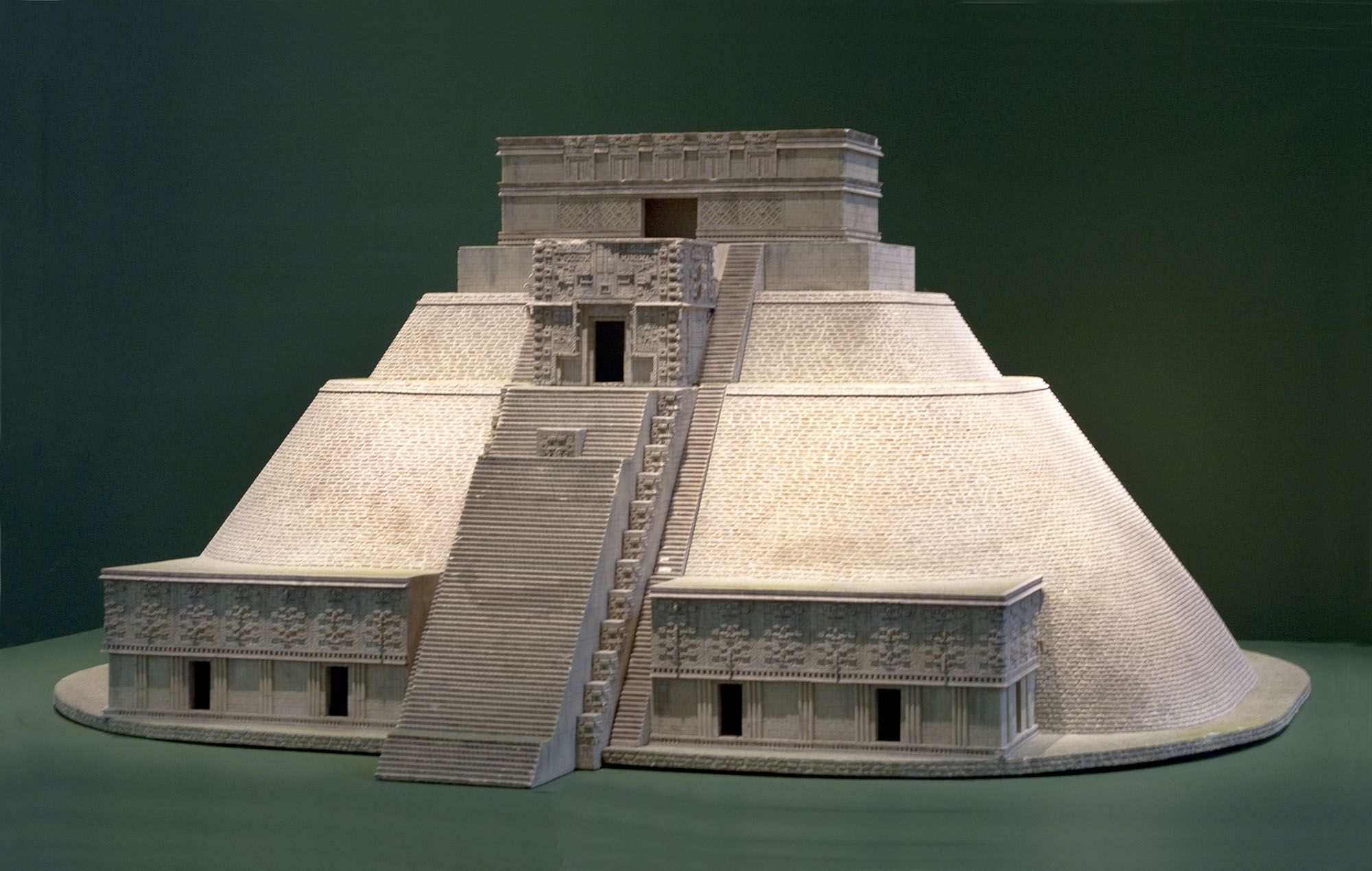
The first major structure is the Pyramid of the Magician, with its unusual rounded base rising above the entrance plaza. From there, the route leads into the Nunnery Quadrangle, through the ball court and toward the Governor’s Palace, House of the Turtles and the southern monumental groups.
The experience is cumulative. One building may not explain Uxmal, but the relationship between them does.
Smooth lower walls are balanced by densely decorated upper sections. Stone mosaics form geometric grids, serpents, figures and repeated masks of Chaac, the rain deity. The repetition makes sense in a part of Yucatán without permanent surface rivers, where collecting rainwater was central to the city’s survival.
Uxmal reached its principal period of development during the Late and Terminal Classic periods, broadly between 600 and 900 CE. It became the most accomplished expression of the Puuc architectural tradition and is now part of a UNESCO World Heritage property.
The site rewards people who look closely. A guide can help explain why façades differ, how the buildings relate to one another and why rain imagery appears so frequently.
Read the full Uxmal travel guide before planning a longer Ruta Puuc day.
 The Nunnery Quadrangle at Uxmal, Yucatán
The Nunnery Quadrangle shows the layered geometric decoration associated with Puuc architecture. Photo: Mesoamerican, CC BY-SA 3.0.
What visiting Ek Balam feels like
Ek Balam is more concentrated.
You enter through a ceremonial arch and walk toward a compact group of structures that includes the Oval Palace, the Twins, a ball court and the large Acropolis. The main visitor route is shorter than Uxmal’s, and most attention eventually settles on one building.
The Acropolis served as a palace, temple and royal funerary complex. Within it is the tomb associated with Ukit Kan Le’k Tok’, the best-known ruler of Ek Balam. Its entrance, known as Sak Xok Naah, is surrounded by elaborate stucco figures and a great open-jawed earth-monster façade.
These reliefs are the archaeological reason to visit. The climb and jungle view are memorable, but the protected stucco is what distinguishes Ek Balam from other northern Yucatán sites.
Ek Balam flourished during the Late and Terminal Classic periods and appears to have been the centre of a regional kingdom. Defensive walls surround the core, giving the site a more enclosed feeling than Uxmal.
Only part of the ancient settlement has been excavated. Beyond the restored centre, much of the city remains beneath vegetation.
For a complete practical breakdown, see the Ek Balam guide.
 Preserved stucco carvings at Ek Balam
The protected stucco façade near the royal tomb is Ek Balam’s most important artistic feature. Photo: Adam Baker, CC BY 2.0.
Which site has better architecture?
Uxmal wins clearly on overall architecture.
Its monuments form a coherent urban composition, and the visitor can move between several major buildings without the experience resting on one pyramid. The Pyramid of the Magician provides the immediate landmark, but the Governor’s Palace and Nunnery Quadrangle are equally important.
Ek Balam has fine individual details, particularly around the royal tomb, but much of its visual impact is concentrated on the Acropolis.
Choose Uxmal when you want:
- A larger ceremonial city
- Several major structures rather than one dominant building
- Puuc stone mosaics
- Long façades and architectural symmetry
- A site that can sustain three hours of close exploration
Choose Ek Balam when you want:
- A royal palace and funerary complex
- Preserved stucco rather than extensive stone mosaics
- A shorter, more focused archaeological visit
- A clearer connection to a named ruler and his tomb
- A physical climb as part of the experience
Can you climb the pyramids?
Climbing is the most practical difference between Uxmal and Ek Balam.
Visitors cannot climb the Pyramid of the Magician or the principal monuments at Uxmal. The site is experienced from its plazas, paths and permitted terraces.
At Ek Balam, visitors are normally allowed to climb the Acropolis. Access can still be suspended for conservation, maintenance, rain or safety reasons, so follow the signs and instructions in place on the day.
The Acropolis staircase is steep, exposed and uneven. The descent often feels harder than the ascent. Wear shoes with grip and keep both hands free.
The climb is not a sensible choice for everyone. Travelers with vertigo, knee problems, poor balance or limited mobility can still visit the ground-level site, but they will miss its best viewpoint and the elevated royal tomb façade.
Parents should make an individual assessment for children. There are exposed edges and long sections without the type of barriers found at a modern attraction.
 View across the forest from Ek Balam
The summit view is one of Ek Balam’s principal advantages. Photo: Adam Jones, CC BY-SA 3.0.
Which site is less crowded?
Ek Balam normally receives fewer visitors overall.
That does not mean every part of it feels empty. The site is compact, and most visitors eventually gather on the same Acropolis staircase and beneath the protective roof around the stucco façade.
Uxmal receives more organized groups, particularly during the middle of the morning, but its larger plazas distribute people more effectively.
For the quietest visit at either site, arrive for opening.
At Uxmal, early arrival gives you time in the Nunnery Quadrangle before larger groups move through. At Ek Balam, it lets you climb before the staircase becomes hot and busy.
Neither site has the same persistent vendor atmosphere found around Chichén Itzá. Uxmal feels more formal and monumental. Ek Balam feels smaller and more rural.
Which is better for photography?
Uxmal is better for architectural photography.
Its strongest compositions include:
- The Pyramid of the Magician from the entrance plaza
- Doorways framing the pyramid from the Nunnery Quadrangle
- Long views across the Governor’s Palace terrace
- Close studies of Chaac masks and geometric stonework
- The House of the Turtles against open sky
Ek Balam is better for:
- Jungle panoramas from the Acropolis
- Photographs showing the scale of the staircase
- Close views of the protected stucco
- Images combining ruins and surrounding forest
- A more active travel narrative involving the climb and cenote
Arrive early for cleaner photographs and lower contrast. Midday limestone can appear flat and harsh, especially at Uxmal.
Drones require authorization and should not be assumed to be permitted at either archaeological zone.
 Pyramid of the Magician at Uxmal, Yucatán
The rounded profile of the Pyramid of the Magician is unlike the principal pyramids at most other Maya sites. Photo: Sybz, CC BY-SA.
Which is better for families?
There is no single answer for every age group.
Families with younger children
Uxmal avoids the risk of a steep pyramid climb, but the visitor circuit is longer and exposed to the sun. A compact pushchair may help near the entrance, although uneven stone and steps limit where it can go.
The Choco-Story museum opposite Uxmal can make the overall day more varied for children who have limited patience for archaeological detail.
Families with active school-age children
Ek Balam often works better.
The site is compact, the Acropolis provides a clear challenge and Cenote Xcanché adds swimming afterward. Children still need close supervision on the stairs and upper terraces.
Families with mixed mobility
Uxmal is generally the better choice when some members of the group do not want to climb.
There are still uneven paths, heat and changes in level, but the main monuments can be appreciated without ascending a major pyramid.
At Ek Balam, the ground-level structures remain worthwhile, but the central experience is strongly tied to the Acropolis.
Which is hotter and more tiring?
Both sites become hot quickly.
Uxmal involves a longer route across several open plazas. The heat builds gradually, and people often underestimate the walk because the ground is not especially steep.
Ek Balam is smaller, but the Acropolis climb creates a short period of greater physical effort. The exposed staircase can become uncomfortable by late morning.
Go early throughout the year, especially from March through May.
Bring:
- At least 1.5 litres of water per person
- A hat with useful shade
- High-SPF sunscreen
- Closed shoes or secure walking sandals
- Cash
- Insect repellent when continuing to a cenote
- Official identification when claiming resident or concession rates
Food is not normally permitted inside the archaeological areas. Eat before entering or use the visitor facilities afterward.
Current opening hours and entrance fees
Published charges combine federal INAH admission with additional state CULTUR fees. The ticket office may issue separate receipts.
| Detail | Uxmal | Ek Balam |
|---|---|---|
| Opening hours | 8:00 am–4:00 pm | 8:00 am–5:00 pm |
| Last access | 3:00 pm | 4:00 pm |
| Published INAH fee for foreign visitors | $105 MXN | $210 MXN |
| Published CULTUR fee for foreign visitors | $461 MXN | $481 MXN |
| Approximate combined foreign admission | $566 MXN | $691 MXN |
| Published parking charge | Confirm locally | $100 MXN |
These were the official published figures when this guide was updated. Fees and access policies can change.
Yucatán residents are listed as exempt from the state CULTUR portion when qualifying identification is presented. Other federal exemptions and Sunday concessions depend on nationality, residency and official documentation.
Carry pesos even when card payment is advertised. Terminals can fail, and parking, guides or nearby community attractions may require cash.
Getting to Uxmal
From Mérida
Uxmal is approximately 80 kilometres south of Mérida. Driving normally takes around 1 hour 15 minutes to 1 hour 30 minutes, depending on where you begin and city traffic.
Follow Highway 261 toward Muna and Santa Elena. The final approach is straightforward and signposted.
A rental car provides the most useful flexibility because you can arrive at opening and continue to Kabah afterward.
Read the full Mérida to Uxmal transport guide.
Public transport
Regional buses can make an independent visit possible, but services are less frequent than the main intercity routes.
Confirm the outward and return times at the terminal on the day before traveling. Do not build a tight Kabah extension around an unverified timetable.
Tour or private driver
A guided tour is useful when you want architectural interpretation rather than transport alone.
A private driver works better for travelers who prefer to explore independently but still want an early departure, Kabah extension and flexible lunch stop.
The Uxmal and Kabah archaeological tour is a practical starting point when comparing organized options.
Getting to Ek Balam
From Valladolid
Ek Balam is approximately 25 kilometres north of Valladolid. The drive takes around 30 minutes.
A rental car or taxi is the simplest arrangement. Shared transport can also operate from Valladolid, but departure points, prices and return frequency should be confirmed locally.
See the complete Valladolid to Ek Balam guide.
From Mérida
Ek Balam is a considerably longer day from Mérida than Uxmal.
Allow roughly 2 hours 15 minutes to 2 hours 30 minutes each way, depending on the route and departure point. It can work with a rental car or private driver, but it is not the natural archaeological day trip from Mérida.
Choose Uxmal instead unless Ek Balam’s climb is a particular priority or the visit forms part of a transfer toward Valladolid.
From Cancún or the Riviera Maya
Ek Balam is easier to reach from the eastern peninsula than Uxmal.
It commonly appears in long day tours from Cancún and Playa del Carmen, often combined with Valladolid or a cenote. These days involve substantial road time, so check group size, pickup sequence and time actually allocated at the ruins.
Travelers using the Tren Maya still need a road transfer. Valladolid is the most practical rail and overnight base for Ek Balam.
What to combine with Uxmal
Kabah and the Museo Arqueológico del Puuc
Kabah is the strongest archaeological addition.
It lies farther south along Highway 261 and is known for the Codz Poop, or Palace of the Masks, whose façade is covered with repeated Chaac imagery.
The Museo Arqueológico del Puuc opened at Kabah in July 2026. Its collection provides wider context for Uxmal, Kabah, Sayil, Labná, Xlapak and the communities of the Puuc region.
Allow enough time for both the ruins and museum rather than treating Kabah as a short photograph stop.
Read the complete Kabah visiting guide.
 Chaac masks at the Codz Poop in Kabah
The Codz Poop at Kabah makes the most natural architectural companion to Uxmal. Photo: HJPD, CC BY-SA.
Choco-Story
Choco-Story stands close to the Uxmal entrance and works well for families or travelers who prefer one archaeological site rather than two.
It adds cacao history, gardens and a less exposed afternoon activity.
Santa Elena
Santa Elena is useful for lunch, small local accommodation and a quieter overnight near the Ruta Puuc.
Staying nearby also makes it easier to reach Uxmal at opening. Compare the best hotels near Uxmal.
GuideExploring Uxmal: Ancient Maya CityUxmal is a Puuc‑style Maya archaeological site in the hills southwest of Mérida, Yucatán, best visited as a day trip from the city. The site opens daily from 08:00 to 17:00 with the last entry around 16:00; the combined federal (INAH) and state (CULTUR) ticket costs roughly MXN 500–600 for foreign visitors and must be paid in cash or with an offline card, keeping both receipts. From Mérida the most flexible way to arrive is by car: take highway 261 south toward Muna/Santa Elena and follow the signs to Uxmal, a drive of about 1 hour 15 minutes in light traffic, with a modest parking fee at the entrance. Buses and colectivos also run the route but are slower and less suited to a tight day schedule, while guided tours provide transport, a licensed guide and optional add‑ons such as Kabah or the evening light‑and‑sound show. A typical visit lasts three to four hours, following the suggested circuit of Pyramid of the Magician, Nunnery Quadrangle, Ball Court, Governor’s Palace, House of the Turtles and Dovecote. Climbing is generally prohibited, but the small museum near the gate is included in the ticket price. Visitors should aim to be at the gate at opening to enjoy cooler temperatures and minimal crowds; shade is scarce, so bring a wide‑brimmed hat, high‑SPF sunscreen, at least two liters of water per person and sturdy shoes. Early morning light highlights the Puuc mosaics, while the late‑afternoon sun casts striking shadows on the Dovecote. If attending the night “Ecos de Uxmal” show, bring a light layer, bug spray and a small flashlight. Drones are not allowed and touching carvings is prohibited.OpenWhat to combine with Ek Balam
Cenote Xcanché
Cenote Xcanché is reached by a jungle route from the archaeological area. Depending on current operations, visitors may walk, cycle or use local transport between the entrance areas.
Visit the ruins first and swim afterward.
The cenote is operated separately from the archaeological zone, with its own admission charge, facilities and activity prices. Confirm closing time before beginning a late visit to Ek Balam.
 Cenote Xcanché near Ek Balam
Cenote Xcanché turns Ek Balam into a combined archaeology and swimming day. Photo: Adam Jones, CC BY-SA 3.0.
GuideCenote Xcanché Guide: Swim Near Ek Balam from ValladolidCenote Xcanché is a semi‑open limestone pool set in the forest near the Ek Balam archaeological zone, north of Valladolid in the municipality of Temozón. The cenote is about a 30‑minute drive from Valladolid, 2.25–2.75 hours from Mérida and 2–2.5 hours from Cancún; visitors usually reach it by rental car, taxi, private driver or an organized tour, and the walk from the Ek Balam entrance to the water is roughly 1.5 km, often done on foot, bike or a local tricycle‑style transport. Entry to the cenote costs a few hundred pesos; the exact amount varies with season and any extra activities such as zip‑line, rappel or biking, and cash in pesos is required because cards are not reliably accepted. The site is open only during daylight hours, with no specific closing time given, so arriving late after the ruins is discouraged. A typical visit lasts 1.5 to 2 hours, longer if adventure options are added. Visitors can expect a rustic setting with wooden stairs, platforms, changing areas, bathrooms, life jackets and basic food or drinks. The water may appear dark blue, green or almost black depending on light. Bring swimwear, a towel, water, a hat, sandals or water shoes with grip, and a dry bag for wet clothes. Life jackets are advisable for children and less confident swimmers, and sunscreen, oils or insect repellent should not be worn in the water. The cenote is best visited after touring Ek Balam in the early morning, then swimming around late morning or midday, followed by lunch in Valladolid. Weekdays are quieter; the path can be slippery in the rainy season and the stairs may be challenging for those with limited mobility.Open
Temozón
Temozón is known regionally for smoked meats and woodwork. It can provide a more local lunch stop than returning immediately to Valladolid.
GuideTemozón: Smoked Meats, Wood Shops & Ek Balam BaseTemozón is a small town a short drive north of Valladolid in the Yucatán, known for its smoked pork sausages and longaniza displayed along the main street and for a concentration of woodworking and furniture showrooms, with the Ek Balam archaeological zone and the community‑run cenotes X’canché and Hubiku only minutes away. The town itself is free to visit and the shops generally operate from 9 am to 6 pm, though hours can vary. Ek Balam is open daily 8 am–5 pm (last entry around 4 pm) and charges foreign adults about $561 MXN (INAH $100 plus a $461 state fee) and Mexican nationals about $227 MXN, with free entry for many locals on Sundays. Cenote X’canché costs roughly $170 MXN and Hubiku about $100 MXN for swimming only, with a separate buffet charge if desired. Cash in Mexican pesos is required; cards are rarely accepted at the small shops. A typical visit lasts four to six hours for the meat and furniture strip plus a cenote, or a full day if Ek Balam is added. Visitors can expect to order smoked meats by weight, eat them on‑site with tortillas and salsas, browse custom cedar and hardwood furniture, explore the climbable Maya ruins with jungle views, and then cool off in either the semi‑open X’canché (reached by a 1.5 km path) or the closed‑cavern Hubiku with its buffet. The town centre is flat but sidewalks are uneven, and the cenotes have stairs. Recommended transport is a car or frequent taxis/colectivos from Valladolid (12–14 km, 15–20 min); Ek Balam is another 14 km beyond Temozón. Bring small‑bill cash, swimwear, water shoes, sun protection and a reusable bottle; ask for mixed meat platters, confirm price per kilo, keep two receipts for Ek Balam, rinse before swimming and avoid non‑biodegradable sunscreen.Open
Valladolid
Valladolid remains the most practical base.
Visit Ek Balam early, swim at the cenote and return for a late lunch, evening walk and overnight stay. Use the Valladolid travel guide and Valladolid hotel guide when shaping the stop.
GuideValladolid Travel Guide: What to Do, Where to Stay and How to Plan Your TripValladolid is a small colonial town in eastern Yucatán, roughly halfway between Mérida and Cancún and within an hour’s drive of Chichén Itzá and Ek Balam. The guide suggests staying two nights for most itineraries, with three nights better for families or those who want to visit several cenotes or make day trips to Río Lagartos, Las Coloradas or Cobá. Getting there is easy by rental car, ADO bus, Tren Maya or private driver; the bus station is central, while the train station lies outside the historic centre and requires a taxi or shuttle. Within the town the historic centre, Calzada de los Frailes and the main square are all walkable, but a car, taxi, colectivo, bicycle or scooter is needed for most cenotes and ruins. Typical activities include a morning walk around the main square, visiting Iglesia de San Servacio and the municipal palace, strolling the colourful Calzada de los Frailes, and touring the Convent of San Bernardino de Siena. Cenote Zací, just outside the centre, offers a convenient swim; the local market provides cheap breakfast and snacks. Visitors should plan to start early at ruins and cenotes to avoid the heat, bring cash in small bills, wear grip sandals for cenote water, and respect church dress codes. In the hotter months (April‑May) a hotel with a pool is advisable, and the most comfortable weather is from November to March.Open
Two realistic day plans
Uxmal and Kabah from Mérida
| Time | Plan |
|---|---|
| 6:30–6:45 am | Leave Mérida |
| 8:00 am | Enter Uxmal |
| 8:00–11:00 am | Explore the archaeological zone |
| 11:00–11:30 am | Water and snack break |
| 11:30 am | Drive toward Kabah |
| 12:00–2:00 pm | Visit Kabah and the Museo Arqueológico del Puuc |
| 2:15 pm | Lunch in Santa Elena or nearby |
| 3:30–4:00 pm | Begin return to Mérida |
This is easier with a rental car, private driver or organized tour.
Do not add Sayil and Labná unless the group genuinely wants a full archaeology day. Several sites in strong heat can become repetitive for casual visitors.
GuideExploring Uxmal: Ancient Maya CityUxmal is a Puuc‑style Maya archaeological site in the hills southwest of Mérida, Yucatán, best visited as a day trip from the city. The site opens daily from 08:00 to 17:00 with the last entry around 16:00; the combined federal (INAH) and state (CULTUR) ticket costs roughly MXN 500–600 for foreign visitors and must be paid in cash or with an offline card, keeping both receipts. From Mérida the most flexible way to arrive is by car: take highway 261 south toward Muna/Santa Elena and follow the signs to Uxmal, a drive of about 1 hour 15 minutes in light traffic, with a modest parking fee at the entrance. Buses and colectivos also run the route but are slower and less suited to a tight day schedule, while guided tours provide transport, a licensed guide and optional add‑ons such as Kabah or the evening light‑and‑sound show. A typical visit lasts three to four hours, following the suggested circuit of Pyramid of the Magician, Nunnery Quadrangle, Ball Court, Governor’s Palace, House of the Turtles and Dovecote. Climbing is generally prohibited, but the small museum near the gate is included in the ticket price. Visitors should aim to be at the gate at opening to enjoy cooler temperatures and minimal crowds; shade is scarce, so bring a wide‑brimmed hat, high‑SPF sunscreen, at least two liters of water per person and sturdy shoes. Early morning light highlights the Puuc mosaics, while the late‑afternoon sun casts striking shadows on the Dovecote. If attending the night “Ecos de Uxmal” show, bring a light layer, bug spray and a small flashlight. Drones are not allowed and touching carvings is prohibited.OpenEk Balam and Cenote Xcanché from Valladolid
| Time | Plan |
|---|---|
| 7:30 am | Leave Valladolid |
| 8:00 am | Enter Ek Balam |
| 8:00–10:30 am | Explore the site and climb the Acropolis if open |
| 10:30 am | Continue toward Cenote Xcanché |
| 11:00 am–1:00 pm | Swim and change |
| 1:30 pm | Lunch in Temozón or Valladolid |
| Afternoon | Rest or explore central Valladolid |
This plan is compact enough for families, but bring dry clothing and avoid scheduling a formal lunch too early.
GuideEk Balam Guide: Climbing the Acropolis and Swimming Cenote XcanchéA complete guide to visiting Ek Balam in Yucatán: climb the Acropolis for jungle views, see the preserved stucco carvings, and cool off in Cenote Xcanché. Includes entrance fees, transport from Valladolid, and practical tips.OpenShould you visit both?
Yes, when your itinerary includes both Mérida and Valladolid.
The two sites reveal different sides of northern Maya architecture and political life. Uxmal represents the Puuc region’s refined stone construction and planned monumental spaces. Ek Balam provides a more intimate royal complex, preserved stucco and an elevated view over the eastern Yucatán forest.
They should not normally be visited on the same day.
The sites sit on opposite sides of the state, and combining them creates too much driving with little time to absorb either place. A better itinerary is:
- Three or four nights in Mérida, including one Uxmal and Kabah day
- Two nights in Valladolid, including one Ek Balam and cenote morning
This distributes the road time and keeps each visit in the cooler part of the day.
Final verdict
Uxmal is the better archaeological site overall.
Its scale, architectural coherence and Puuc stonework make it the stronger choice when you can visit only one site and distance is not a factor.
Ek Balam is the better active experience.
The climb, royal stucco and nearby cenote create a more varied half-day, particularly from Valladolid.
The most sensible decision is usually geographic:
- From Mérida: visit Uxmal
- From Valladolid: visit Ek Balam
- From the Riviera Maya: Ek Balam is the more practical of the two
- For architecture: choose Uxmal
- For climbing and swimming: choose Ek Balam
- For limited mobility: choose Uxmal
- For an archaeology-focused Yucatán itinerary: visit both on separate days
For quick help deciding which site fits your hotel base, use the free Yucatán Guide WhatsApp assistant. Travelers who want a real person to review transport, pacing and nearby stops can use Human Trip Support or the Trip Plan & Booking Portal.
Information sources and image notes
Practical information was checked on 31 July 2026.
Current opening hours, ticket categories and visitor rules should be confirmed through the official INAH Uxmal listing and INAH Ek Balam listing shortly before traveling.
The Museo Arqueológico del Puuc at Kabah opened in July 2026. Operating arrangements may continue to settle during its first months.
Images in this article are hosted by Wikimedia Commons under the licences stated in their captions.


