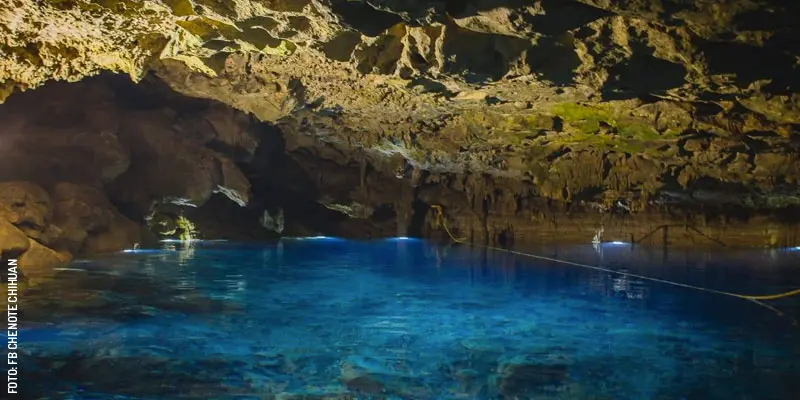
Yes. Most well-managed tourist cenotes in Yucatán are reasonably safe for ordinary swimming. You do not need to avoid them because they are natural sinkholes.
They are not hotel pools, however. Cenotes can be very deep, the access may involve wet limestone stairs, water quality is not visible to the eye, and many sites do not have a lifeguard watching every swimmer.
For most travelers, the practical answer is simple: choose a managed cenote with maintained access and staff, wear a life jacket when required or whenever you are not confident in deep water, supervise children closely, do not swallow the water, and never jump unless staff have marked a specific area as safe.
The type of cenote matters less than the way it is managed. An open cenote can still be deep with a difficult exit. A cave cenote can be straightforward if it has solid stairs, lighting, platforms and clear rules.
The quick safety answer
| Situation | Practical answer |
|---|---|
| Confident swimmer at a developed cenote | Generally a reasonable activity |
| Non-swimmer | Use a properly fitted life jacket and stay close to a safe exit |
| Young children | Choose a developed site, check child-size jackets and keep an adult within reach |
| Pregnancy | Not automatically unsuitable, but choose easy access and follow medical advice if you have restrictions |
| Open cuts, recent surgery or weakened immunity | It is safer to skip the swim or ask a clinician first |
| Jumping from ledges | Only where staff explicitly permit it |
| Swimming into cave passages | Not for ordinary visitors |
| Scuba cave diving | Specialist activity requiring proper certification, equipment and a qualified operator |
Most visitors who use a normal swimming area at a reputable cenote have an uncomplicated visit. The greatest improvement you can make is choosing the right site for your group rather than choosing only from photographs.
What can actually go wrong at a cenote?
The main risks are ordinary water and access risks, not mysterious features of the cave.
Deep water
Many cenotes have no beach-like edge. The water may become deep immediately beside the entry platform, and the bottom may be far below you even when the water is clear.
Do not assume you can stand. Ask staff about depth, entry points and any shallow sections before getting in.
A weak swimmer should use a life jacket even when the rule is optional. A strong swimmer may still prefer one in a crowded, dark or very deep cenote.
Slippery stairs and uneven access
Wet limestone, wooden platforms and stone steps can become slippery. The route down is often more difficult than the swim itself, particularly for young children, older travelers and anyone with limited balance or mobility.
Use the railing. Walk rather than rush. Water shoes with a firm sole are more useful than loose flip-flops.
Unsafe jumping and diving
Deep water does not automatically make a jump safe. Rocks, ledges, submerged structures, other swimmers and poor take-off surfaces can still cause serious injury.
Only jump from an area specifically approved by staff. Do not copy another visitor simply because they have already done it.
Poor supervision
Some cenotes have lifeguards or water attendants. Others only have ticket staff near the entrance.
Treat staff presence as an additional safeguard, not a replacement for watching children or swimming with a companion. Never leave a young or nervous swimmer alone in the water while you take photographs elsewhere.
Water quality
Cenote water is groundwater. It is not filtered and disinfected in the same way as a swimming pool.
Clear water can still contain microorganisms. Pollution can also enter Yucatán's limestone aquifer through sewage, septic systems, agriculture and surface activity. That does not mean every cenote is unsafe, but it does mean you should treat the water as untreated natural water.
Going beyond the visitor area
The illuminated swimming pool and the underwater cave system are not the same activity.
Do not follow an underwater opening, swim under a rock ledge or enter a dark passage because it looks close. Distances and directions become difficult to judge underwater, and an ordinary swimmer has no reason to leave the marked visitor area.
 A cenote in Yucatán, the region's signature natural swimming holes
How to choose a safer cenote
A safer cenote is not necessarily the most famous or the most expensive. Look for signs that the operation manages visitors properly.
A good choice usually has:
- Maintained stairs, ladders or platforms
- Handrails on steep access routes
- Clear entry and exit points
- Staff on site during opening hours
- Life jackets in usable condition and several sizes
- Posted rules for swimming and jumping
- Showers before the water
- Lighting where the access passes through a cave
- A controlled visitor area rather than unrestricted cave access
- Toilets and changing space away from the water
- A clear way to call for help
Be cautious when you find:
- Rotten steps, loose railings or unstable platforms
- No staff and no other visitors
- No safe way to climb out of the water
- Improvised electrical lighting beside wet surfaces
- Alcohol being used around jumping areas
- Visitors entering closed passages without supervision
- Water with a strong sewage smell, visible waste or an unusual surface film
- An operator who cannot explain the depth, exit route or life-jacket rules
Rustic does not always mean dangerous, and developed does not always mean perfectly managed. Use what you can see.
When a place feels poorly maintained, leave. Yucatán has enough cenotes that there is little reason to force a swim at the wrong one.
Is cenote water clean?
Cenote water often looks exceptionally clear because rainwater filters through limestone and there may be little sediment floating in the pool. Clarity is not proof that the water has been recently tested or is free from bacteria.
Public-health agencies assess recreational water through sampling and indicator organisms rather than appearance alone. The US EPA's recreational-water guidance explains why contamination risk cannot be judged simply by looking at the water.
For a visitor, the useful precautions are:
- Do not swallow cenote water.
- Shower before entering. Remove sunscreen, repellent, oils and cosmetics when the operator asks you to.
- Do not swim when you have diarrhea or a stomach illness. This protects other visitors as well as the water.
- Avoid swimming with a fresh open wound, infected cut or recent surgical site.
- Rinse off after the swim, especially if you have sensitive skin.
- Follow any closure or warning posted by the operator.
- Seek medical advice if you develop persistent vomiting, diarrhea, fever, breathing symptoms or a worsening wound after swimming.
Do not panic over every report about groundwater contamination. The sensible conclusion is not that all cenotes are dangerous. It is that natural water carries some uncertainty and should be treated differently from a maintained pool.
Are open cenotes safer than cave cenotes?
Not automatically.
An open cenote may have bright natural light but very deep water, a long staircase and no shallow edge. A cave cenote may have excellent lighting, solid platforms, mandatory life jackets and staff beside the water.
Choose according to infrastructure and your comfort level:
- Open cenotes can feel less enclosed and may suit nervous visitors, but check the depth and exit.
- Semi-open cenotes often balance natural light with a cave setting.
- Closed cave cenotes can feel dark or crowded and may involve steep stairs, but a well-managed one can still be suitable for ordinary swimming.
- Rustic cave cenotes with ladders, low light and limited staff are better for confident, mobile travelers.
Anyone prone to claustrophobia should choose an open or broad semi-open cenote rather than hoping the feeling will pass after descending.
Are cenotes safe for children?
They can be, but the right cenote makes a large difference.
For children, choose a place with good stairs, visible staff, child-size life jackets, a stable entry platform and enough space to supervise without losing sight of them.
Do not assume an open cenote is shallow. Many open pools are deep beside the edge.
For younger children and weak swimmers:
- Fit the life jacket before descending to the water
- Check that it cannot ride over the child's chin
- Keep an adult within arm's reach
- Use steps rather than jumps for entry
- Stay near the platform or designated rope
- Take breaks before the child becomes tired or cold
- Do not use an inflatable toy as a replacement for a life jacket
- Leave if the water area becomes too crowded to supervise properly
Ask whether the smallest available life jacket actually fits your child before paying. Operators vary, and a jacket designed for an older child may not be appropriate for a toddler.
Our guide to family-friendly cenotes in Yucatán focuses on access, facilities and supervision rather than photographs alone.
Can non-swimmers visit cenotes?
Yes, but not every cenote is a good choice.
A non-swimmer can enjoy a managed cenote with a properly fitted life jacket, a stable entry and a companion who remains close. Stay beside the platform, steps or a designated rest rope rather than floating into the middle of a large pool.
Do not rely on holding another person as your flotation plan. Panic can place both people at risk.
A non-swimmer may be more comfortable at:
- A developed cenote with staff beside the water
- A pool with an easy staircase
- A place where life jackets are required
- A broad open or semi-open cenote with good light
- A venue where seeing the cenote does not require entering the water
A dark cave pool with a ladder, no shallow area and no staff is not the place to learn whether you feel comfortable in deep water.
Pregnancy, health conditions and mobility
Pregnancy does not automatically rule out visiting or swimming in a cenote. The main practical concerns are often slippery steps, heat, dehydration, difficult access and the distance from medical care.
Choose a developed site with railings, toilets, shade and an easy route to the water. Enter using steps, avoid jumping and stop if you feel lightheaded or unwell. Ask your maternity clinician before swimming if you have pregnancy complications, activity restrictions or concerns about untreated natural water.
Travelers with heart or respiratory conditions, seizure disorders, major mobility limitations, recent surgery or weakened immune systems should consider the specific site rather than treating all cenotes alike. A doctor who knows your condition can give more useful advice than a general travel article.
Someone who cannot comfortably descend and climb wet stairs may still enjoy a cenote viewpoint, restaurant or surface area. Ask about access before travelling; the word “developed” does not guarantee step-free entry.
Swimming, snorkeling and cave diving are different activities
Ordinary cenote swimming means staying in the designated recreational area.
Snorkeling may be permitted in the same area, but only use equipment you are comfortable with. A mask can narrow your field of view, and a nervous swimmer should not use snorkeling as a reason to move farther from the exit.
Freediving under ledges or into underwater openings is not normal tourist swimming. Do not hold your breath and explore a passage without training and supervision.
Scuba cavern and cave diving are specialist activities. Cave diving requires specific certification, redundant equipment, gas planning and an experienced operator. A recreational scuba qualification alone does not make someone ready to enter an overhead cave environment.
What about bats and cave air?
Bats are common in some cave cenotes. They usually remain above the visitor area and are not a reason to avoid a normal swim.
Do not touch bats, disturb roosts or walk through piles of droppings. Histoplasmosis is a lung infection associated with breathing fungal spores from contaminated material. The CDC explains that exposure comes from inhaling spores, particularly when contaminated soil or droppings are disturbed.
That is different from briefly swimming beneath bats in a ventilated visitor cavern. People with weakened immune systems or significant lung disease should be more cautious about dusty, guano-heavy cave environments and seek medical advice when unsure.
What should you bring?
Keep the kit simple:
- Swimsuit already worn under light clothing
- Water shoes with good grip
- Towel
- Dry bag or waterproof phone pouch
- Reusable drinking water
- Cash in small denominations
- Rash guard or UV shirt
- A change of dry clothes
- Any medication you normally carry
- Child flotation equipment when you know the site may not have the right size
Many operators require visitors to shower off sunscreen and insect repellent before entering. Use clothing, a hat and shade for sun protection before the swim, then apply sunscreen again after you have finished.
Bring as few valuables as possible. Use a locker where one is available rather than leaving phones, passports or car keys in an unattended bag.
Is it safer to visit independently or on a tour?
Both can work.
A tour is useful when you want transport, a known schedule and an operator that regularly uses the same cenote. Check how much actual swimming time is included and whether the group will arrive during the busiest part of the day.
Independent travel gives you more control over timing. Arriving near opening time usually means a calmer platform, easier supervision and less waiting for changing rooms.
A rental car or private driver is generally easiest for rural cenotes around Homún, Cuzamá and smaller villages. Public transport can reach some towns, but the final road and return journey may be awkward.
Read our guides to the best cenotes without a car, cenotes near Mérida and cenotes near Valladolid before choosing the route.
If you use a taxi to a rural cenote, arrange the return before the driver leaves. Mobile signal and app-based rides cannot be assumed at every site.
A practical checklist before you get in
Take one minute at the water's edge.
- Is the entry stable?
- Can you see how you will get out?
- Does the life jacket fit?
- Do you know whether the water becomes deep immediately?
- Is jumping prohibited or restricted?
- Is a staff member nearby?
- Is your child or companion within sight?
- Are you sober, hydrated and feeling well?
- Have you removed products when required?
- Are you staying inside the marked swimming area?
When the answer to an important question is no, fix it before entering or choose another cenote.
Common mistakes to avoid
The most common mistake is choosing a cenote only because of one photograph. The beam of light or hanging roots tell you little about stairs, crowds, life-jacket sizes or water access.
Another mistake is assuming clear water means shallow water. It often does not.
Do not arrive after drinking alcohol, race down wet stairs, jump from an unmarked ledge or enter a passage beyond the visitor area.
Avoid trying to fit four or five cenotes into one day. Repeated changing, stairs, heat and driving become tiring. One or two well-chosen cenotes usually make a better day.
Frequently asked questions
Are cenotes safe for tourists?
Most managed tourist cenotes are reasonable places to swim when visitors follow the rules. Safety varies by site, so check the access, staff, life jackets and exit before entering.
Can you get sick from swimming in a cenote?
It is possible to become ill after swimming in untreated natural water, although most visitors do not. Do not swallow the water, avoid swimming with open wounds or stomach illness, and rinse afterward.
Do all cenotes have lifeguards?
No. Some have lifeguards or water attendants, while others have general staff only. Ask rather than assuming.
Are life jackets always mandatory?
Rules vary by cenote and operator. Wear one whenever it is required and whenever you are not fully comfortable in deep water.
Is it safe to jump into a cenote?
Only from a designated area where staff permit it. Do not improvise a jump from rocks, stairs or platforms.
Are cenotes safe after heavy rain?
Ask the operator about current conditions. Heavy rain can make roads, stairs and platforms slippery, and a site may close if access or weather conditions are unsuitable.
Are cenotes safe if you are pregnant?
A cenote visit may be possible during an uncomplicated pregnancy, but access, falls, heat and individual medical restrictions matter. Choose an easy site and follow advice from your maternity clinician.
Is swimming in a cave cenote dangerous?
A managed cave swimming area is not automatically dangerous. The risk changes when visitors leave the designated pool, enter dark passages or attempt freediving or scuba cave exploration without specialist training.
The bottom line
Most travelers can swim safely in a well-managed Yucatán cenote. Choose the operation by its access and safety practices, not only by how dramatic it looks online.
Wear a life jacket when required or when you are not confident. Keep children close. Walk carefully on wet stairs. Do not swallow the water. Do not jump unless the area is approved. Stay out of underwater passages.
A cenote with poor access, no safe exit or no useful answers from staff is not worth the gamble. Choose another one.
For the next step, use the Plan hub to compare itineraries, transport and practical resources already available.
Image credits
- Hero image: Cenote Xkeken by Haakon S. Krohn, licensed under CC BY 4.0.
- On-page image: Cenote en Yucatán México by Mcantus, licensed under CC BY-SA 4.0.