Cenote Kikil is an open-air cenote in the small community of Kikil, around 6 kilometres north of Tizimín on the road toward Río Lagartos. It is a useful swimming stop for travelers already exploring northeastern Yucatán. It is not the cenote most visitors should cross the state to see on its own.
The setting is simple: a broad natural pool below limestone walls, trees around the rim, wooden stairs to the water and modest visitor facilities above. The appeal is the combination of a cool swim, a community tourism project and an easy position between Tizimín and the north coast.
Cenote Kikil is not Cenote Ik Kil near Chichén Itzá. The names are similar, but the two cenotes are in different parts of Yucatán and suit different routes.
Go to Kikil if your day already includes Tizimín, Río Lagartos, San Felipe or El Cuyo. Choose a closer cenote if you are based in Mérida or Valladolid and only want somewhere to swim.
Cenote Kikil at a glance
| Detail | Practical answer |
|---|---|
| Location | Kikil, around 6 km north of Tizimín on the road toward Río Lagartos |
| Cenote type | Open-air cenote with deep freshwater |
| Published hours | Daily, 8:00 AM–6:00 PM |
| Published admission | Approximately MXN 50 per person |
| Time needed | Around 1.5–2 hours for swimming; up to 3 hours with lunch |
| Best for | Northeastern Yucatán road trips, Tizimín stays and coastal routes |
| Less suitable for | Travelers making a special journey from Mérida only for one cenote |
| Easiest transport | Rental car, private driver or taxi from Tizimín |
| Facilities | Parking, palapas, food service and basic visitor facilities; confirm current operation |
| Swimming | Deep water reached by wooden stairs; no beach-style shallow entry |
| Payment | Bring Mexican pesos and do not depend on card payment |
| Contact | 986 866 3118 or 999 513 3760, as currently published by Yucatán Travel |
The official Yucatán tourism listing currently publishes daily opening from 8:00 AM to 6:00 PM and an approximate entrance price of MXN 50 per person. Local prices, life-jacket arrangements and food service can change before online listings are updated. Call or check the Cenote Kikil Facebook page before making a tightly timed journey.
Is Cenote Kikil worth visiting?
Cenote Kikil is worth visiting when it improves a route you already want to make.
It works particularly well as a cooling stop after a morning boat trip in Río Lagartos, a short excursion from Tizimín or a break while traveling between inland Yucatán and the northeastern coast. The cenote gives the day variety without requiring a major detour.
Choose Kikil if you want:
- A proper swim rather than a quick photograph.
- A less commercial setting than the large cenote parks around Chichén Itzá.
- A locally rooted stop connected to a small community.
- A practical addition to a Tizimín or Río Lagartos route.
- Somewhere to slow down for lunch and shade if the restaurant is operating.
Choose another cenote if you want:
- Easy public transport from Valladolid or Mérida.
- Step-free access to the water.
- A shallow pool for toddlers.
- A polished club, resort or large changing complex.
- A cave cenote with dramatic shafts of light.
- The famous Ik Kil experience near Chichén Itzá.
Kikil is not the strongest first cenote for a traveler with only one free day in Yucatán. It becomes much more worthwhile when the surrounding route already makes sense.
Current hours, price and contact details
The most useful currently published information is:
- Open: Sunday to Saturday.
- Hours: 8:00 AM–6:00 PM.
- Approximate admission: MXN 50 per person.
- Telephone: 986 866 3118.
- Alternative telephone: 999 513 3760.
- Activities listed: swimming, an interior cenote visit and local food.
Treat the price as a planning figure rather than a guaranteed tariff. Ask whether the current admission includes a life jacket, whether children pay a different price and whether the restaurant will be open during your visit.
Bring cash in small notes. Even when a venue sometimes accepts cards, terminals and mobile signal can be inconsistent outside larger towns.
Do not arrive at 5:30 PM expecting a full visit. You need time to pay, change, descend the stairs, swim, shower and return to the car before closing.
What Cenote Kikil is like
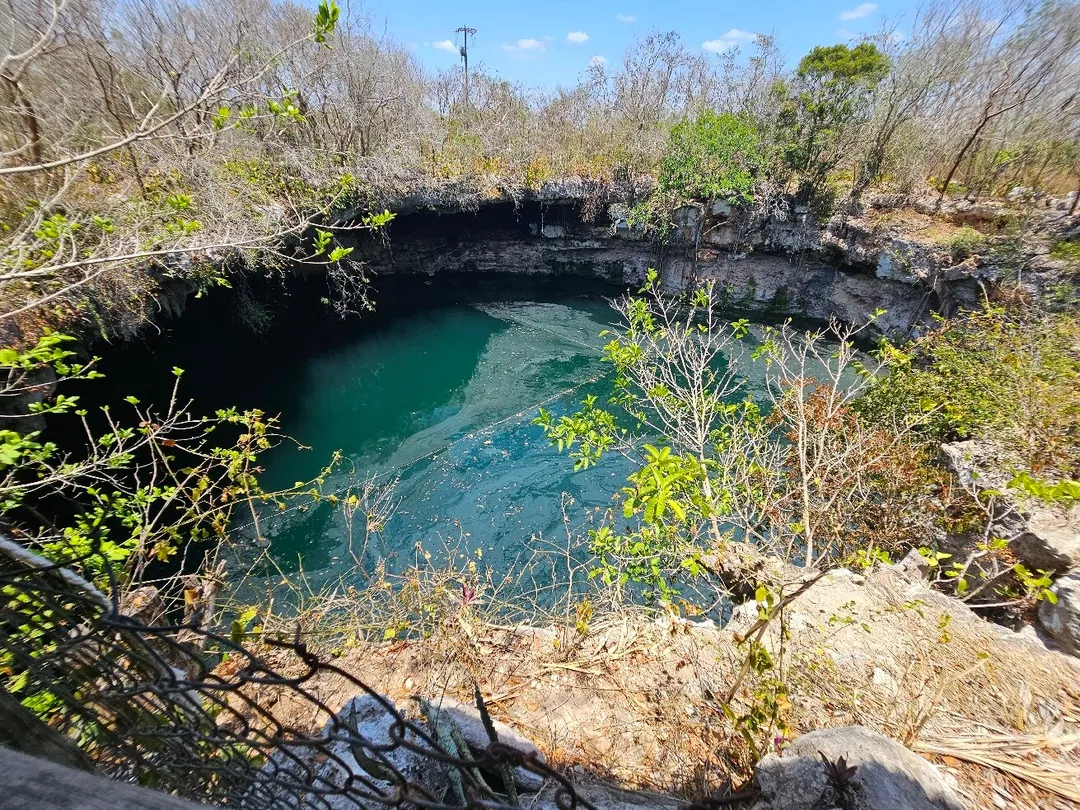
Kikil is an open cenote rather than an enclosed cave. The roof has collapsed widely enough to expose the pool to daylight, trees and the sky. Limestone walls ring the water, with vegetation growing around the edge and roots reaching down in places.
The water is usually described as green or blue-green rather than the bright electric blue seen in heavily edited photographs. Its color changes with the season, cloud cover, vegetation and angle of the sun.
A wooden staircase descends from the upper grounds to a platform beside the water. This gives the visit a rustic feel, but it also means wet steps, uneven surfaces and a sustained climb back up. Move slowly and use the handrails.
The water is deep. There is no sandy edge, gradual entry or reliable place for a small child to stand. Safety ropes have historically crossed parts of the pool, giving swimmers somewhere to rest, but they are not a substitute for a life jacket or close supervision.
Cenote Kikil has previously been described as a community ecotourism project operated by a local cooperative. That background helps explain the modest, regional character of the place. It should not be treated like a private resort where every service is standardized throughout the week.
Swimming, life jackets and safety
The main reason to visit is to swim. The pool is broad enough for a relaxed dip, but its depth changes the kind of visitor it suits.
Historical reporting from the site states that life jackets were required for swimming. Current official tourism information does not explain whether a jacket is included in the admission price, rented separately or still mandatory in every circumstance. Ask at the entrance and follow the staff’s current rules.
Use a life jacket when:
- You are not comfortable floating in deep water.
- You are swimming with children.
- You tire easily or have limited confidence in open water.
- Staff require one.
Do not jump from the limestone rim, stairs or unmarked platforms. A deep cenote is not automatically safe for jumping. Submerged ledges, changes in water level and an awkward exit can make improvised jumps dangerous.
Before entering:
- Shower if requested.
- Remove sunscreen, insect repellent, oils and heavy lotions.
- Leave food and alcohol outside the swimming area.
- Secure phones, keys and wallets rather than leaving them unattended.
- Check where the safest entry and exit points are.
Read our broader guide to visiting cenotes in Yucatán and our guide to cenote safety before your first swim.
Is Cenote Kikil good for children?
The official state tourism listing marks Kikil as recommended for children. In practical terms, it is best for children who can follow instructions around stairs and deep water.
It can work well for families with:
- Confident swimmers.
- Children comfortable wearing life jackets.
- Adults able to supervise continuously.
- Enough time to change and move slowly on the stairs.
It is less suitable for toddlers, children who dislike deep water or families expecting a shallow splash area. One adult should remain focused on supervision rather than assuming staff or other visitors are watching the water.
Accessibility and mobility
Yucatán Travel describes the experience as inclusive, but that broad designation does not mean the water is step-free.
The usual route to the pool involves a wooden staircase down into the cenote. Travelers with limited mobility, balance concerns, knee problems or difficulty climbing should call before visiting and ask:
- How many steps are currently in use.
- Whether there are handrails throughout the descent.
- Whether resting points are available.
- Whether any viewing area is accessible without descending.
- Whether staff can assist with a life jacket or entry into the water.
- Whether toilets and restaurant areas are accessible.
A traveler who cannot manage stairs may still be able to enjoy the upper grounds, restaurant or viewpoint, but do not assume access to the water without confirmation.
The official listing also marks the site as pet-friendly. Ask where pets are permitted and whether they can enter the restaurant or swimming area before arriving with one.
Facilities and food
The grounds have been described as including parking, paths, palapas, shaded areas, bathrooms, showers and a restaurant. Past reporting also mentioned cabins, but accommodation and other services should not be treated as guaranteed without direct confirmation.
The official tourism page currently lists an à-la-carte restaurant serving fish, seafood, beef, pork and chicken. Older accounts refer to regional dishes such as longaniza, grilled meats and escabeche oriental.
The restaurant is useful when it is open because it lets you swim and eat without returning immediately to Tizimín. It should not be the only meal plan on a long travel day unless you confirm service first.
A sensible backup is to eat in Tizimín, where there are more dependable choices for breakfast, lunch, fuel, water and supplies.
 Ex-convent in Kikil village near Cenote Kikil
How to get to Cenote Kikil
Cenote Kikil is close to the community of Kikil on the road north from Tizimín toward Río Lagartos. Use the current map pin and download the route before leaving town.
Approximate driving times are:
| Starting point | Approximate drive |
|---|---|
| Tizimín | 10–15 minutes |
| Valladolid | 1 hour 10 minutes–1 hour 25 minutes |
| Río Lagartos | 45–55 minutes |
| San Felipe | 45–60 minutes |
| El Cuyo | Around 1 hour 15 minutes |
| Mérida | Around 2 hours 30 minutes–3 hours |
| Cancún | Around 2 hours 45 minutes–3 hours 15 minutes |
Times vary with town traffic, road works, rain and stops at villages. Go slowly over topes and watch for motorcycles, bicycles, livestock and pedestrians near settlements.
By rental car
A rental car is the simplest option. Kikil sits naturally on a self-drive route through Tizimín and the north coast. Fill the tank in Tizimín rather than waiting until you are on a rural stretch.
Download offline maps, carry cash and avoid making your first rural drive after dark. Read our guide to getting around Yucatán for broader advice on roads, buses and drivers.
By private driver
A private driver makes sense for families, groups and travelers combining several stops. The driver can wait during the swim, protect the return timing and help confirm whether the cenote is operating before departure.
For quick route questions, use the free Yucatán Guide WhatsApp assistant. A route with Río Lagartos, lunch and a cenote is easier when the order of the day is decided in advance.
By taxi from Tizimín
A taxi from Tizimín is practical for a simple out-and-back visit. Agree on the total price before leaving and decide whether the driver will wait or return at a fixed time.
Do not depend on finding a passing taxi at the cenote. Save the driver’s number and confirm the pickup plan before you swim.
By public transport
Public transport is possible only with extra effort. First reach Tizimín by bus or colectivo, then arrange a taxi or local ride for the final section.
This is not the best choice when you have a boat reservation in Río Lagartos or another fixed appointment. A missed connection can consume much of the day. Our Mérida to Tizimín transport guide explains the longer intercity portion.
 Ex-Convento de los Santos Reyes in Tizimín
The best ways to combine Cenote Kikil
Kikil works best as a supporting stop, not as the whole day.
Río Lagartos first, Kikil on the return
For wildlife-focused travelers, the most sensible order is usually:
Tizimín or Valladolid → Río Lagartos morning boat trip → lunch → Cenote Kikil → Tizimín or Valladolid
Boat conditions, wildlife activity and heat often make the coast more rewarding earlier in the day. Swimming later gives you a cool break before the final drive.
Do not add Las Coloradas automatically. Río Lagartos, lunch, Las Coloradas and a cenote can become rushed, especially from Mérida. Choose the boat experience or a fuller Las Coloradas visit as the main activity rather than treating both as quick photographs.
 Flamingos in the Ría Lagartos Biosphere Reserve
Tizimín and Kikil half-day
This is the easiest version.
Spend the morning in Tizimín, see the central church and plaza, buy water and then take a taxi or drive to Kikil. Swim for 60–90 minutes and have lunch at the cenote if the restaurant is open, or return to town.
This route suits travelers staying overnight in Tizimín or breaking a longer journey toward the coast.
San Felipe and Kikil
San Felipe is a calm coastal village with seafood, colorful wooden houses and access to the ría. Kikil can be added before or after the coast, but avoid scheduling too many activities around a fixed boat time.
A comfortable order is often:
Tizimín → San Felipe morning → seafood lunch → Cenote Kikil → Tizimín
GuideSan Felipe, Yucatán Guide: Fishing Port, Mangroves, Beaches & Río Lagartos Day TripSan Felipe is a small fishing port on Yucatán’s northeast coast, west of Río Lagartos and near the Ría Lagartos Biosphere Reserve. It is reached most easily by rental car or private driver; the drive from Mérida takes about 3 to 3.5 hours, from Valladolid 1.5 to 2 hours, and from Río Lagartos only a short hop. Public transport exists but is limited and requires careful timing. A half‑day visit covers a walk along the malecón, viewing the colorful wooden houses and having a simple seafood lunch; a full day adds a guided boat tour of the mangroves, birdwatching, beach time and possibly an overnight stay. Boat tours are not included in the town’s basic offering and must be arranged locally or in advance; they typically include navigation through mangroves, springs and quiet channels, with guidance on safety and wildlife. The town has no formal opening hours, but the best light and cooler weather are early morning and late afternoon, especially between November and March. Visitors should bring cash, a hat, sunglasses, reef‑safe sunscreen, water, a dry bag, insect repellent and light long sleeves, and follow guide instructions near wildlife areas. Expect a quiet, undeveloped coastal atmosphere, limited beach infrastructure and the need to carry out any trash. Early departure is advisable if travelling from Mérida to avoid a long, hot day.Open
El Cuyo and Kikil
Kikil can fit into an El Cuyo transfer day, but El Cuyo is far enough from Mérida and Valladolid that it is better treated as an overnight destination.
Do not build a Mérida–Kikil–El Cuyo–Mérida day unless you are comfortable spending most of the day in the car. A better plan is to swim at Kikil on the way to or from an El Cuyo stay. Read our El Cuyo guide before deciding whether the extra distance suits your trip.
GuideEl Cuyo Travel Guide: Beaches, Kitesurfing, Hotels and How to Get ThereEl Cuyo is a small Gulf‑side beach town at the northeastern tip of Yucatán, set on the edge of the Ría Lagartos Biosphere Reserve where flamingos, sea‑turtle nesting and reliable winds make it a quiet eco‑destination. The town and its public beach are free to enter and are open 24 hours a day. The best periods for kitesurfing are November to June, for flamingos April to September, and for turtle nesting May to October; the dry season runs December to April. By car, El Cuyo is about 2½–3½ hours from Cancún Airport and 3–4 hours from Mérida, using paved inland highways; fuel and cash should be taken before the final stretch and parking is on sand near the beach. Public transport involves an ADO or Oriente bus to Tizimín from Mérida (2½–3½ hours) followed by a colectivo/minivan to El Cuyo, or a longer Cancún‑to‑El Cuyo connection via Kantunilkín or Valladolid, taking roughly 4–5 hours total. Visitors can expect a long, natural beach backed by dunes, mangroves and pastel wooden houses, gentle Gulf swells, and steady breezes that attract kitesurfers of all levels. Amenities are modest: a few groceries, seafood shacks, a pharmacy, a clinic and one ATM that may be out of cash, so bring pesos. Wi‑Fi and mobile data are unreliable, and many places prefer cash. Tips include keeping at least 60 m from flamingo colonies, avoiding lights and touching turtles during nesting season, using reef‑safe sunscreen, carrying a flashlight, water and insect repellent, and driving cautiously on roads with speed bumps and occasional potholes. Day trips to the flamingo‑rich Ría Lagartos, the pink lakes of Las Coloradas, or the colonial town of Valladolid are popular, and several local schools offer kitesurf lessons and equipment rentals.Open
From Valladolid
From Valladolid, Kikil is reasonable when the day continues to Río Lagartos, San Felipe or Tizimín. It is not the most efficient choice for a cenote-only outing because many good swimming places sit closer to the city.
Leave early, keep the coastal activity as the main event and use Kikil as the swim stop. This avoids turning the day into a list of hurried attractions.
From Mérida
From Mérida, Kikil should be part of a longer northeastern Yucatán route. A same-day return is possible, but the drive is long.
A practical day is:
Mérida → Río Lagartos or San Felipe → lunch → Cenote Kikil → Mérida
Leave early and return before you are tired. An overnight in Río Lagartos, San Felipe, Tizimín or El Cuyo produces a calmer trip and gives the coast more time.
 A rural highway in Yucatán
Kikil village and the old Franciscan convent
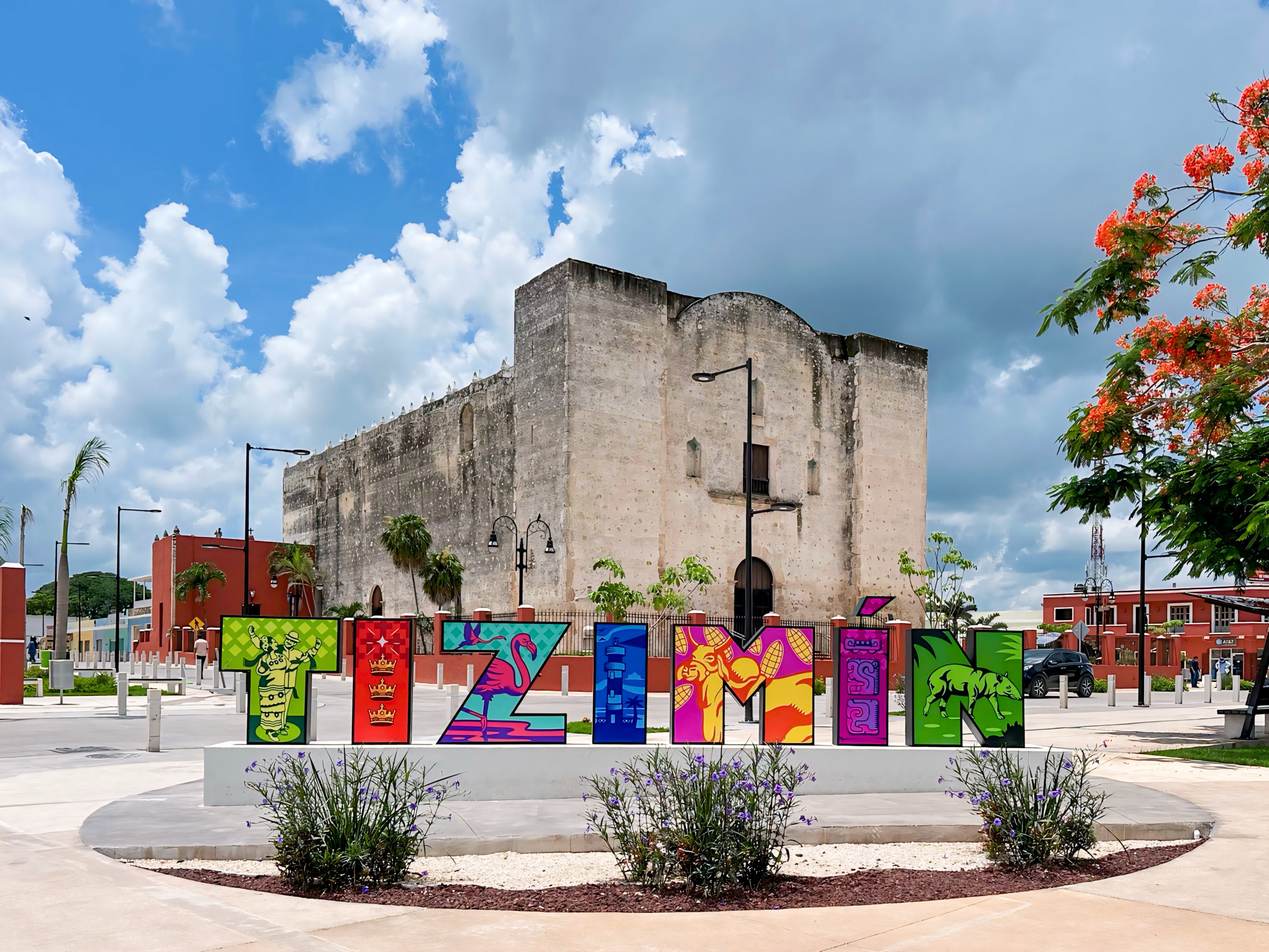
Do not confuse the cenote complex with the whole community. Kikil is a small comisaría of Tizimín, set in the cattle country of northeastern Yucatán.
The village has the remains of a Franciscan convent generally dated to the seventeenth or early eighteenth century. The structure has received restoration work, but it still has a weathered, partly ruined appearance. The official tourism description also points visitors toward a large local álamo tree and its exposed roots.
This is a short stop rather than a formal museum visit. Be respectful around the church, community buildings and private homes. Do not climb unstable masonry or treat the village as an abandoned photo set.
 Kikil village near Tizimín, Yucatán
Best time to visit
Cenote Kikil is open-air, so weather matters more than it does in a fully enclosed cave cenote.
Go shortly after opening when:
- You want cooler air above the water.
- You prefer a quieter swim.
- Kikil is your first activity of the day.
- You are staying in Tizimín.
Go in the afternoon when:
- You have already completed a Río Lagartos or San Felipe morning.
- You want a swim before returning inland.
- You have confirmed that you will arrive with enough time before closing.
Weekends, Easter week, summer holidays and Mexican long weekends can bring more local visitors. Rainy-season vegetation is greener, but steps may be wetter and insects more noticeable. In the dry season the surrounding cattle country can look brown and exposed even while the cenote remains shaded.
Avoid entering during thunderstorms or when staff close the water for safety.
What to bring
Pack lightly, but do not assume every item can be bought at the entrance.
Bring:
- Mexican pesos in small notes.
- Swimsuit.
- Towel.
- Dry clothes.
- Sandals or shoes with grip.
- Refillable water bottle.
- Waterproof phone pouch.
- Bag for wet clothes.
- Insect repellent to apply after swimming.
- Snacks for the road, especially with children.
Leave expensive jewelry behind. Do not apply sunscreen, oils or repellent immediately before entering the cenote. Shower first and follow posted rules.
Common questions about Cenote Kikil
Is Cenote Kikil the same as Ik Kil?
No. Kikil is north of Tizimín on the road toward Río Lagartos. Ik Kil is near Chichén Itzá and Pisté.
How much does Cenote Kikil cost?
The official Yucatán tourism page currently lists an approximate admission of MXN 50 per person. Confirm the current price and what it includes before making a special journey.
What are the opening hours?
The currently published hours are 8:00 AM–6:00 PM every day. Operations can change for maintenance, private events or local reasons, so call when timing matters.
Can you swim at Cenote Kikil?
Yes. Swimming is one of the main listed activities. The water is deep and reached by stairs, so follow the current life-jacket rules and supervise children closely.
Does Cenote Kikil have food?
The official listing describes an à-la-carte restaurant with fish, seafood and meat dishes. Confirm that food service will be available on the day you visit.
Can you visit without a car?
Yes, but the easiest car-free approach is to reach Tizimín and take a taxi. Arrange the return before the driver leaves.
How long should you spend there?
Allow around 1.5–2 hours for a straightforward swim. Allow up to 3 hours if you want lunch, a slower change and time in the village.
Final planning advice
Cenote Kikil is a good regional stop, not a universal must-do. Its value comes from where it sits: close to Tizimín and on the inland approach to Río Lagartos, San Felipe and the northeastern coast.
Go early if Kikil is your main plan. Put it later in the day if the coast is your priority. Bring cash, confirm the current operation and keep the route simple.
For most travelers, the best version is one major coastal activity, one unhurried meal and one swim at Kikil. That is enough for a full day without turning northeastern Yucatán into a checklist.